PharmaResearch Re-Rating Check: Can Rejuran Move From Medical Device Monopoly to U.S. Derma-Cosmetics Platform?

PharmaResearch's multiple compression reflects the 4Q25 miss, a pause in medical-device exports, domestic skin-booster competition and skepticism toward cosmetics durability. This note tests whether Rejuran Cosmetics' U.S. Sephora and Olive Young sell-through can reopen the re-rating path.

AI Infrastructure Multiple Map: Why Samsung Electronics Looks Cheap and Samsung Electro-Mechanics Looks Expensive

GPU, HBM, CPU, MLCC and FC-BGA all sit inside the same AI infrastructure cycle, but they do not deserve the same multiple. This note decomposes the spread through pricing power, LTAs, customer lock-in, capex burden and peak-earnings doubt, then links Samsung Electronics and Samsung Electro-Mechanics in one relative-value frame.

How This Blog Is Made: Introducing Thesis OS, Our Open-Source Research Operating System

The posts on Korea Invest Insights aren't written one by one from scratch — they're produced through a structure called the Thesis Investment OS. Alpha gathers the evidence, Lattice turns that evidence into judgment, and Arki keeps the whole system healthy. Together these three roles form an open-source research operating system. This post explains that structure in plain terms and invites you to visit the GitHub repository.

ADR Hits a Six-Year Low: Will the Megacap Chip Squeeze Tighten, or Is It Time for the Laggards?

On May 29, 2026 the KOSPI printed a fresh all-time high at 8,476pt, yet the same day's ADR sank to roughly 52% — the lowest since March 2020, a six-year trough. The index made a record high while nine out of ten stocks fell. Here is a single, clear read on whether the Samsung–SK Hynix concentration tightens further or whether the neglected names are setting up to rebound.

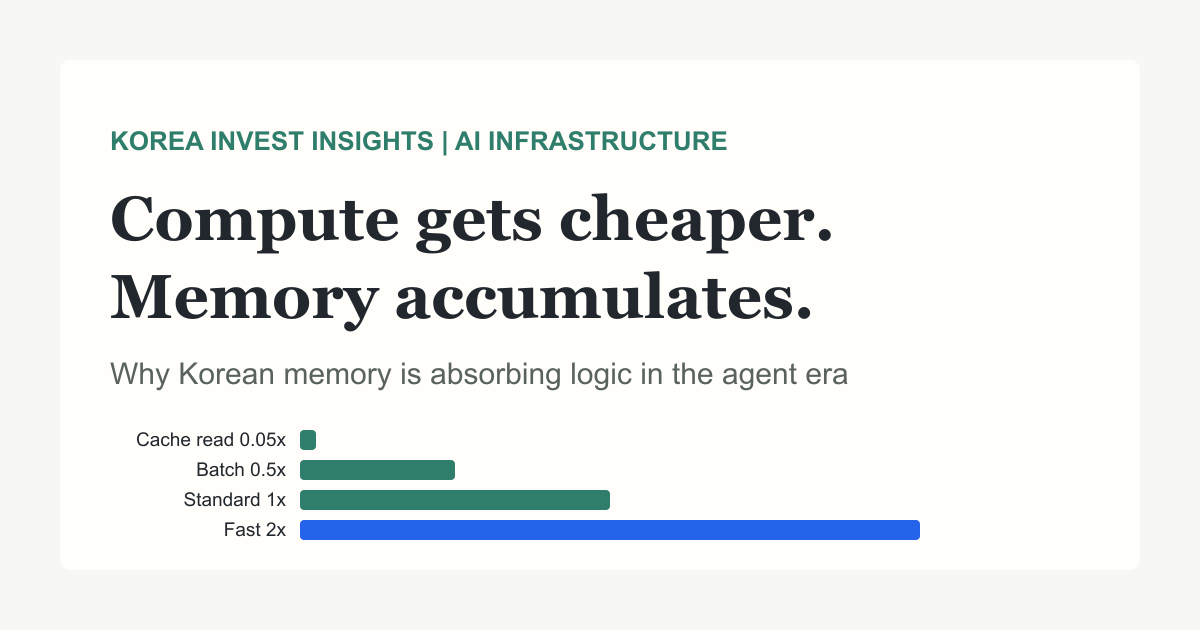
AI Token Futures and Cost Per Token: It's Now a Cost Race, Not a Performance Race

China's Shanghai Futures Exchange is early-designing AI-token-price-linked futures, while CME and ICE are preparing GPU compute futures. Once AI usage gets a market price, the industry shifts from a performance race to a cost-per-token race. The conclusion: don't buy generic AI stocks — buy the bottleneck parts, chips and platforms that lower the customer's cost per token. The Korea read-through runs Samsung Electronics (HBM, eSSD, KV-cache) and Samsung Electro-Mechanics (FC-BGA, MLCC, silicon capacitor).

Dell's Earnings Surprise and Korean Semiconductors: Pricing Power Sits With Components, Not Server Assembly

Dell's FY2027 Q1 print was a massive earnings surprise — revenue +88%, EPS +214% — yet its AI-server gross margin fell from 21.6% to 18.1%. The takeaway: pricing power and the durable margin do not sit with the server assembler (Dell); they sit upstream with memory and high-value component makers. The Korea read-through runs Samsung Electronics (HBM, server DRAM, eSSD) and Samsung Electro-Mechanics (FC-BGA, high-end MLCC, silicon capacitor).

Samsung Electro-Mechanics at ₩138T Market Cap: An AI Components Play at Hyundai's Weight Class — Can It Command a Premium Over Murata and Ibiden?

Samsung Electro-Mechanics' common-share market cap has reached the same weight class as Hyundai Motor and is closing in on Murata's market cap. We break down the silicon capacitor reference landscape, competitive axes across Murata, TSMC, Intel EMIB, Empower/ADI, and AP Memory, and the conditions that would justify a ₩150–205T market cap range.

Recommendations 0

Samsung Electro-Mechanics Silicon Capacitors and Intel EMIB-T: The Component That Moved Inside AI Package Power Delivery

Reinterpreting Samsung Electro-Mechanics' ₩1.5 trillion silicon capacitor contract through the lens of Intel EMIB-T and AI package PDN. What is officially confirmed is a Si-Cap contract with a large global customer; final adoption in Google TPU v8e and Intel EMIB-T remains in the realm of estimates. The core thesis: Samsung Electro-Mechanics is beginning to move inside AI package power integrity—beyond MLCC and FC-BGA.

Recommendations 0