📚 Connected context This note links the Korea liquidity/breadth regime, the Real Money flow framework, the US non-semiconductor re-rating translation, the Korea market after GTC Taipei, and the Broadcom AI semiconductor follow-up.
TL;DR
- AI data center spending is no longer only a Big Tech capex line. It is becoming an infrastructure asset class involving power, land, private infrastructure capital, debt and equity funding.
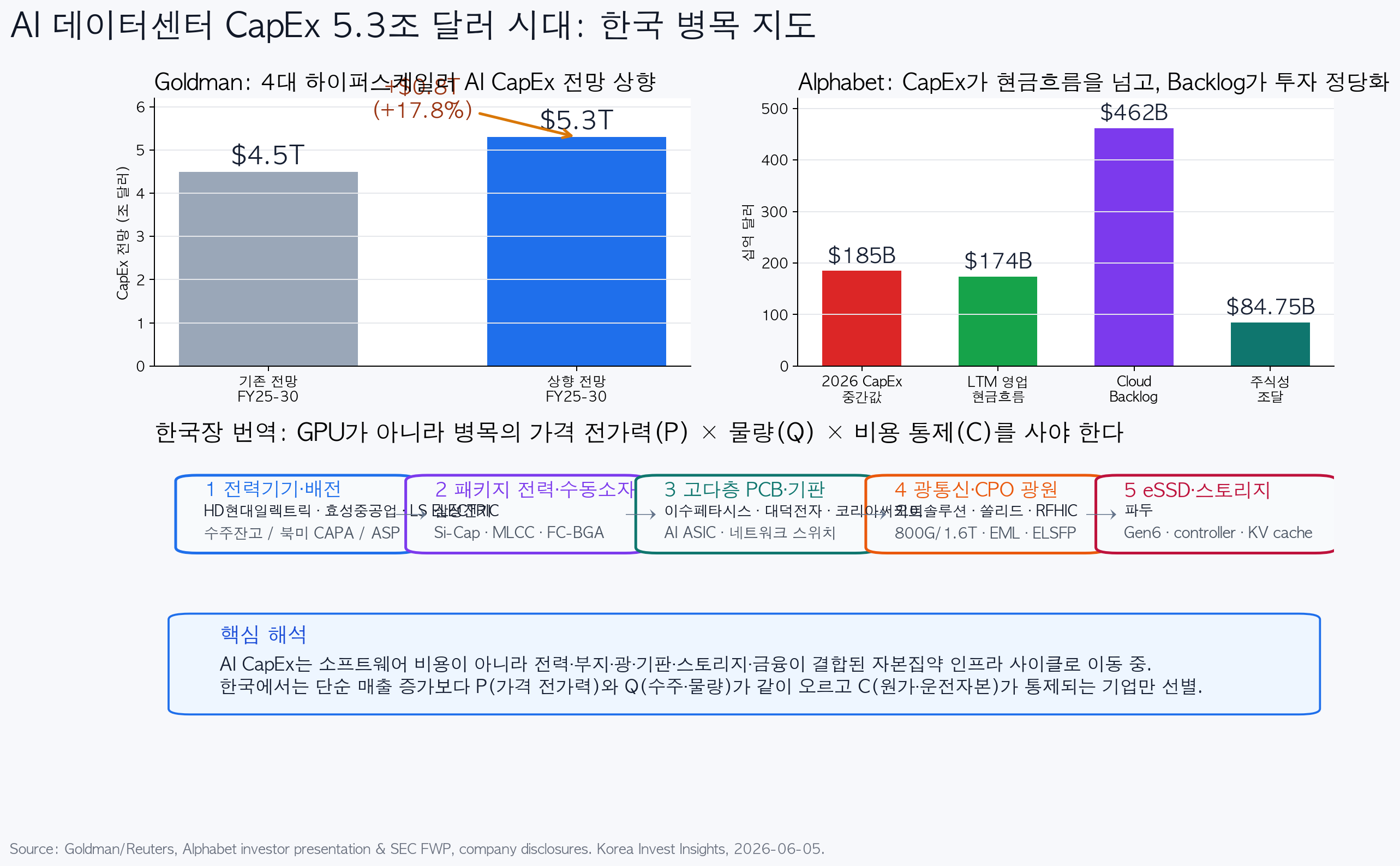
- Reuters reported that Goldman raised FY2025-2030 capex expectations for Meta, Microsoft, Amazon and Alphabet from $4.5T to $5.3T. Alphabet also guided 2026 capex to $180-190B and said 2027 would significantly increase versus 2026. (Reuters/Goldman, Alphabet)
- For Korea, this is not a “buy every AI theme” signal. The right order is: power equipment, Samsung Electro-Mechanics’ MLCC/FC-BGA/Si-Cap, high-layer PCBs, optical/CPO and eSSD/storage.
- Low-margin server integration and SI need proof of recurring revenue and operating cash flow before receiving a high multiple.
What Changed
[Fact] Reuters reported, citing Goldman Sachs, that private infrastructure and real-estate capital should play a larger financing role in the AI data-center boom. Goldman increased the combined FY2025-2030 capex forecast for Meta, Microsoft, Amazon and Alphabet to $5.3T from $4.5T. (Reuters/Goldman)
Old forecast: $4.5T
New forecast: $5.3T
Increase: $0.8T
Revision: about +17.8%
[Fact] Alphabet’s June 2026 investor presentation said 2026 capex should be $180-190B, six times 2022 and double the prior year, and that 2027 capex should significantly increase compared with 2026. Most of the spend will go into technical infrastructure. (Alphabet)
Alphabet also highlighted Google Cloud momentum, including Q1 Cloud revenue growth of 63% year over year and backlog above $460B. (Alphabet)
The message is that AI data centers are becoming a technology, infrastructure and financing event at the same time.
Korea Translation
| Priority | Layer | Korean names to watch | Investment read |
|---|---|---|---|
| 1 | Power equipment and grid | HD Hyundai Electric, Hyosung Heavy, LS ELECTRIC | Earliest numerical proof through orders, backlog and ASP. |
| 2 | MLCC / FC-BGA / Si-Cap | Samsung Electro-Mechanics | Rare combination of package substrate and power-integrity components. |
| 3 | High-layer PCB / networking boards | Isu Petasys, Daeduck, Korea Circuit | Second-order bottleneck from AI Ethernet and server boards. |
| 4 | Optical / CPO | OE Solutions, Solid, RFHIC | Structural optionality as data center links move toward optics. |
| 5 | eSSD / storage | Fadu and peers | AI inference and KV-cache can make storage a new bottleneck. |
| 6 | Cooling / server integration | GST, LG Electronics, M83-type integrators | Demand is real, but margins and cash flow must be proven. |
Stock Ideas
Power equipment is the most visible bottleneck. HD Hyundai Electric reported Q1 2026 orders of $1.797B and backlog of $7.888B. LS ELECTRIC also benefited from data-center demand and reported strong Q1 results. (HD Hyundai, The Elec)
Samsung Electro-Mechanics has the strongest multi-leg non-memory argument. It has MLCC, FC-BGA and silicon capacitors. The company announced a roughly KRW 1.5T silicon capacitor contract for 2027-2028, but investors still need repeat orders, customer diversification and margin proof. (Samsung Electro-Mechanics)
PCB and substrate names should not be lumped together. AI networking boards, FC-BGA and memory module substrates have different customer and margin structures.
Optical links are a structural watchlist. TrendForce expects combined monthly capacity of EML and CW-DFB laser diodes to reach 50.7M units in 2026, driven by AI data centers. (TrendForce)
eSSD and storage are less crowded but less proven. Fadu is a possible Korean proxy, but the key is repeated orders, gross margin and customer disclosure rather than a single contract headline. (The Elec/Fadu)
Final View
The $5.3T AI capex frame does not mean buying every Korean AI stock. Korea’s market breadth is still weak, and capital is flowing into a narrow set of leaders.
The right strategy is to sort AI infrastructure by P x Q x C:
- Price: can the company raise ASP or mix?
- Quantity: does backlog turn into revenue?
- Cost: does operating cash flow remain positive?
The highest-priority Korean layers are power equipment, Samsung Electro-Mechanics, high-layer PCBs, optical links and eSSD/storage. Server integration and low-margin SI remain lower priority until they prove cash flow and recurring economics.