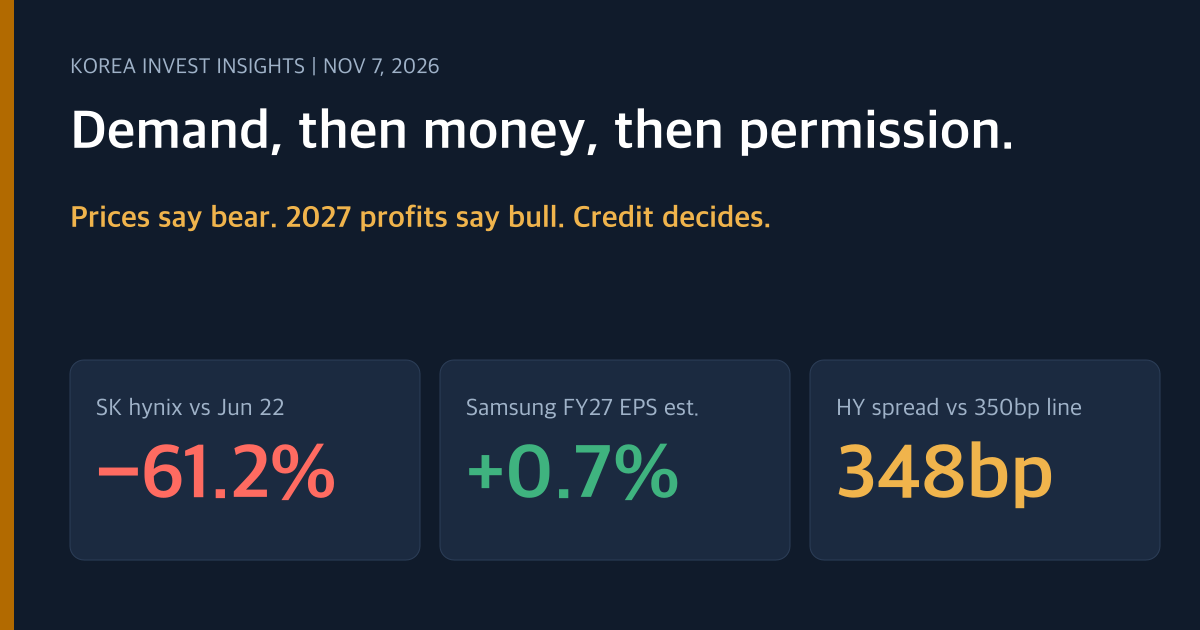
Since September 23, the KOSPI is down 28.5%. From their June highs, Samsung Electronics is down 47.9% and SK hynix 61.2%. The Philadelphia Semiconductor Index (SOX) fell 38.4% from June 22 to its November 5 low.
Over the same weeks, the profit side got stronger. Samsung booked KRW 107.4 trillion of operating profit in the third quarter. TrendForce expects fourth-quarter conventional DRAM contract prices to rise another 10-15% (TrendForce, September 30). All four big US hyperscalers raised their 2027 capex on third-quarter earnings calls. Korea’s October chip exports reached $56.44 billion, up 259.4% from a year earlier.
Both facts are true because the market’s question kept changing. In late September it asked whether AI infrastructure could keep its pricing power at high rates. In mid-October it asked how long record profits last. By late October it asked who pays. This week it asked whether politics will keep allowing the build-out. Each question sits further from the one thing that improved, which is profit.
Our call: the price verdict is bear. The 2027 profit verdict is bull. The variable that connects them is credit. The high-yield spread closed at 348bp on November 5, 2bp below the 350bp line we watch.
Both verdicts can be tested against lines you can watch: 330bp and 350bp on the high-yield spread. At the end we ask which side you take.
Prices fell like a bear market while profit estimates rose
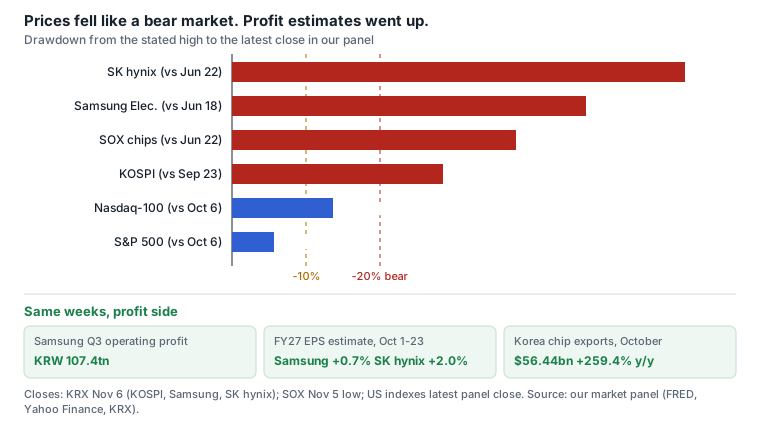
Korean memory’s big drop started in June, not October. Samsung peaked on June 18 and SK hynix on June 22. October added a second leg: from October 6 to 15, Samsung fell 22.8%, SK hynix 28.8% and the KOSPI 20.0%.
The US looks different. The S&P 500 is 5.7% below its October 6 record close, and the Nasdaq-100 is 13.6% below its high. The gap comes from how sensitive each company’s revenue is to the business cycle. The side that buys AI demand fell least. The side that sells components fell most.
The question moved four times, each time away from profit
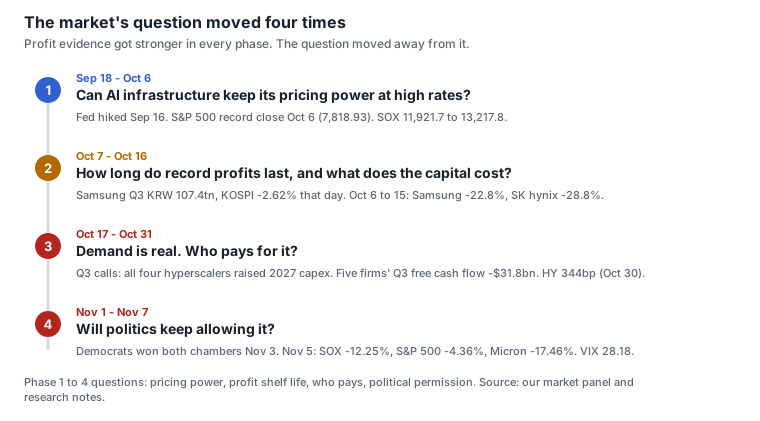
The October turn shows it best. Samsung’s record KRW 107.4 trillion landed 1.2% above one consensus (LSEG, KRW 106.1 trillion) and 4.7% below another (Visible Alpha, KRW 112.73 trillion), and the two use different bases. The KOSPI still fell 2.62% that day. The argument had moved from the size of profit to its duration.
Then it moved to money. On October 14, CoreWeave fell 15.5% and Oracle 8.8% in US trading. Both fell more than Micron (-4.1%). Oracle’s five-year credit default swap (CDS) stood at 288bp, up 26bp. CoreWeave’s 2032 bond yielded 14.8%. The market was selling the financing chain, and memory sat inside it.
By the third quarter calls the demand evidence was hard to argue with. Amazon booked most of 2027 and a large part of 2028. Google’s API token volume rose 40% quarter on quarter. North American data center vacancy stood at 1.4%. But the five companies’ combined third-quarter free cash flow was -$31.8 billion, and capex in the latest quarter ran at 116% of operating cash flow. External funding needs for 2027 come to about $200 billion, with guarantee paths of $48 billion at Alphabet and $41.5 billion at Meta.
The bull case: 2027 profit is already sealed
| Argument | Evidence | Source |
|---|---|---|
| 2027 profit is locked | SK hynix long-term deals above 50% of volume. Three makers’ 2027 volume commitments unchanged. FY27 EPS estimates up between Oct 1 and Oct 23 (Samsung +0.7%, SK hynix +2.0%). Q4 DRAM contract prices seen +10-20% | Company data, consensus |
| Korean memory activity is strong | October chip exports $56.44bn (+259.4%), memory $50.14bn (+360.5%), 14.4% above the Q3 monthly average. The September-to-October dip repeats last year’s calendar pattern | Korean trade ministry, Nov 1 |
| Supply, not demand, sets the 2027 ceiling | Google API token growth: +60% (Q1), +37% (Q2), +40% (Q3, quarter on quarter). All four hyperscalers raised 2027 capex. Amazon booked most of 2027 | Earnings calls, our model |
| Cheap | FY27 P/E: Samsung 3.12x, SK hynix 2.81x (Oct 26). 12-month forward P/B: 1.25x and 1.27x (Nov 6) | Consensus, secondary |
| Fear is high and shorts are crowded | VIX 28.18 on Nov 5, the highest since Mar 31. FINRA short interest on Oct 15 versus Sep 30: EWY +57.3%, SOXX +35.5% | FINRA, secondary |
| Credit has not followed stocks down | Nov 3 to 5: SOX -15.0% while the high-yield ETF HYG rose 0.4%. Spread 340bp to 348bp. The won held at 1,341 on Nov 5 | FRED, Yahoo Finance |
| Macro pressure eased | US 10-year 5.31% (Oct 5) to 4.859% (Nov 6). Brent front month $113.43 (Oct 29) to $97.76 (Nov 6) | Market panel |
The bear case: money is the weakest link
| Argument | Evidence | Source |
|---|---|---|
| The policy cushion thinned | Democrats won both chambers on Nov 3. Texas’s TCEQ paused permits on Sep 21, and a winning candidate has promised new halts. New York Executive Order 62 covers 50MW-plus projects for up to a year. 38-40 local restriction bills passed. 56% of voters call AI and data centers an important issue | Executive order, secondary tallies |
| Funding is the weakest link | High yield 266bp to 348bp (+82bp). CCC 1,075bp to 1,356bp (Oct 23 high). Investment grade 77bp to 93bp. Oracle CDS reported above 300bp (secondary, not confirmed first-hand). CoreWeave unsecured debt priced at 15% or more. OpenAI’s funding target cut from $30bn to $20bn (secondary) | FRED, secondary |
| The Fed still leans toward hiking | Hiked on Sep 16, held on Oct 28 with two dissents for a hike. December hike odds 67.7-81% (secondary sources conflict). October payrolls +165,000 versus +65,000 expected. September core PCE 3.1% | Federal Reserve, secondary |
| AI labs face a profit scissors | Anthropic’s quarterly revenue growth fell from +144.2% to +46.7% quarter on quarter, compute cost rose from 48.1% to 58.2% of revenue, and Q3 showed a GAAP operating loss (S-1/A). Blended token prices fell 26.8% in four weeks while B200 rental rose 10.6% | SEC filing, one non-representative sample |
| 2028 supply and the bullwhip | The big four plan 15-17% more 2028 wafers (CXMT included). Buyer inventories sit 1-5 weeks above normal, 8-13% of 2027 shipments | Model |
| Memory spot turned for the first time | DDR5 16Gb spot from $61.50 to $60.167 (-2.17%) by Nov 6. DDR4 8Gb from $47.107 (Oct 23) to $45.607. NAND and DDR4 fell together, as in March-April | Market panel |
The policy row needs one more line. The market used to treat Washington as a backstop for the AI build-out, an “AI put”. Our reading is that it is weaker at the federal level and now has state-level brakes. The same election also pulled Brent and the 10-year yield down, which lowered macro risk. Counting “AI put weaker” and “rates and oil lower” as independent factors double counts one event.
Why credit decides
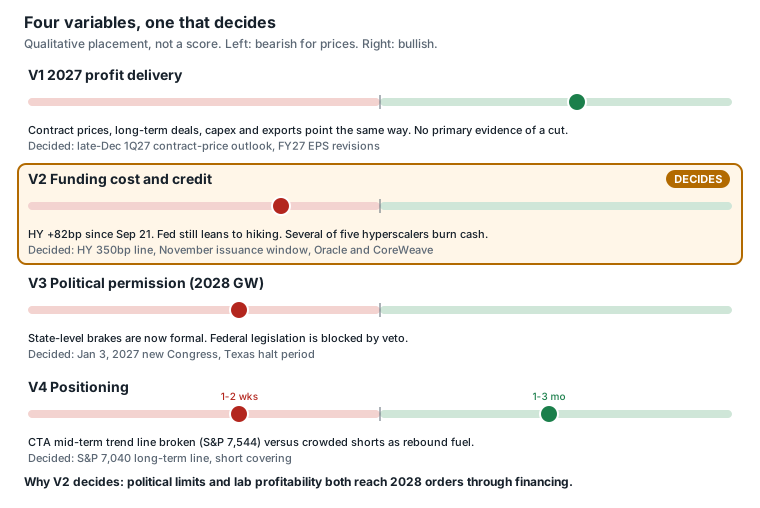
Political limits and AI-lab profitability both reach 2028 orders through one channel: financing. When the policy cushion thins, return on invested capital and the durability of free cash flow become the only backstops. The market then asks harder about credit. This is why strong 2027 profit cannot lift the price discount yet. Price will not release its duration discount until credit settles.
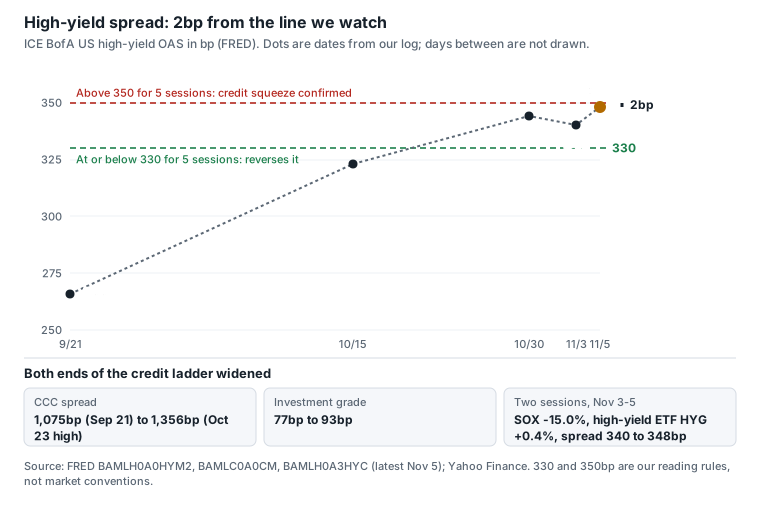
The chart carries the best bull argument and the best bear argument at once. In the two sessions when SOX fell 15%, spreads widened only 8bp, so credit has not followed equities down. But the spread has widened 82bp since September 21, and it sits 2bp from the line where the funding story stops being a worry and becomes a fact (FRED).
What flips the call
| If this happens | Then |
|---|---|
| Nvidia’s fiscal third-quarter report holds its fourth-quarter guidance and shows supply commitments of $279 billion or more, and the November issuance window clears with high yield at or below 330bp for five sessions | The call turns bull on price. Credit unlocks and 2027 profit takes over the price. |
| High yield stays above 350bp for five sessions | Bear confirmed: the credit-squeeze scenario is on. |
| Any one hyperscaler cuts its 2027 capex | Bear confirmed: the demand-slowdown scenario is on. |
| The late-December outlook for first-quarter 2027 conventional contract prices turns flat or lower | Bear confirmed, and it breaks the 2027 profit leg itself. |
The two bull conditions must arrive together. One is not enough. The bear conditions work alone.
Where we could be wrong
Objection one: “A 15% two-day drop in chips is forced selling, not a financing story." Partly right, and it is right for the next one to two weeks. Trend-following funds and retail leverage dominate that window. Our credit claim is about one to three months, when crowded shorts turn into rebound fuel instead of pressure.
Objection two: “Fear at 28 and a P/E under 3.2x say buy." Fear and low multiples describe the price. They say nothing about who finances 2028. We do not treat them as evidence for a bottom by themselves.
Objection three: “2027 profit is sealed, so 2028 is far away." Stocks price duration, not one year. Buyer inventories sit above normal and the big four plan 15-17% more wafers for 2028. If orders for 2028 depend on credit, the 2027 profit does not release the price.
What to check next
| When | What | Where |
|---|---|---|
| Every trading day | High-yield, CCC and investment-grade spreads | FRED |
| By November 10 | Nvidia’s fiscal third-quarter report date (our files show November 18, 19 and 20) | Nvidia investor relations |
| November 11 and 19 | Weekly DDR5 and DDR4 spot. A weekly DDR5 average at or below $57.44 is our alert line | Spot price panel |
| December FOMC | Hike odds (about two-thirds or more on secondary sources, which conflict) | CME FedWatch |
| Late December | First-quarter 2027 conventional contract-price outlook | TrendForce |
What this means
Korean memory prices already paid for a cyclical bear market, while 2027 profit estimates went up. The gap between them closes when credit decides, and not before.
Over one to two weeks, selling by trend-following funds and by retail leverage dominates. Over one to three months, crowded shorts increase the size of any rebound. The S&P 500 has already broken 7,544, a mid-term line that trend-following funds watch. Their long-term line sits at 7,040.
This is not a call to buy. Fear gauges and low multiples alone are not a reason.
Data notes
- We collected no new external data for this post. Figures come from our dated market panel and notes. Where a note marked a figure as secondary, we kept that label.
- Brent differs by contract month across sources. We used only the front-month series in our panel ($113.43 on Oct 29, $97.76 on Nov 6).
- The November 6 KOSPI close is the KRX value, 5,059.69. A Yahoo Finance value of 5,042.88 appears in other notes.
- Nvidia’s report date differs across our files. Check it at the source.
- The only SK hynix September-end close we hold is the September 30 panel value, and we did not carry Micron’s October 1 earnings figures.
Which breaks first? Reply with A, B or C, and one data point that backs your pick.
A. Credit: high yield stays above 350bp for five sessions.
B. Capex: a hyperscaler cuts its 2027 plan.
C. Neither: Nvidia’s guidance holds, the November issuance window clears and high yield falls to 330bp or lower.
This is for research and information only, not investment advice. Estimates and scenarios are analytical assumptions, not trading instructions or individual portfolio decisions. Figures are dated data, and some reported figures are secondary compilations. We used Anthropic’s Claude for research and editing. Anthropic appears in this post as an AI lab whose filed S-1/A figures we report as filed and do not weigh.