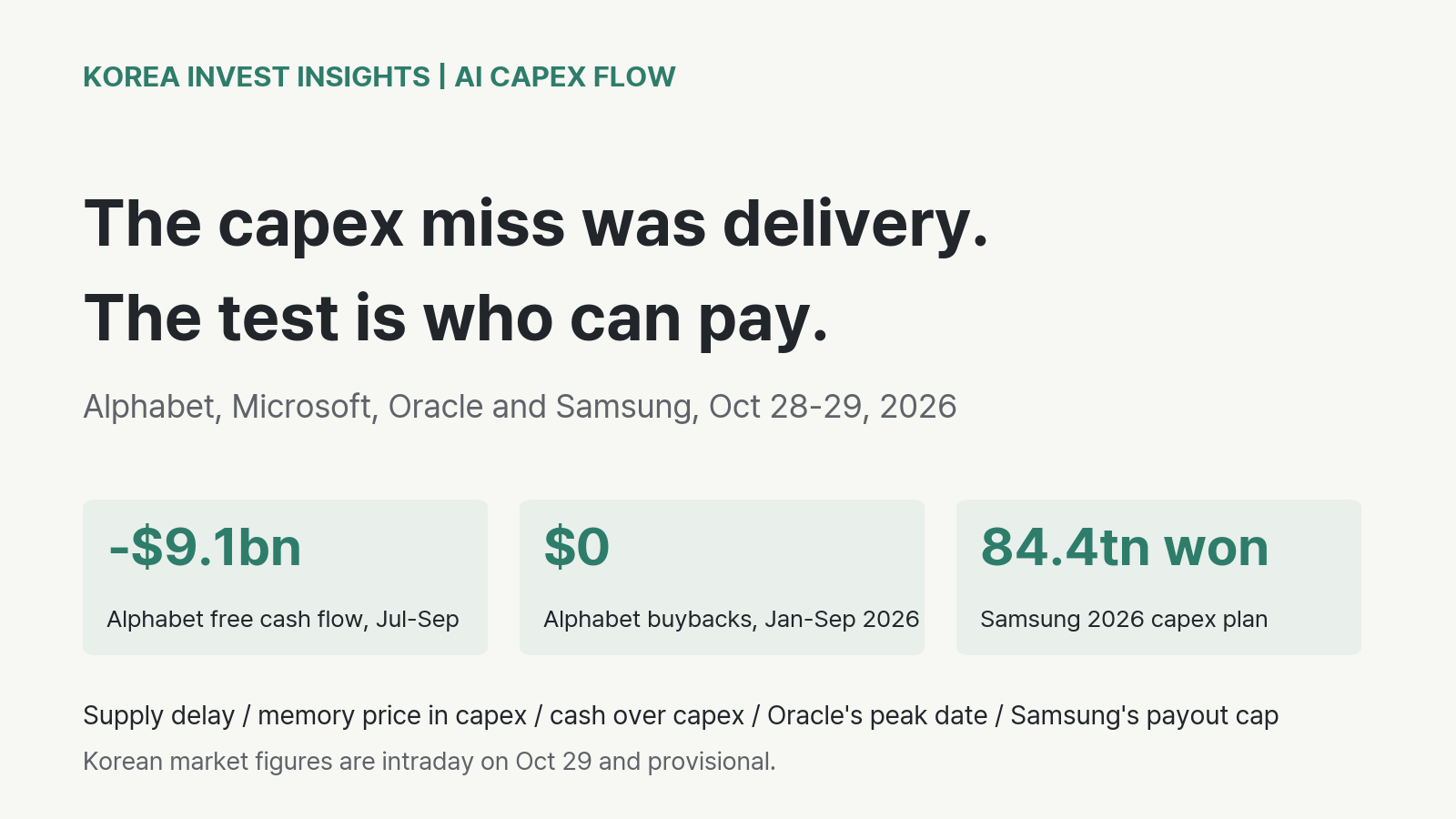
On October 28, Alphabet and Microsoft reported their September quarters and Oracle held its investor day. The two hyperscalers spent about $9 billion less on capex than analysts expected, and both blamed supply. Alphabet fell about 10% after hours, Microsoft rose about 3%, and Oracle had already closed 10.7% higher. CNBC on Alphabet, CNBC on Microsoft
The next morning in Seoul, the KOSPI rose to about 6,100, up 1.5%, with all of that US news already known. Then, from 9:50 a.m., Samsung Electronics filed its results, its dividend and its capex plan, and the index reversed. By 11:15 a.m. it was down 3.0%.
Our judgment: the AI capex cycle has not slowed, but its funding has changed. Spending now runs ahead of operating cash at most builders, so markets reward the companies that can pay and punish the ones that need outside capital. The same test reached Seoul. Samsung’s own capex jump limits how much of its record profit can go to shareholders, and that, at least as much as US capex, is what the market traded as the KOSPI reversed after 9:50.
This article is dated October 29, 2026. Korean market figures are intraday values at 11:15 a.m. KST and are provisional until the close.
Capex held up; the funding changed
- The miss came from supply. Alphabet said it is in a “supply-constrained environment” and started renting outside compute. Microsoft said some third-party capacity deliveries were delayed. Alphabet expects 2027 capex to rise significantly, and Microsoft expects spending to accelerate in January–June 2027.
- Demand indicators are still rising. Google Cloud revenue grew 103% and its backlog reached $561 billion. Azure grew 48%.
- Part of the spending is price. Microsoft named higher memory and storage costs in its second-half capex. Samsung said its DRAM prices rose about 20% in the third quarter.
- Investors priced cash. Alphabet had negative free cash flow, bought back no stock and issued equity. Microsoft had $18.6 billion of free cash flow. Their shares moved in opposite directions.
- Oracle put a date window on the peak. It expects peak capex in fiscal 2027–2028, through May 2028, and a step-down in fiscal 2029.
- Seoul fell on a payout question. Samsung’s shareholder returns are set at 50% of free cash flow, so its 84.4 trillion won capex plan caps the payout that its profit would otherwise support.
The shortfall came from supply
| Company | Quarter capex | Analyst estimate | Company explanation | Direction |
|---|---|---|---|---|
| Alphabet, Jul–Sep 2026 | $51.4bn | $55.1bn | “Supply-constrained environment”; started using third-party compute at the end of the quarter | 2026 range of $195–205bn kept; 2027 to “increase significantly” |
| Microsoft, Jul–Sep 2026 | $45.2bn incl. finance leases | $50.7bn | Some third-party capacity deliveries delayed; demand still exceeds supply | December quarter above $50bn; about $170bn for the calendar year; faster in Jan–Jun 2027 |
| Oracle, investor day | Not given | — | Peak capex in fiscal 2027–2028 | Step-down in fiscal 2029; free cash flow of at least $30bn |
Sources: Alphabet earnings release; Alphabet and Microsoft calls; estimates from LSEG and StreetAccount via CNBC; Oracle investor day release. Microsoft’s figure includes finance leases; Alphabet’s is cash paid for property and equipment.
The demand side points the other way. Google Cloud revenue rose 103% to $30.7 billion. Its backlog was $561 billion, and Alphabet expects to recognize just over 55% of it within 24 months. Azure grew 48%, and Microsoft’s commercial remaining performance obligation rose 73% to $677 billion. We covered Microsoft’s quarter in detail earlier today.
Microsoft did not name the late partners. CNBC read the lower capex as a sign that infrastructure partners are taking longer to deliver, and noted that Microsoft relies on neoclouds for capacity. CoreWeave and Nebius fell almost 5% in extended trading, and IREN fell about 3%. CNBC These companies build with debt, and CNBC also cited concern that rising interest rates will make that debt too costly. If the delay sits in that layer, a delivery problem is a funding problem in a different form.
Part of the spending is price
Microsoft said capex in the second half of its fiscal year, January to June 2027, will accelerate mainly because of CPUs, “inclusive of higher memory and storage costs”, and GPUs, as well as third-party deliveries that shifted into that period. In July, according to Data Center Knowledge, Amazon raised its 2026 plan to about $220 billion and said the increase mainly reflected higher memory costs. Data Center Knowledge On its call this morning, Samsung said its DRAM prices rose about 20% and its NAND prices rose in the high teens in the third quarter, led by server products. Chosun Biz via Naver
This matters for how to read capex totals. Capex dollars now grow faster than the compute they buy, and the difference shows up as memory makers’ margins. SK hynix earned an 80% operating margin last quarter. KII, Oct 29 The buyers see the same number as a cost that their own cash flow has to carry.
The market priced cash
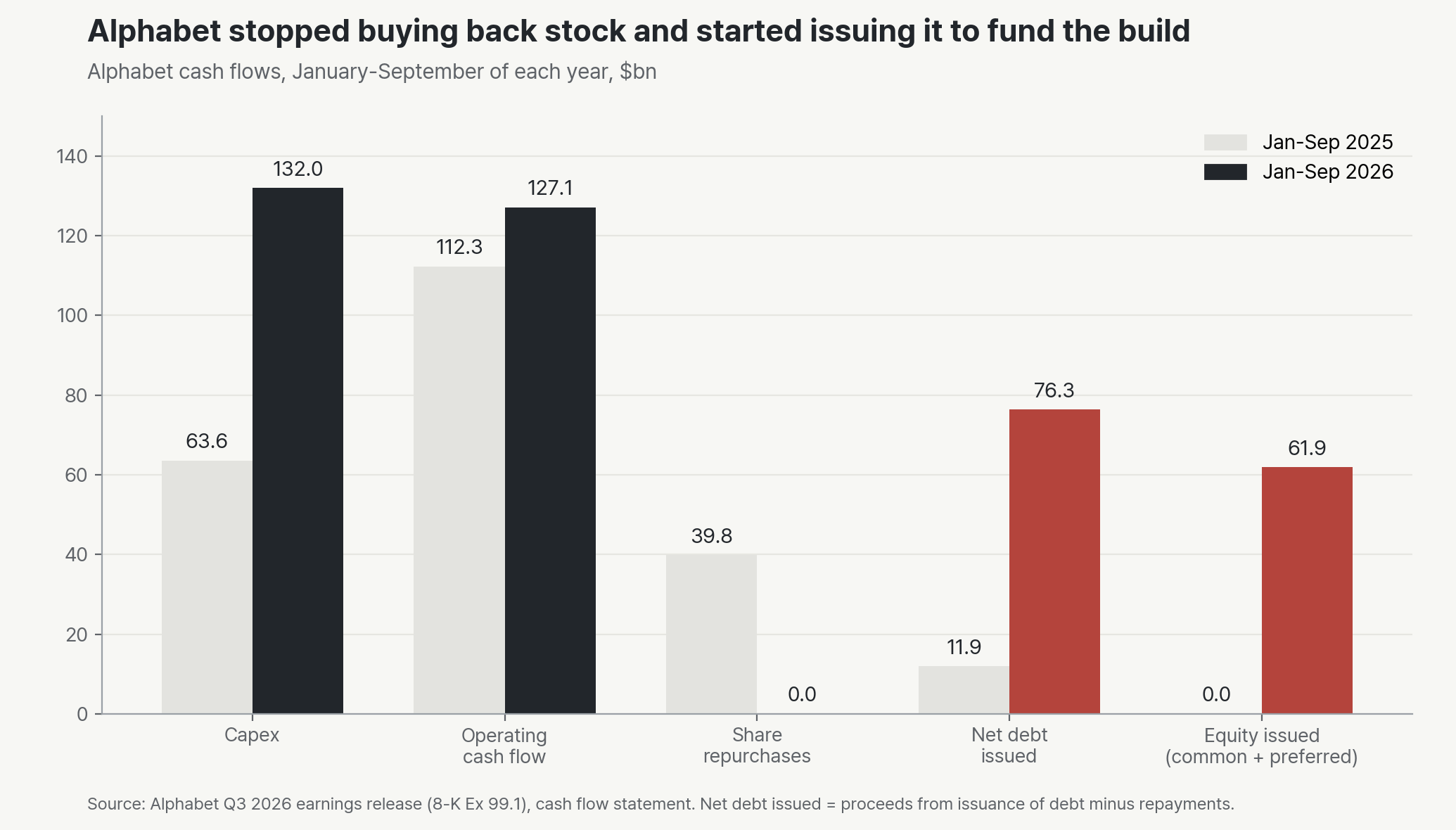
Alphabet’s numbers explain its fall better than its capex. In the quarter, free cash flow was negative $9.1 billion; CNBC cited an estimate of negative $2.7 billion. Alphabet bought back no stock, against $11.5 billion a year earlier. It issued $12.4 billion of common stock through its at-the-market program. From January to September it issued $42.9 billion of common stock and $19.1 billion of mandatory convertible preferred stock, and its net new debt was $76.3 billion. Long-term debt rose to $125.1 billion from $46.5 billion at the end of 2025. Alphabet still holds $265.1 billion of cash and marketable securities, so this is a funding choice made from strength. But one of the most profitable builders now funds part of its spending with outside capital. Alphabet earnings release
Microsoft is the contrast. Its free cash flow was $18.6 billion, down 27% but positive, and its shares rose. Oracle rose 10.7% after it said it would limit additional capital raises through fiscal 2030 to $20 billion, split between equity and debt and excluding refinancing. That is on top of a $20 billion at-the-market equity sale completed in the June–August quarter. KII on Oracle The three reactions line up with cash and funding.
The suppliers show the same split from the other side. They rose in the regular session, before the two reports, and gave back only 2–3% after hours while Alphabet fell 10%:
| Stock or index, Oct 28 | Regular session | After hours |
|---|---|---|
| Vertiv | +16.5% | −2.8% |
| Micron | +5.9% | −2.5% |
| AMD | +3.2% | −2.0% |
| Broadcom | +2.8% | −2.2% |
| Nvidia | −1.2% | −0.7% |
| Philadelphia Semiconductor Index | +1.75% | — |
Source: CNBC and Nasdaq quote data. After-hours trading is thin. Investors sold the payer that needs outside capital and only trimmed the suppliers.
The cost of outside money is rising. The 10-year Treasury yield closed at 5.05% on October 28. US Treasury The Federal Reserve held its target range at 3.75–4.00% the same day, and two members, Lisa Cook and Beth Hammack, voted for a quarter-point increase. Federal Reserve When builders need debt and equity to fund capex, a 5% risk-free rate makes the cash test sharper.
Oracle dated the peak
Oracle said: “Following a period of peak capex in FY27-FY28, capital expenditures are expected to step-down in FY29.” Its fiscal 2027 began in June 2026, and fiscal 2028 ends in May 2028. Oracle gave an explicit window for its capex peak. None of the hyperscalers that reported this month has given one. It also said vendor financing, customer-provided hardware and customer prepayments will reduce its upfront cash needs. Oracle investor day release
The date does not signal weaker 2027 demand. It tells suppliers when one large buyer expects its build to stop rising. The funding sentence moves part of the cash burden to suppliers and customers. For memory makers, payment terms and prepayments will matter as much as price.
Seoul reversed after Samsung’s filings
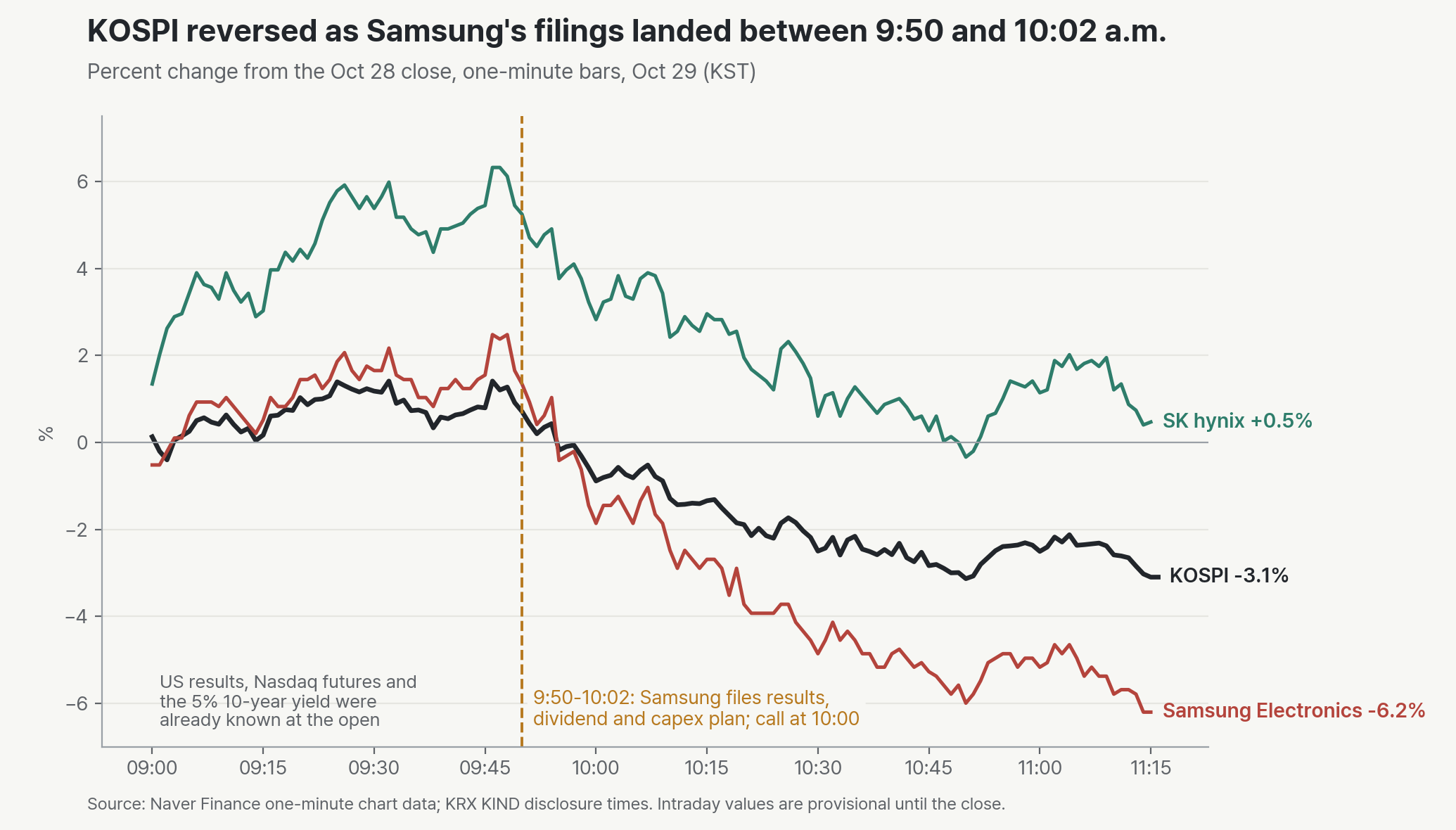
The KOSPI rose 6.63% on October 28 to 6,012.44. Before the open on October 29, investors already knew that Alphabet had fallen 10% after hours, that Nasdaq-100 futures were lower and that the 10-year yield was at 5%. The index still rose to about 6,100 by 9:46 a.m. Samsung filed its third-quarter results at 9:50 a.m., a 30 trillion won quarterly dividend at 9:53 a.m., a correction to its preliminary results at 10:00 a.m. and its 2026 capex plan at 10:02 a.m. Its call started at 10:00 a.m. The index had already slipped from its 9:46 high when the first filing landed at 9:50. It went negative at 9:55 and kept falling. KRX KIND disclosure times
At 11:15 a.m., the evidence pointed to domestic selling:
| Item, 11:15 a.m. KST | Value |
|---|---|
| KOSPI | 5,830, −3.0% |
| Samsung Electronics | −6.6% |
| SK hynix | +0.3%, after about +6% at 9:46 a.m. |
| Foreign investors, KOSPI net | +394 billion won |
| Institutions, KOSPI net | −633 billion won |
| Individuals, KOSPI net | +125 billion won |
| Advancers / decliners | 132 / 759 |
| Nikkei 225 / Taiwan TAIEX | +0.2% / −1.4% |
Source: Naver Finance market data, intraday and provisional. Nikkei and TAIEX quotes are delayed.
Foreign investors were net buyers while the index fell. If the cause were a US capex scare, foreign selling of memory stocks would lead. Instead, institutions sold, and the steepest falls came from Korean news. LG Energy Solution fell about 10% after LG Chem decided to sell about 2.5 trillion won of its stake. Doosan Enerbility fell about 12% after Korea Hydro & Nuclear Power ended contract talks with its consortium for the Czech Dukovany plant. Newsis Korean power-equipment makers such as Hyosung Heavy Industries and HD Hyundai Electric fell about 6% on the morning after Vertiv rose 16.5% in New York.
Samsung’s payout is bound by its own capex
Samsung’s call was positive on demand. It said memory demand next year will “greatly exceed supply” and that it will start HBM4E mass production in the first half of 2027. Money Today via Naver Its third-quarter operating profit was 107.4 trillion won on revenue of 195.3 trillion won. The October 8 preliminary release had already shown 107.4 trillion won, so the profit was not news. DART It also said lower dollar and euro exchange rates cut operating profit by about 10 trillion won from the previous quarter, mostly in components.
The capex plan is the link to the payout. Samsung expects 84.4 trillion won of facility investment in 2026, 31.7 trillion won more than in 2025, with 76.8 trillion won in its chip division. DART, Asia Economy via Naver Samsung’s policy returns 50% of its 2024–2026 free cash flow. That free cash flow excludes prepayments under long-term memory supply agreements, which Samsung treats as deposits. In August, Samsung put the remaining pool for 2026 at about 90–110 trillion won. DART, Aug 21
Today Samsung declared the 30 trillion won dividend that it had planned in August, at 4,601 won per share. On the call, it said about 35 trillion won of returns had been executed or confirmed, which leaves 55–75 trillion won. Samsung said a large part will go to buying back and cancelling shares. The final size will be set at the board meeting in late January 2027. Financial News via Naver
The arithmetic is unchanged from August, and the call did not raise the range after a record quarter. The late-January date for the final decision was already in the August disclosure. An industry source told Herald Economy that it still appeared to disappoint investors who wanted an earlier commitment. Herald Economy via Naver We cover the buyback calendar and the preferred-share question in a separate post. A higher capex plan lowers the free cash flow base. Customer prepayments, which pay for new capacity, are excluded from it. SK hynix had announced about 100 trillion won of returns for this year the day before, including at least 30 trillion won of cash dividends and at least 60 trillion won of buybacks and cancellation. Newspim Investors compared the two this morning.
For Korean memory, the capex boom is good for earnings and a constraint on payouts. The question for Samsung’s stock has moved from whether AI demand lasts to how much of the cash reaches shareholders.
Our judgment, and what would change it
Cash now ranks ahead of capex as the variable that sets AI-builder valuations. The quarter’s shortfall came from late deliveries. Demand indicators kept rising, and part of the spending growth is higher memory prices. The pressure now falls on funding. Builders with negative free cash flow, such as Alphabet, are issuing new equity and debt while the 10-year yield is at 5%. In Seoul, the same pressure appeared as a payout cap tied to Samsung’s own capex.
| Evidence | What it would mean |
|---|---|
| Amazon (after the US close on Oct 29) raises capex while free cash flow stays near zero | Spending continues; the funding test gets sharper |
| Alphabet’s fourth-quarter call gives 2027 capex growth well below 2026’s | Builders are rationing; the first real slowdown signal |
| Microsoft’s December-quarter capex comes in below $50bn | The delay is more than timing |
| Oracle exceeds its $20bn funding cap or its credit spreads widen sharply | Credit becomes the binding constraint |
| Google Cloud backlog or Microsoft’s commercial RPO falls | A supply delay is turning into a demand delay |
| Samsung’s January board raises total 2026 returns above 110 trillion won | The payout constraint loosens |
| Foreign investors turn net sellers of Korean memory stocks | The Korean move becomes an AI-demand question |
The next checks are Amazon’s results tonight, the KOSPI close and foreign flows, and Samsung’s January board decision.
Do you think markets are right to reward cash over capex growth, or is Alphabet’s turn to outside funding the price of staying ahead? Tell us which number would change your mind.
Disclosure: Alphabet, Amazon and Microsoft are investors in Anthropic, whose Claude models assisted research and editing for this post.
Research and information only; not investment advice. Estimates and scenarios are analytical assumptions, not company guidance, trade instructions or personalized portfolio decisions. Figures are date-bound. AI tools assisted research and editing.