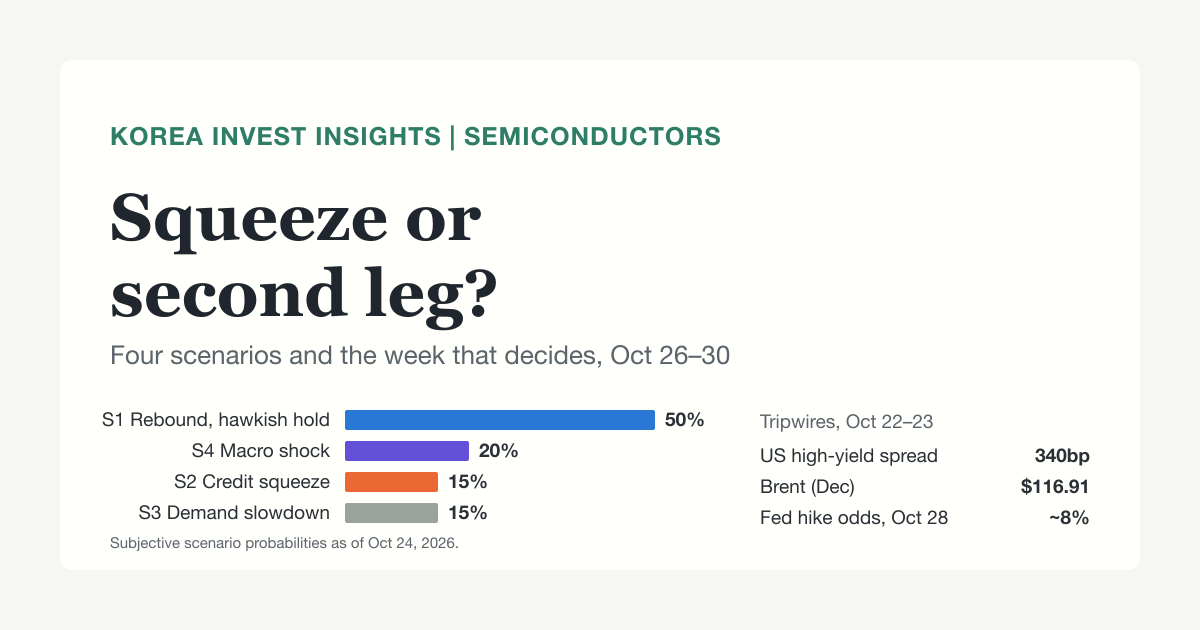
Last week we mapped who holds what after October’s chip crash: it was a long unwind, not a short attack. This week answers the next question. Does the unwind end in a short squeeze, or in a second leg down?
Two things moved after Friday’s close. The December Brent contract settled at $116.91, up 3.3%, while 10-year inflation breakevens rose 2bp and the 2-year yield rose 4bp.1 Under the rule we set in advance, that makes it an inflation-type oil day, so the macro-shock scenario rose from 15% to 20% and the base case fell from 55% to 50%. Meanwhile the US high-yield spread stood at 340bp on Oct 22, 10bp below our 350bp credit alarm.2
The base case is still a rebound. Memory earnings for 2026 and 2027 got stronger this month, and most of the forced selling is done. But this week the burden of proof sits with credit and oil, not with AI demand. Below are the four scenarios, the lines that move them, and what to watch each day from Monday to Friday.
Five things to take away
- Base case (S1, 50%): a rebound with a hawkish Fed on hold. The other three are a credit squeeze (S2, 15%), a capex slowdown (S3, 15%) and a macro shock (S4, 20%). All probabilities are our subjective estimates as of Oct 24.
- The bear case needs proof. We call the downturn confirmed only on one of three events: an annual cut to next year’s memory profit consensus, US high-yield spreads at 350bp or more, or one Big Tech company slowing 2027 capex. None has happened yet. The credit line is the closest.
- Oil is now the swing factor for the macro case. Brent above $110 counts against us only on days when inflation gauges rise with it. We judge that every day.
- Thursday, Oct 29 is the densest day: Oracle’s investor day, the FOMC, Alphabet, Microsoft and Samsung’s call land within ten hours in Korea time.
- In Korea, a lasting rebound needs foreigners to buy Samsung Electronics and SK hynix shares again. On Friday they sold about KRW 0.98 trillion of KOSPI stocks, almost at our KRW 1 trillion alarm.3
Prices are Oct 23 closes. Korean closes are final prints after the 20:00 KST extended session. This is analysis, not a trading instruction.
Where the cycle stands
We track the cycle in four layers. The market has priced them very differently.
| Layer | State | Priced in? | What we see |
|---|---|---|---|
| A. Memory profits, 2026–27 | Strong | Barely | 2027 operating-profit consensus for Samsung still rising; DDR5 spot up 11.7% since Sep 16 |
| B. Supply and demand, 2028+ | Uncertain | Heavily | Wafer capacity at four makers up 15–17% in 2028; CXMT gaining share |
| C. Funding and rates | Worsening | Partly | HY spread 340bp, Oracle CDS near 315bp, US 10-year at 5.00%, Brent $116.91 |
| D. Positioning | Largely flushed | Largely | Hedge-fund AI net buying erased, CTA longs down 69%, but gross leverage still near a record |
The A layer kept improving while the stocks fell. Consensus for Samsung’s 2027 operating profit rose to KRW 555 trillion at Kiwoom and KRW 561 trillion at FnGuide, and Micron’s FY27 EPS consensus rose 12.8% in 30 days.4 DDR5 16Gb spot averaged $61.27 on Oct 23, against $54.83 on Sep 16.5
The swing question is whether the C layer spills into the B layer. In plain terms: do higher funding costs make the AI builders who borrow cut their 2028 orders? Credit for hyperscalers is fine; IG spreads are 89bp.2 The pressure sits at the weak end, in Oracle and the debt-funded neoclouds.6
The D layer is the main reason we keep the base case. Goldman’s model of CTA equity longs fell about 69%, and the share of fund managers who call semiconductors the most crowded trade fell from 82% to 45%.7 The exception is gross leverage. Hedge funds still run about 312% gross, so a second round of de-grossing is possible if longs and shorts move against each other.8
Where the tripwires stand
The chart shows each line we monitor, the latest value and the distance to the line that would move a scenario.
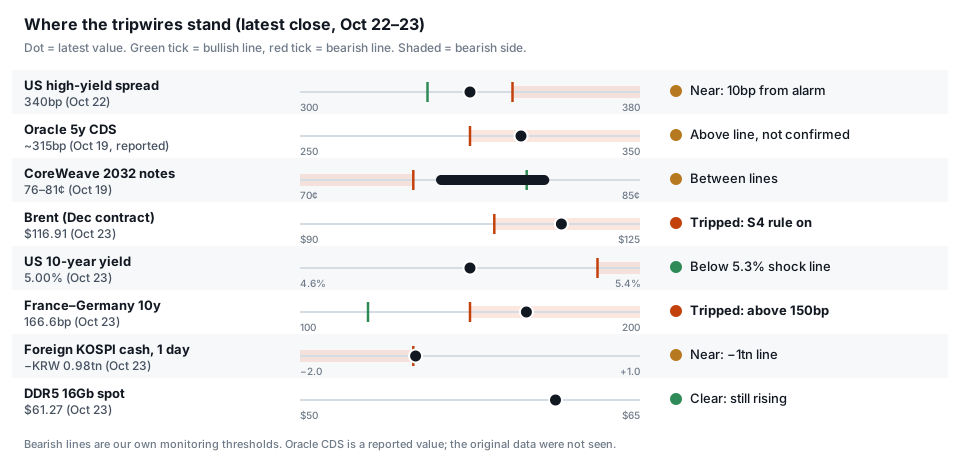
Two lines have tripped and three are close. Brent and the France–Germany spread are past their lines. France’s spread was 166.6bp on Oct 23, before Moody’s kept the country’s Aa3 rating later that day.9 The high-yield spread, Oracle’s CDS and Friday’s foreign selling in Korea are near theirs. The physical memory market is the one clean green light.
Four scenarios to mid-November
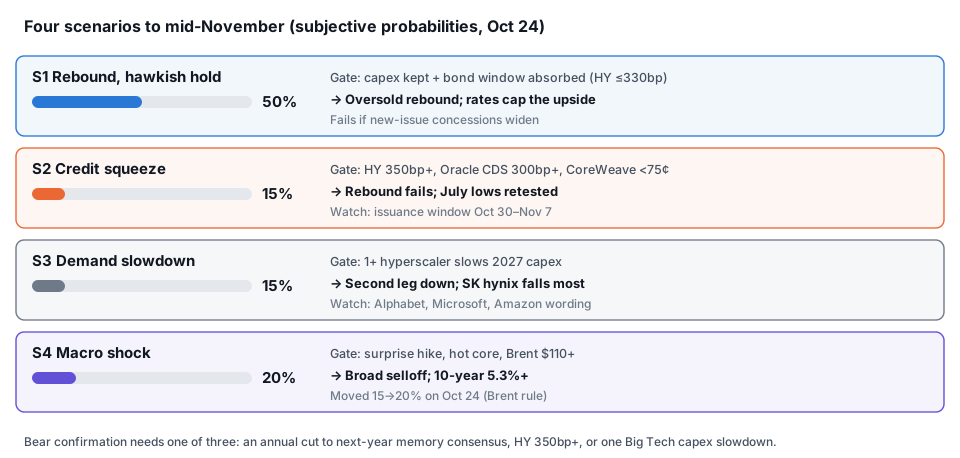
S1. Rebound under a hawkish hold (50%). Big Tech keeps 2027 capex rising, memory makers confirm 2027 contracts and HBM4, the Fed holds and leaves December open, and the post-earnings bond window clears with high-yield spreads at 330bp or less. The result is an oversold rebound with rates capping the upside. It breaks if new bond deals need bigger concessions in early November. Then S1 turns into S2.
S2. Credit squeeze (15%). Capex holds, but it is funded with more debt and special-purpose vehicles. The gates are high-yield spreads at 350bp or more, Oracle’s five-year CDS staying above 300bp and CoreWeave’s 2032 notes below 75 cents. Good earnings get a weak reaction and the July lows are retested.
S3. Demand slowdown (15%). One or more hyperscalers slows 2027 capex or stresses discipline. This is the second leg down, and SK hynix would fall the most because its valuation leans hardest on HBM. Meta did not trigger it on Oct 21: it raised the low end of its 2026 range and gave no 2027 number.10
S4. Macro shock (20%). A surprise rate hike, hot core inflation or Brent above $110 on an inflation-type day. The result is a broad selloff with the 10-year at 5.3% or more. Markets price only about an 8% chance of a hike on Oct 28, with more risk in December, so the live channel this week is oil, not the Fed.11
Roughly, these line up with last week’s positioning paths: S1 is the short-cover path A, S3 is path B (one more de-gross, then a cover), and S2 is path D (the shorts win on credit). S4 does not need a positioning trigger; it hits everything at once.
What moves the odds
We change probabilities only on a primary source or on a threshold break, in 5-point steps and no more than 10 points per scenario in a day. Three rules matter this week.
- The oil rule. Brent settles at $110 or more. If 10-year breakevens or the 2-year yield rise at least 1bp that day, the oil move is inflation-type: S4 goes to 20% and S1 to 50%. If breakevens, the 2-year and copper all fall, it is supply-type: S4 goes back to 15% and S1 to 55%. Mixed days change nothing.
- The credit rule. Each S2 gate that breaks with a primary source moves S2 up. A high-yield spread back at 330bp or less with deals clearing moves S1 up.
- The capex rule. If Big Tech puts 2027 capex on hold, we move 15 points from the short-cover path to the de-gross path and review S3 for 5 more points.
The week ahead, day by day
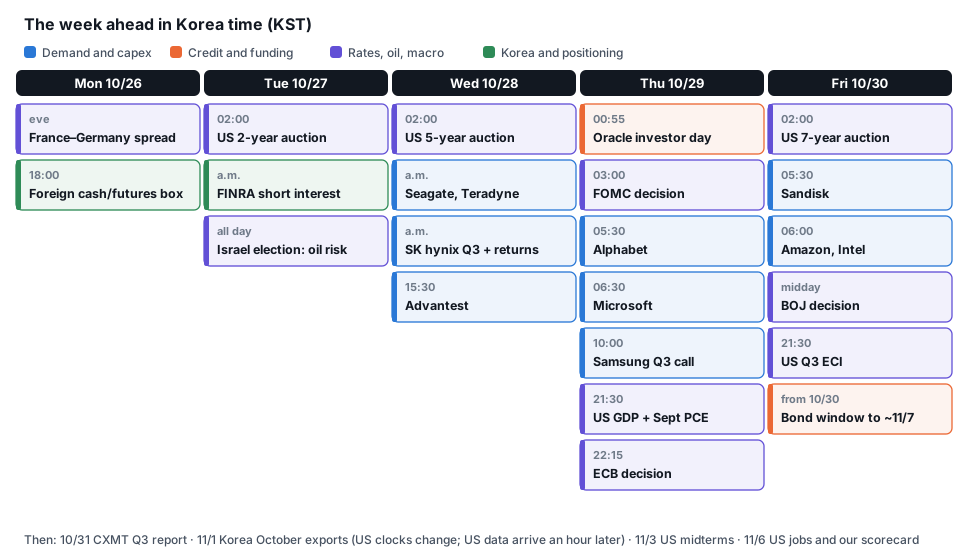
Times are Korea time (KST). US earnings after the New York close arrive the next morning in Korea.12
Monday, Oct 26: Europe and the Korea flow box
- France–Germany 10-year spread. This is the first trading day after Moody’s decision. Below 150bp turns our sovereign alarm off; staying above 150bp keeps it on. A spread that keeps widening would push European rates and the macro case together.
- Korea foreign flows (after 18:00). We sort each session into one of four boxes. Bullish: foreigners net buy Samsung Electronics and SK hynix for two or more sessions and turn buyers of KOSPI 200 futures. Bearish: foreign cash selling of KRW 1 trillion or more in a day, or KRW 3 trillion or more over five sessions, together with futures buying.
Tuesday, Oct 27: shorts and oil
- 02:00, US 2-year auction. A tail of 1bp or more would add pressure at the front end. The 5-year follows Wednesday and the 7-year Friday.
- Morning, FINRA short interest (settled Oct 15). Did neocloud shorts hold or grow? We compare CoreWeave, Core Scientific, Nebius, Galaxy Digital, Hut 8 and Teradyne with Sep 30. More shorts means more squeeze fuel if the week goes well. We also check whether shorts on Korea and chip ETFs (EWY, SOXX, SMH) rose.
- All day, Israel’s election. The channel to chips is oil. Under our rule, a Brent spike alone does not move S4; the inflation gauges have to move with it.
Wednesday, Oct 28: SK hynix
- Early morning, Seagate and Teradyne. Seagate’s HDD and flash pricing is an early read on storage demand and on Samsung’s NAND. Teradyne is on our squeeze list.
- SK hynix third quarter and a new shareholder-return plan. Brokers expect funding of more than KRW 30 trillion for new returns.13 The KRW 40 trillion buyback absorbed foreign selling until it ended on Oct 21. A large new program would refill that demand gap. Beyond the headline profit, we watch four points: how much 2027 HBM4 volume is under contract, the 2027 capex plan, HBM4E customers and timing, and how many ASIC customers buy HBM4.
- What would worry us. A 2027 capex plan far above expectations reads as 2028 supply, not as strength. A thin return plan reopens the demand gap.
- 15:30, Advantest. Memory tester orders. It is the one equipment name roughly flat since late June.
Thursday, Oct 29: ten hours that decide the month
- 00:55, Oracle investor day. The funding mix is the test. More customer prepayments would ease the credit chain. More debt or off-balance-sheet funding would add to it. Oracle’s CDS staying above 300bp would push S2.
- 03:00, FOMC. A hold is expected. The risk is wording that signals further hikes, which is an S4 trigger. With no forward guidance from Chair Warsh, the statement carries more weight than usual.
- 05:30, Alphabet. Three numbers: third-quarter capex against a consensus near $55.8 billion, any direction for 2027 capex, and API token growth. Google’s API ran at 22 billion tokens a minute in the second quarter, up 37.5% from 16 billion.14 Growth below 15% a quarter would lean bearish on demand. A hold or cut in 2027 capex would move S3.
- 06:30, Microsoft. We use four tests: demand still exceeds supply; calendar 2026 capex is raised or the December quarter is at least the September quarter; leases signed but not yet started keep growing; Azure grows 45% or more. Three of four would support the squeeze case. We put the odds near 42%.
- 10:00, Samsung Electronics third-quarter call. Memory margins, the share of 2027 supply under long-term contracts and any price floors, HBM4 qualification and new ASIC customers.
- 21:30, US third-quarter GDP and September PCE. Core PCE above expectations, a day after a hawkish FOMC, is the S4 combination.
- 22:15, ECB decision. Watch any comment on France’s spread and the bank’s bond-buying backstop.
Friday, Oct 30: Amazon and the bond window
- 02:00, US 7-year auction. The first auction after the FOMC and PCE.
- 05:30, Sandisk; 06:00, Amazon and Intel. For Amazon: AWS capex, how much of the 2026 increase is memory prices rather than more buildings, and how much 2028 capacity is already reserved. For Sandisk: NAND pricing and Chinese competition, read against Samsung’s NAND comments the day before.
- Midday, Bank of Japan. A hold is expected; the question is a December signal. Yen carry matters for global rates.
- 21:30, US third-quarter employment cost index. Wage-driven inflation is the slow S4 channel.
- From Oct 30 to about Nov 7, the bond window. After earnings, hyperscalers and their partners usually issue bonds. Watch new-issue concessions. High-yield spreads at 330bp or less with deals clearing would support S1. Spreads at 350bp or more with failed or pulled deals would confirm S2.
Over the weekend and the week after
- Oct 31: CXMT’s third-quarter report (margins and expansion plans).
- Nov 1, 09:00: Korea’s October exports. The US leaves daylight saving time the same day, so US data arrive one hour later in Korea from Nov 2.
- Nov 3: US midterm elections. Nov 6, 22:30: US October jobs.
- Nov 6: we score this map: which scenario played out, which positioning path, and whether the squeeze list beat its Oct 21 closes.
Every day: three standing checks
- DRAM spot. As long as DDR5 spot holds or rises, the physical market does not confirm the selloff.
- Korea’s flow box. Box ① (cash buying plus futures buying) is the only one that supports a lasting rebound.
- The oil rule. Brent at $110 or more is judged every day against breakevens, the 2-year yield and copper.
Our read
We keep the rebound as the base case for one reason: the layer that pays memory makers is getting stronger, while the selling that drove October looks mostly done. What would change our mind fast is not a weak quarter. It is a high-yield spread through 350bp with deals failing, or one hyperscaler cutting 2027 capex. Either one would mean the funding problem has reached the buyers who pay for memory.
Your turn
Which single print matters most to you next week: SK hynix’s capex plan, Microsoft’s four tests, the FOMC statement, or Brent? And where is your line? Tell me in the comments. I will score this map on Nov 6, so your thresholds go into the scorecard too.
If this watch list helps you get through the week, a like helps other investors find it.
Disclaimer: For research and information purposes only. Not investment advice. Names cited are for analytical illustration; readers should perform their own due diligence and consult licensed advisors before any investment decision.
Brent December 2026 futures settlement of $116.91 on 2026-10-23 (+3.3%), as reported by Yahoo Finance for the December contract (BZZ26). A continuous front-month series showed a lower value around the contract roll. Breakeven and 2-year moves from FRED T10YIE and the US Treasury daily curve. The oil rule is our own pre-set rule. ↩︎
Federal Reserve Bank of St. Louis: ICE BofA US High Yield OAS 3.40% and US Corporate (IG) OAS 0.89% on 2026-10-22, the latest available on Oct 24. ↩︎ ↩︎
Naver Finance investor-trend data (KRX based) for 2026-10-23: foreigners −KRW 981.1 billion in KOSPI cash equities, institutions +KRW 868.2 billion. SK hynix accounted for about −KRW 0.60 trillion of foreign selling (shares × KRX close). ↩︎
Consensus data compiled by Kiwoom Securities (2027 operating profit KRW 546 trillion to 555 trillion) and FnGuide (554 trillion to 561 trillion); Micron FY27 EPS consensus revision over 30 days. Secondary data, as of mid-October 2026. ↩︎
TrendForce, DRAM spot price: DDR5 16Gb (2Gx8) 4800/5600 session average $61.267 on 2026-10-23 and $54.83 on 2026-09-16, from captured price tables. ↩︎
CNBC, CoreWeave and Oracle credit stress, 2026-10-19: Oracle five-year CDS about 315bp; CoreWeave 2032 notes near a 14.9% yield. Other reports quoted Oracle near 322bp; we did not see the original data. ↩︎
CTA longs from Tickmill summaries of Goldman Sachs flow notes (Oct 20); fund-manager crowding from Mace News on the BofA October survey. Secondary summaries. ↩︎
Tickmill, summary of Goldman Sachs notes, 2026-10-20: gross leverage 311.7% and net 72.7% for the week of Oct 16. Secondary. ↩︎
CNBC, Moody’s holds steady on France’s credit rating, 2026-10-23. The spread of 166.6bp is the 10-year benchmark difference on Oct 23 from our daily market panel. ↩︎
Meta Platforms, third-quarter 2026 results (SEC Form 8-K, Exhibit 99.1), 2026-10-21. ↩︎
FXStreet, 2026-10-23, citing the CME FedWatch Tool: about an 8% chance of an October hike and higher odds for December. Context on guidance from Forbes, 2026-10-19. ↩︎
Company and official schedules: SK hynix earnings call notice; Oracle investor day notice; Federal Reserve FOMC calendar; Microsoft earnings date; Alphabet earnings date; Amazon earnings webcast; Sandisk results date; Samsung Electronics IR events; BEA release schedule (GDP advance estimate and September personal income and outlays on Oct 29, 8:30 a.m. ET); ECB meeting calendar; FINRA short interest schedule. Bank of Japan, Treasury auction and other times follow published schedules as compiled in our event calendar. ↩︎
Money Today, 2026-10-19, citing securities-industry expectations; the earlier program is in the SK hynix newsroom. ↩︎
Alphabet second-quarter 2026 results (SEC Form 8-K, 2026-07-22): 22 billion API tokens per minute against 16 billion in the prior quarter. The 15% line and the Microsoft tests are our own thresholds. ↩︎