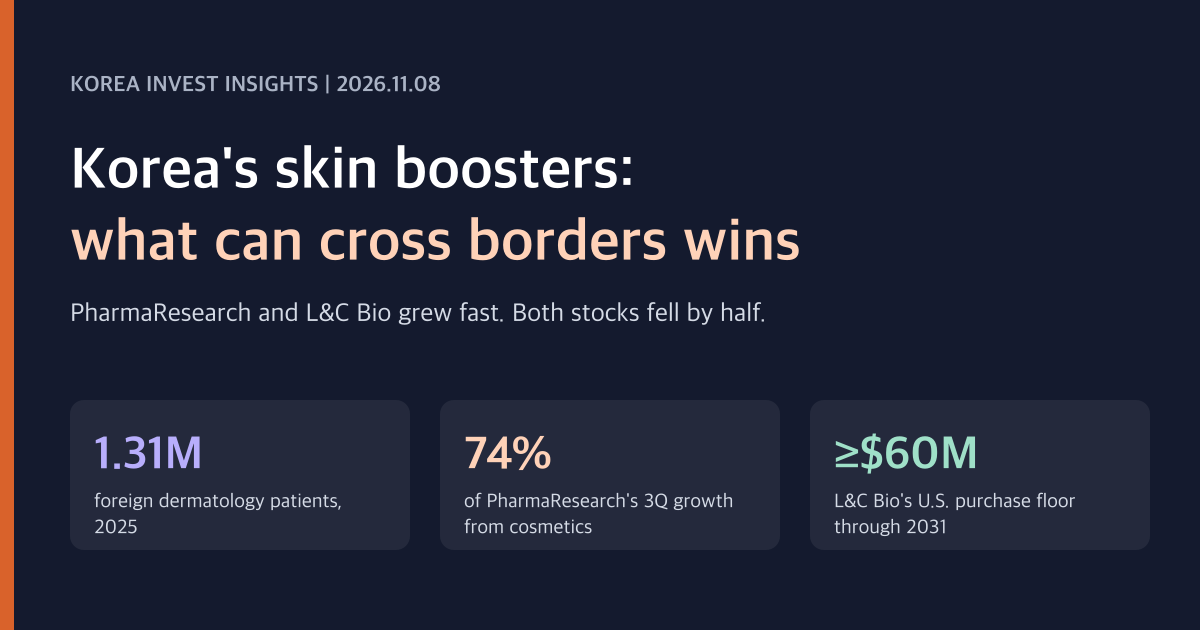
Rejuran and Re2O are two of the best-known Korean skin boosters, and the two listed companies behind them keep growing. PharmaResearch, the maker of Rejuran, grew third-quarter revenue 26.7% from a year earlier. L&C Bio, the maker of Re2O, grew first-half revenue 81%.
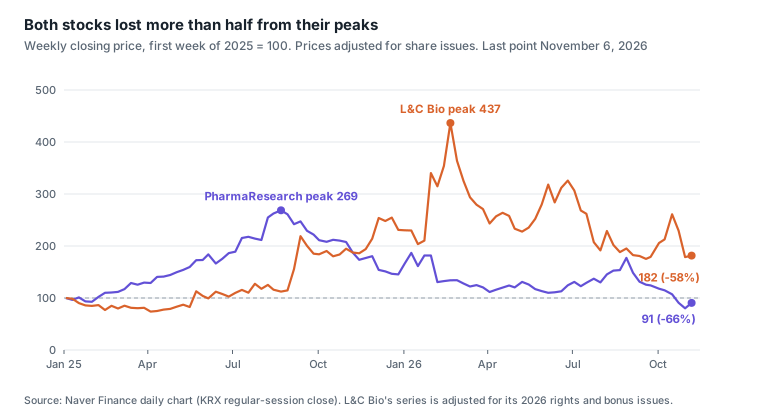
The share prices tell a different story. On November 6, PharmaResearch closed 67% below its August 2025 peak. L&C Bio closed 58% below its February 2026 peak.
So what changed? Demand did not disappear. What changed is where the next won of profit can come from. Korea’s home market is crowded, and its regulator is reviewing the newest product type. The next leg of growth has to come from abroad, and abroad each product needs a legal route.
Our view: Korea’s lead in skin boosters is real and still growing in volume. Early approvals, dense and cheap clinics, 1.31 million foreign dermatology patients in 2025 and K-beauty retail feed one another. But the next leg depends on which products can legally cross borders. Cosmetics cross fastest. PN injectables registered as medical devices come next: Rejuran is approved in 52 countries, but China lists it only as a class II topical product, and the U.S. has no approved PN injectable. Human-tissue boosters such as Re2O are Korea’s fastest-growing product and the least portable one. The status that lets them sell at home without product approval also keeps them out of China until a device version exists. The market now pays about four times more per won of 2026 operating profit for L&C Bio than for PharmaResearch. We think that gap prices the home-market boom more than the export path.
- Foreign patients treated in Korea rose from 0.61 million in 2023 to 2.01 million in 2025, and dermatology counted 1.31 million. The tourist VAT refund on cosmetic procedures ended on December 31, 2025, and the bills to restore it are still in the National Assembly.
- PharmaResearch’s third-quarter revenue grew 26.7%, but operating profit grew only 1.2%. Cosmetics supplied 74% of the growth. Domestic medical-device sales were flat. Net profit fell 40.5% on an ₩18.5 billion non-operating loss that the company has not yet explained.
- Re2O went from ₩0.4 billion of sales in 2024 to ₩23.6 billion in the first half of 2026, 34% of L&C Bio’s revenue. L&C Bio’s 2025 net loss of ₩138 billion came from two non-cash items, and its operating profit stayed positive.
- On October 13, Korea’s drug regulator told the National Assembly that it will review how about 100 human-tissue products, none with product approval, are managed. The study is due by the end of 2026. For L&C Bio’s valuation, that review matters more than any single quarter.
This post follows our earlier notes, Who Owns Rejuran? and the PharmaResearch Re-Rating Check. The wider map is in the K-Beauty hub.
A skin booster repairs skin quality, and its material decides the law
A skin booster is an injection given at many small points just under the skin to improve hydration, elasticity and texture. A filler adds volume. Botulinum toxin relaxes muscles. A skin booster works on the quality of the skin itself.
The category is not one product. Several materials compete, and in Korea each one follows its own legal route. The route matters as much as the chemistry, because it decides how fast a product can launch at home and whether it can be sold abroad.
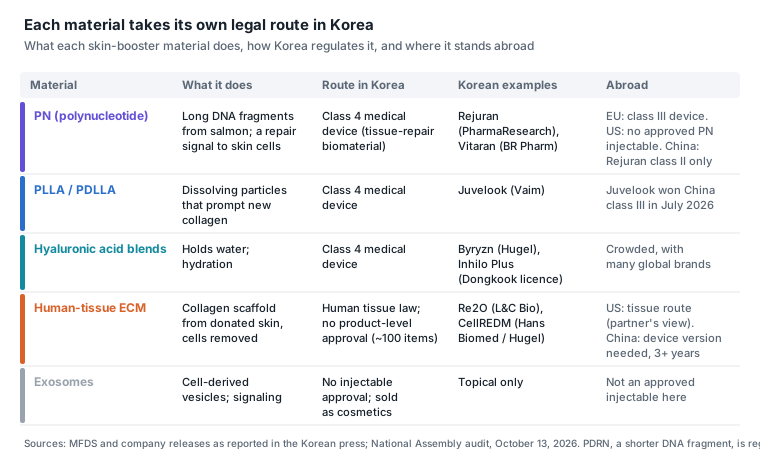
PN, short for polynucleotide, is Korea’s original skin booster. It uses long DNA fragments purified from salmon germ cells. PharmaResearch’s annual report describes PN as the longer DNA fraction, which forms a three-dimensional gel and is used in medical devices. The shorter fraction, PDRN, is regulated as a drug. The technology has Italian roots: PharmaResearch first sold Mastelli’s PDRN drug Placentex in Korea and later made its own.
Human-tissue ECM is the newest material and the most unusual one. ECM stands for extracellular matrix, the protein scaffold that holds skin cells in place. Re2O is a powder made from donated human skin with the cells removed. Korea regulates it under the Human Tissue Safety Act as a tissue graft, not as a medical device. That route needs no product-level approval. About 20 Korean companies now sell about 100 such products.
Korea got here first through a loop that runs from the regulator to the shop shelf
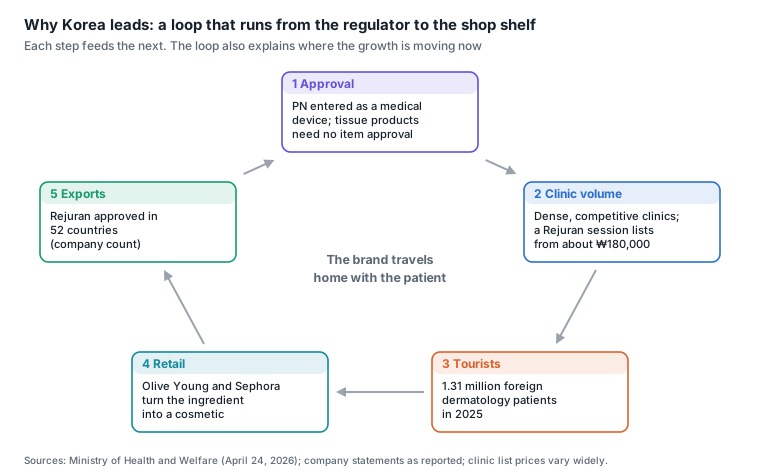
Korea’s advantages reinforce one another.
The approval path opened early. Rejuran launched in 2014 as a medical device, and PharmaResearch’s own filing dates the Korean skin-booster market from that launch.
Korea has many competing aesthetic clinics. Clinic pages in Seoul’s Gangnam district list a Rejuran session from about ₩180,000, roughly $130. Prices vary widely, but low prices bring high volume, and high volume gives doctors experience and companies data.
Foreigners now come to Korea for these procedures. Korean retail then turns the clinic ingredient into a consumer product: “PDRN” and “Rejuran” moved from the clinic to Olive Young shelves, and from there to Amazon and Sephora.
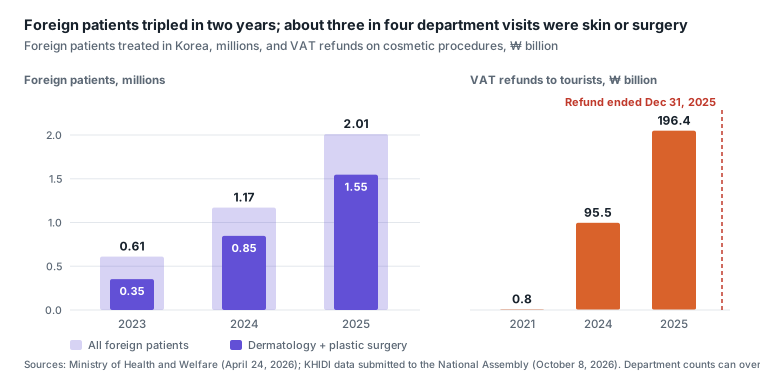
Foreign patient numbers more than tripled in two years, to 2.01 million in 2025. Dermatology alone counted 1.31 million patients. China and Japan supplied 60.6% of the total. Dermatology and plastic surgery made up 74% of visits by department.
The VAT refund for tourists’ cosmetic procedures, worth ₩196.4 billion in 2025, ended on December 31, 2025. Spending has not collapsed so far. An analysis of foreign-issued Hana Card payments by the Korea Health Industry Development Institute (KHIDI) shows spending at Korean medical businesses up 38.6% in the first half of 2026, to ₩1.42 trillion. A plastic surgeons’ association says patient numbers fell 20% to 30% after the refund ended. That is an interested party’s claim, and it has not published the data.
Market-size figures for this category are not reliable. One research firm puts Korea’s skin-booster market at $88 million in 2024. In 2025 PharmaResearch alone booked ₩314 billion of medical-device revenue, which includes Rejuran. Global estimates run from $1.27 billion to $1.53 billion, depending on the firm and the year. We use company revenue and government counts instead.
The market moved from one approved injectable to a crowded field, and the rules are catching up
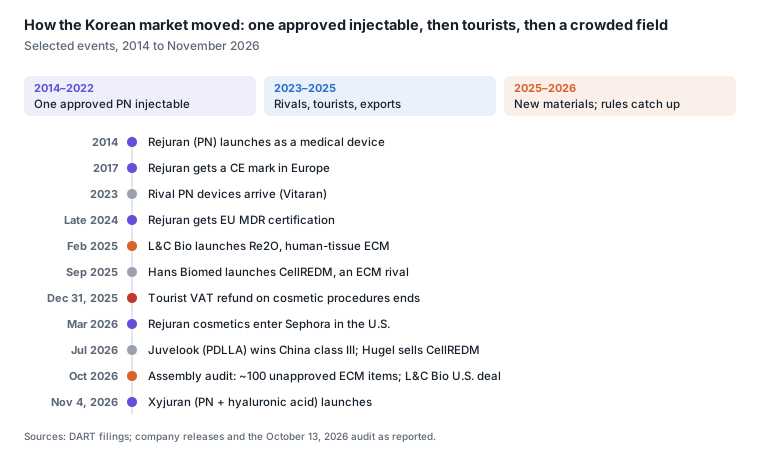
The first phase lasted almost a decade. Rejuran was the reference product, and PharmaResearch’s device line set the price.
The second phase brought rivals and tourists. Other PN devices arrived from 2023, such as BR Pharm’s Vitaran. PharmaResearch’s annual report now says that later entrants compete on price and distribution, and that toxin and filler companies are entering to round out their portfolios.
The third phase brought new materials. L&C Bio launched Re2O in February 2025. Hans Biomed launched a rival ECM product, CellREDM, in September 2025, and Hugel started selling it in July 2026. Vaim’s Juvelook, a PDLLA collagen stimulator, won class III approval in China in July 2026. PharmaResearch answered on November 4 with Xyjuran, a PN and hyaluronic-acid device approved for the temporary improvement of crow’s-feet lines.
The rules are now catching up with the human-tissue boom. At the October 13 audit, lawmakers said that about 100 ECM products from about 20 companies are sold without product approval, and that the tissue law has no advertising rules. The head of the Ministry of Food and Drug Safety (MFDS) acknowledged limits in the current system and said a policy study would finish this year. No reclassification has been decided. In the same session, 96.2% of Re2O use was put in clinic-level facilities.
Inside clinics, the field becomes more crowded and more varied. Outside clinics, brand value moves into cosmetics. In PharmaResearch’s numbers, the second direction is already larger than the first.
Products cross borders in the order regulators allow: cosmetics, then PN devices, then human tissue
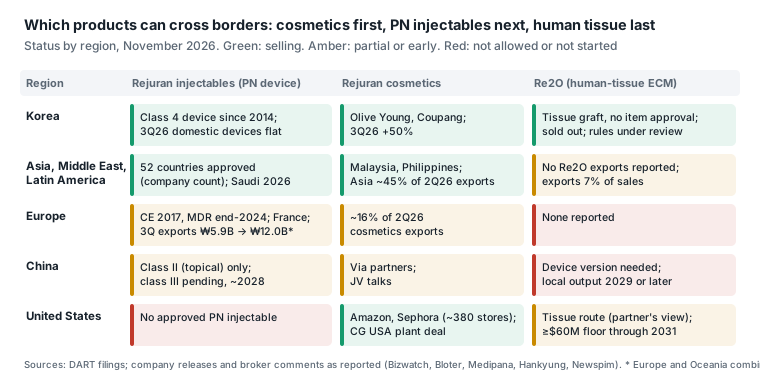
Cosmetics need the lightest approval in most markets. Rejuran cosmetics sell on Amazon and, since March 2026, in about 380 Sephora stores in the U.S. In the first half of 2026, exports made up 68.8% of PharmaResearch’s cosmetics revenue.
PN injectables count as medical devices abroad, and approval goes country by country. Rejuran holds approvals in 52 countries by the company’s count, including Saudi Arabia in February 2026. In Europe it received certification under the EU Medical Device Regulation at the end of 2024, according to press reports, and it sells in France through Vivacy. China and the U.S. remain closed to the injectable. China lists Rejuran only as a class II product for topical use. The injectable needs class III, which requires more clinical data and a factory inspection, and brokers expect approval around 2028.
Press reports say Rejuran’s China sales have fallen since the third quarter of 2025, after the topical product was used for injections there. In the U.S., we found no approved PN injectable.
Human tissue is the hardest to export. Each country has its own tissue rules. China has no separate tissue law and regulates tissue products as medical devices. L&C Bio entered China with MegaDerm Plus, a tissue-based device, which won import approval in January 2025 and went on sale in January 2026. The company’s own plan puts local production of Re2O in China in 2029 or later.
The U.S. path is different. On October 12, L&C Bio signed an exclusive supply deal with an unnamed U.S. partner that owns a tissue bank. The partner judges that Re2O can be sold under the FDA rules for minimally manipulated human tissue, known as 361 HCT/P. That is the partner’s view. We found no FDA statement on the product.
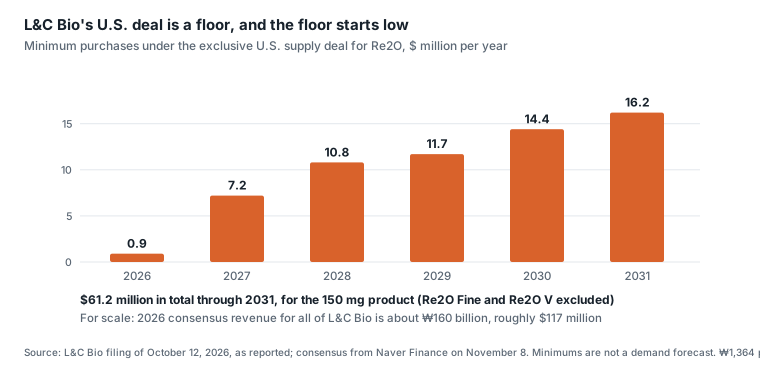
The deal sets minimum purchases of at least $60 million through 2031 for the 150 mg Re2O product; Re2O Fine and Re2O V fall outside the floor. The floor starts at $0.9 million in 2026 and $7.2 million in 2027. The 2027 minimum is about ₩10 billion, or about 6% of L&C Bio’s 2026 consensus revenue. The deal shows that a route exists. It does not yet show demand.
We also share new analyses on Telegram as they are published. You are welcome to join us at @korea_invest_insights.
PharmaResearch: exports and cosmetics carry the growth while the home device line has stalled
PharmaResearch builds its devices, cosmetics and drugs on the same salmon-DNA platform. Rejuran injectables and the knee injection Conjuran are medical devices. Rejuran-branded skincare is cosmetics. PDRN injections are drugs. The company has also sold its own botulinum toxin, Rientox, in Korea since April 2025.
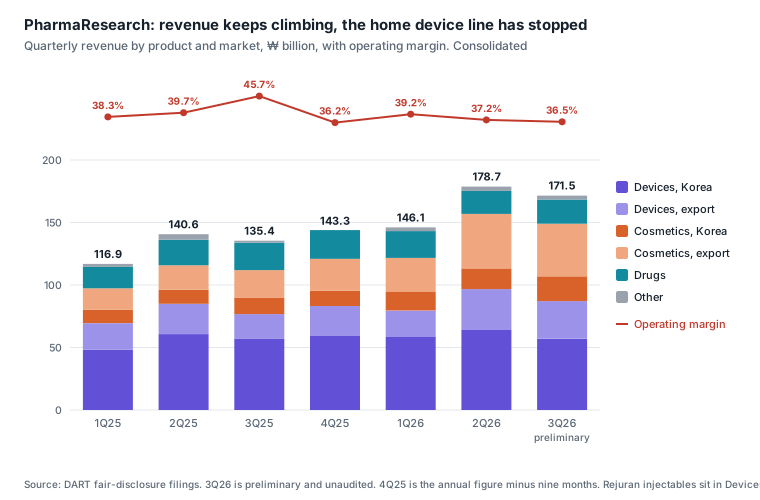
Revenue reached ₩536.3 billion in 2025, with an operating margin of 40.0%. In the first nine months of 2026, revenue grew 26.3% to ₩496.3 billion, and the margin was 37.6%. The mix changed. Exports rose from 36.9% of revenue in 2024 to 38.6% in 2025 and 47.6% in the third quarter of 2026.
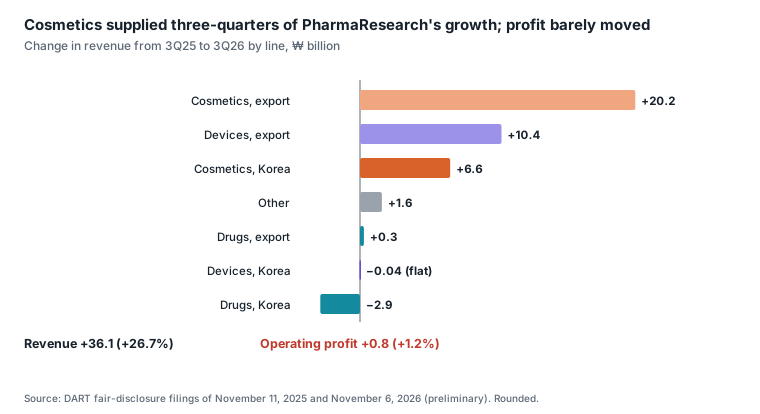
The third quarter shows the shift. Revenue rose ₩36.1 billion from a year earlier. Cosmetics supplied ₩26.8 billion of that: ₩20.2 billion from exports, up 92%, and ₩6.6 billion from Korea, up 50%. Device exports added ₩10.4 billion, up 53%. Domestic medical-device sales, which include Rejuran, the Conjuran knee injection and fillers, were ₩57.1 billion. That is the same as a year earlier and 11.4% less than in the second quarter.
Operating profit rose only ₩0.8 billion, because costs rose by almost as much as revenue. Net profit fell 40.5% to ₩30.2 billion because of an ₩18.5 billion non-operating loss. The preliminary filing does not give the cause. The quarterly report is due by November 14.
Why did the home device line stall? The filings do not say, but the facts around it narrow the answer. The main device line ran at 102.8% of rated capacity in the first half of 2026, so supply is tight, and the company plans to add capacity through 2028. Competing boosters, especially human-tissue ECM, grew fast in the same clinics. And device exports grew 53% in the same quarter, so demand for the product itself has not weakened. Our reading is that competition and capacity now cap the domestic line, and that PharmaResearch is putting its growth into exports and cosmetics. That is an inference.
The cosmetics business is becoming a global brand. In the second quarter, sales in the Americas reached ₩16.6 billion, up 204%, according to brokers cited by Hankyung. On June 30, PharmaResearch signed a deal to buy CG USA, a California cosmetics maker. A press report says Rejuran cosmetics entered Sephora’s Canadian stores in September. Cosmetics need marketing spend and carry lower margins than injectables. That is one reason the operating margin fell to 36.5% from an unusually high 45.7% a year earlier.
In May we set proof points for this company: second-quarter cosmetics exports above ₩30 billion, re-orders in U.S. channels, and an operating margin above 38%. Cosmetics exports came in at ₩43.6 billion. U.S. sales kept growing, but re-order data is not public. The margin was 37.2% in the second quarter and 36.5% in the third. Of the measurable tests, one passed and one missed, and the share price fell from ₩295,000 then to ₩236,000 now.
What decides PharmaResearch from here is whether cosmetics and device exports keep growing faster than the domestic device line weakens, without a further large drop in margin. The upward trigger is Chinese class III approval for the Rejuran injectable, which brokers expect around 2028. The downward trigger we watch is an operating margin below about 35% while cosmetics growth slows.
At ₩236,000 on November 6, PharmaResearch is worth ₩2.45 trillion, about $1.80 billion. That is 9.5 times 2026 consensus operating profit of ₩259 billion and 14.7 times trailing net profit. The company held ₩596 billion of cash and short-term financial assets on June 30. Its value-up plan of March 2026 commits to a dividend payout of at least 25%.
L&C Bio: Korea’s fastest-growing booster has the hardest passport
L&C Bio began as a human-tissue company. Its base product is MegaDerm, an acellular dermal matrix used in breast reconstruction and other surgery. Re2O applies the same processed human skin to aesthetics, as a powder injected under the skin. The company says Re2O replaces extracellular matrix lost to aging or damage, so that the skin’s structure recovers and new collagen forms.
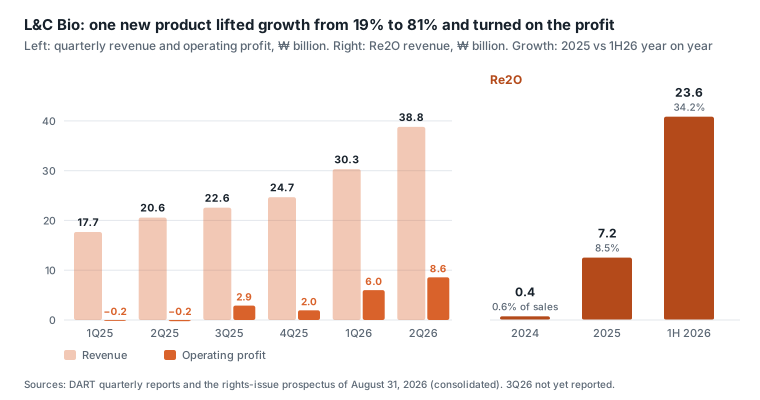
Re2O changed the company. Its sales rose from ₩0.4 billion in 2024 to ₩7.2 billion in 2025 and ₩23.6 billion in the first half of 2026. Consolidated revenue grew 81% in the first half, and the operating margin reached 21.1%. MegaDerm still grew, to ₩45.0 billion in 2025 and ₩23.7 billion in the first half of 2026. The company names Rejuran and Juvelook as Re2O’s competitors.
Supply sets the limit. The powder line ran at 91.9% of capacity in the first half. A dedicated line started in May 2026. A third plant was scheduled to start in October and a fourth in December; we have not confirmed that the third is running. The raw material is donated human tissue. Most of it is imported from two U.S. tissue banks, which supplied 78.5% and 21.5% of 2025 imports, and one overseas bank has an exclusive import contract with L&C Bio. Growth therefore depends on donor supply as well as on plant capacity.
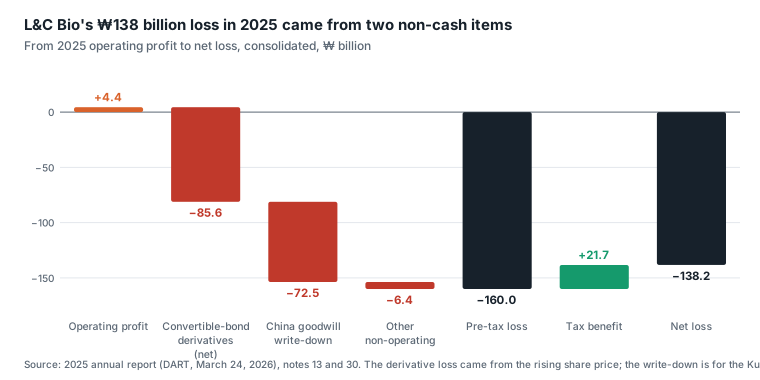
The losses need a careful reading. L&C Bio reported a net loss of ₩138.2 billion in 2025 with an operating profit of ₩4.4 billion. Its rising share price raised the fair value of the conversion and redemption rights in its ₩60 billion convertible bond, which produced a net derivative loss of ₩85.6 billion. The company also wrote down ₩72.5 billion of goodwill on its Chinese unit in Kunshan. Neither item used cash. In 2024 the reverse happened: buying out the Chinese joint venture created a ₩147.9 billion remeasurement gain. The company’s own prospectus says another goodwill impairment at the end of 2026 is likely, because Kunshan sold only ₩1.6 billion in the first half of 2026.
The share count just changed. In October, L&C Bio raised ₩144.7 billion by selling 3.7 million new shares at ₩39,100 to existing shareholders, and the offer was 103.9% subscribed. Most of the money, ₩105 billion, goes to a new manufacturing center in Dongtan due in late 2029. It also issued one bonus share for each share held. Those 30.4 million bonus shares list on November 12, which doubles the share count to 61.1 million.
At ₩23,950, the full share count is worth about ₩1.46 trillion, about $1.07 billion. Some data services still show about ₩0.73 trillion, because they do not yet count the unlisted bonus shares. On the full count, L&C Bio trades at 39.6 times 2026 consensus operating profit of ₩37 billion.
What decides L&C Bio is the regulator first and capacity second. If the MFDS study keeps human-tissue boosters under the tissue law with clearer standards, incumbents with tissue-bank licenses and supply contracts gain a moat. If it pushes them toward device-style approval, launches slow for everyone, including new versions such as Re2O V. The upward trigger is U.S. orders well above the floor in 2027. The downward trigger is a rule that requires product approval, or a slowdown in Re2O sales after the third and fourth plants start.
Side by side, the market pays for the home boom more than for the passport
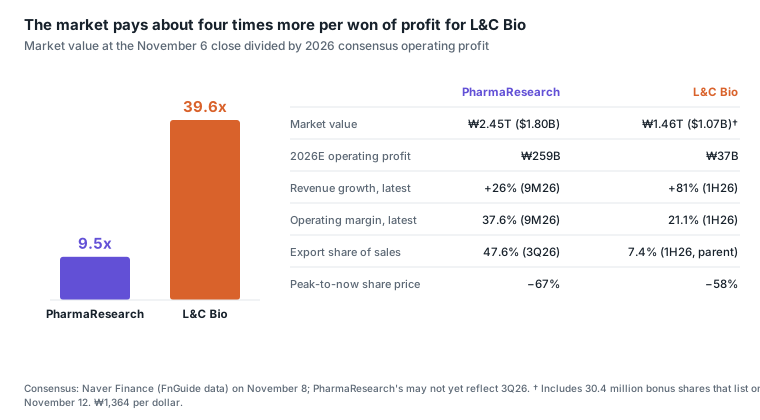
The two companies sit at opposite ends of the portability question.
| PharmaResearch (Rejuran) | L&C Bio (Re2O) | |
|---|---|---|
| Core material | PN from salmon DNA | Donated human skin with the cells removed (ECM) |
| Legal route in Korea | Class 4 medical device | Human tissue graft, no product approval |
| Latest growth | Revenue +26.7%, operating profit +1.2% (3Q26) | Revenue +80.6%, operating margin 21.1% (1H26) |
| Where growth comes from | Cosmetics and device exports | Re2O in Korean clinics |
| Supply limit | Main device line at 102.8% (1H26) | Powder line at 91.9% (1H26); donor tissue |
| Abroad | 52 countries; EU yes; China class II only; U.S. cosmetics only | U.S. via a tissue route, floor of $60M through 2031; China needs a device version |
| What decides the next year | Margin while cosmetics scale | MFDS review and plant ramp-up |
Korea’s lead should last, because the loop of approvals, clinics, tourists and retail is hard to copy. But the money is moving to what travels. PharmaResearch already earns almost half its revenue abroad and trades at 9.5 times operating profit after a 67% fall. The market treats it as a mature franchise with a stalled home line. L&C Bio has the strongest product momentum in Korea and the weakest passport, and it trades at 39.6 times.
If the regulator tightens the human-tissue route, that gap is wider than the difference in growth can justify. We would be wrong on L&C Bio if U.S. demand runs well above the contract floor in 2027 and the regulator leaves Re2O’s status unchanged.
What to check next
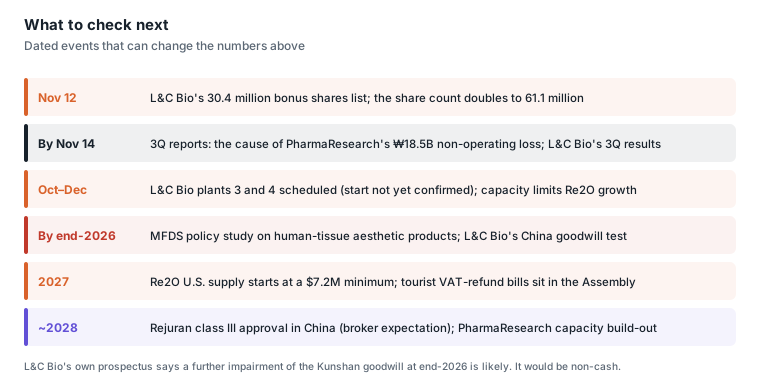
The third-quarter reports can change the profit picture within a week. The MFDS study can change the valuation picture within two months.
Data notes
- PharmaResearch’s third-quarter figures are preliminary and unaudited (DART fair disclosure, November 6). L&C Bio has not reported its third quarter.
- PharmaResearch’s product and domestic/export splits come from its DART fair-disclosure filings. The fourth quarter of 2025 is the annual figure minus nine months. The company does not disclose sales by country. The regional shares of cosmetics exports and the Americas figure come from press reports that cite the company or brokers.
- Rejuran’s 52 countries is the company’s count. The CE mark (2017) and MDR certification (end-2024) come from press reports. We found no Chinese class III, FDA or Brazilian approval for the injectable. The FDA status of PN injectables comes from secondary reviews; we did not search FDA databases directly.
- L&C Bio’s market value uses 61,107,168 shares after the bonus issue, including treasury shares. Naver Finance shows ₩734.5 billion on the pre-bonus count of 30.67 million shares.
- Consensus figures come from Naver Finance (FnGuide data) as of November 8. PharmaResearch’s 2026 consensus may not yet reflect the third quarter.
- Re2O revenue comes from L&C Bio’s August 31 prospectus. Quarterly Re2O sales are not disclosed. The prospectus dates the launch to February 2025 but also shows ₩0.4 billion of sales in 2024.
- The October 13 audit figures (about 100 products, about 20 companies, 96.2% clinic use) come from press reports of the audit.
- Clinic prices come from clinic marketing pages and vary widely.
- The Canadian Sephora entry and the U.S. contract terms come from single press reports of company statements and filings.
- Share prices are KRX regular-session closes on November 6. L&C Bio’s chart is adjusted for its rights and bonus issues. We use ₩1,364 per dollar.
- Market-size estimates from Grand View Research, Mordor Intelligence and Research and Markets are summaries of paid reports. We did not base any conclusion on them.
Sources:
- PharmaResearch 3Q26 preliminary results, DART, November 6
- PharmaResearch 2025 annual report, DART
- PharmaResearch 1H26 report, DART
- PharmaResearch value-up plan, DART
- L&C Bio 2025 annual report, DART
- L&C Bio 1H26 report, DART
- L&C Bio rights-issue prospectus, DART, August 31
- L&C Bio rights and bonus issue decision, DART
- L&C Bio subscription result, DART
- Ministry of Health and Welfare, foreign patients in 2025
- Asia Economy on KHIDI audit data, October 8
- Hankyung on the end of the VAT refund
- Hankyung on the VAT refund bills
- Getnews on foreign patients’ card spending
- Bizwatch on the October 13 audit
- Daily Pharm on the October 13 audit
- Medipana on Rejuran in China
- Bloter on PharmaResearch 3Q26
- SEN TV on PharmaResearch 3Q26
- SEN TV on Xyjuran
- Bizwatch on PharmaResearch 2Q26 and approvals
- Hankyung on PharmaResearch 2Q26
- Daily Pharm on the CG USA deal
- Newspim on L&C Bio’s U.S. supply deal
- Newspim on Re2O capacity and the rights issue
- Rapportian on Juvelook in China
- Hankyung on Hugel and CellREDM
- Bizwatch on the ECM market
Two questions for the comments.
1. If you had a skin-booster treatment in Korea, which product did you choose, and did you buy the brand’s skincare after you went home?
2. Would you accept an injection made from donated human skin? A. Yes. B. Only if my own country approves it as a medical device. C. No.
This is for research and information only, not investment advice. Estimates, multiples and triggers are analytical assumptions, not trading instructions or individual portfolio decisions. Figures are dated data. We used Anthropic’s Claude to help collect sources and edit this post, and Anthropic is not directly related to its subject.