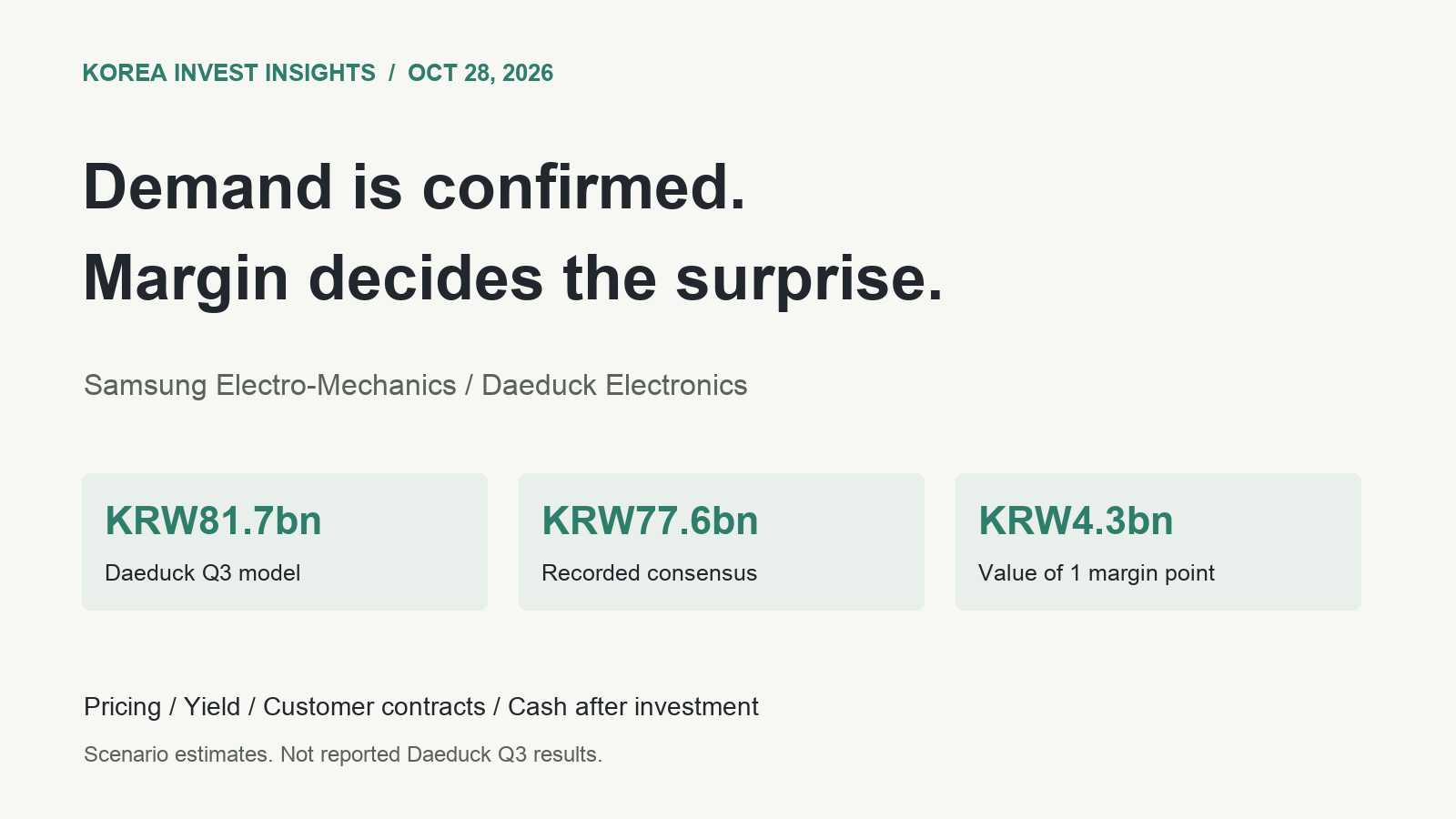
One percentage point of operating margin is worth about KRW4.3 billion in our Daeduck Electronics Q3 model. The model’s entire profit advantage over the latest recorded consensus is only KRW4.1 billion.
That is the investment question after Samsung Electro-Mechanics reported strong AI-component results on October 28. Better substrate demand supports Daeduck’s outlook. A small difference in pricing, yield, product mix or currency can still absorb the apparent earnings beat.
Our sector assessment is positive. Our short-term interpretation is more selective: Daeduck operating profit around KRW80–85 billion would confirm a good quarter, but recent broker forecasts already cluster near the low KRW80 billions. The stronger catalyst would be evidence that Q4 pricing and future customer contracts justify another earnings upgrade.
This article is dated October 28, 2026, after the Korean regular-session close. Samsung Electro-Mechanics’ Q3 figures are preliminary actual results. Daeduck’s Q3 figures below are forecasts; its results are scheduled for October 30. Prices use the KRX regular-session close, not NXT evening trading. Consensus figures retain their stated capture times.
Samsung Electro-Mechanics showed that the mix is changing
Samsung Electro-Mechanics (SEMCO, 009150) reported Q3 revenue of KRW3.763 trillion and operating profit of KRW690.957 billion. Revenue rose 8.9% sequentially while operating profit rose 56.9%. Consolidated operating margin improved from about 12.7% to 18.4%. Official Q3 IR, preliminary filing.
The divisional revenue figures show why the result is more informative than a generic smartphone-season recovery.
| Q3 2026, KRW billions | Revenue | Sequential growth | Main disclosed drivers |
|---|---|---|---|
| Component Solutions | 1,883.0 | +14% | AI-server, network and power-related MLCC demand |
| Package Solutions | 939.0 | +22% | Server CPU, AI accelerator, network and automotive substrates |
| Optical Solutions | 941.3 | -9% | Automotive expansion, offset by sequential camera weakness |
Source: SEMCO Q3 presentation, business divisions. Division figures are rounded. Package revenue also rose 58% year on year.
Optical revenue declined sequentially while the group’s margin improved sharply. The evidence supports a richer AI-component mix. It does not disclose how much profit came from package substrates: SEMCO did not provide a standalone FC-BGA margin, ASP or utilization rate in these slides.
For Q4, the company described additional AI data-center customer demand and plans to respond through new products and capacity. That is useful industry evidence for Daeduck. It is not an order placed with Daeduck. Official results announcement.
A 4.1% beat and a 7.1% beat can describe the same result
The apparent disagreement comes from the denominator, not the reported profit.
| SEMCO operating-profit comparison | Forecast, KRW bn | Actual, KRW bn | Beat |
|---|---|---|---|
| Infomax pre-results survey, as reported | About 663.6 | 690.957 | About 4.1% |
| Naver snapshot saved on October 27 | 645.3 | 690.957 | 7.08% |
The Infomax report describes ten firms’ estimates from the preceding month. The saved Naver value is a different provider snapshot. The analyst populations and cut-off dates need not match. Averaging the two would not create a better consensus. Nor should a post-results estimate be substituted into a pre-results surprise calculation. Infomax report, Naver quarterly data.
For the investment argument, both comparisons point in the same direction: profit exceeded expectations, but the magnitude depends on which expectation set the investor uses.
Daeduck is a different exposure to the substrate cycle
Daeduck (353200) reported Q2 revenue of KRW401.0 billion and operating profit of KRW70.3 billion. Its sales mix was 43% FCCSP, 20% CSP, 23% FC-BGA and 14% multilayer boards, or MLB. FCCSP and CSP serve both memory and non-memory applications; the two percentages cannot simply be labeled “memory exposure.” Daeduck Q2 IR, pp.3 and 8.
Three distinctions matter.
- Industry demand transfers; company economics do not. SEMCO’s package growth supports the direction of high-end substrate demand. Daeduck’s own customer approvals, yields, capacity, pricing and currency exposure determine its profit.
- MLCC is not a Daeduck earnings driver. SEMCO’s reported demand outlook for a specific 1005-size, 47μF capacitor cannot be applied to the whole MLCC market, much less Daeduck’s substrates. The reported “about eightfold” demand outlook also follows an earlier “more than sevenfold” statement; it is not a clean new eightfold group-growth forecast. Current call reporting, prior call transcript report.
- A peer’s contract is not Daeduck’s contract. SEMCO’s October 19 disclosure covers KRW360.49 billion of package-substrate supply during 2027, with no contract deposit or advance payment. The public filing does not identify FC-BGA versus BT, or the customer by name. It cannot establish that Daeduck has secured a funded long-term agreement. Supply-contract filing.
The distinction is especially useful now: the sector can have a strong demand outlook while individual suppliers capture very different margins and face different funding needs.
Around KRW82 billion is already in the discussion
Daeduck’s recorded October 28 portal consensus was revenue of KRW418.5 billion and operating profit of KRW77.6 billion. The local provider record was captured at 16:35 KST; we do not present it as a later evening update.
Recent broker reports on the company’s IR site were already above that aggregate.
| Source and date | Q3 revenue, KRW bn | Q3 operating profit, KRW bn | Q4 operating profit, KRW bn |
|---|---|---|---|
| Naver aggregate, October 28 snapshot | 418.5 | 77.6 | Not used here |
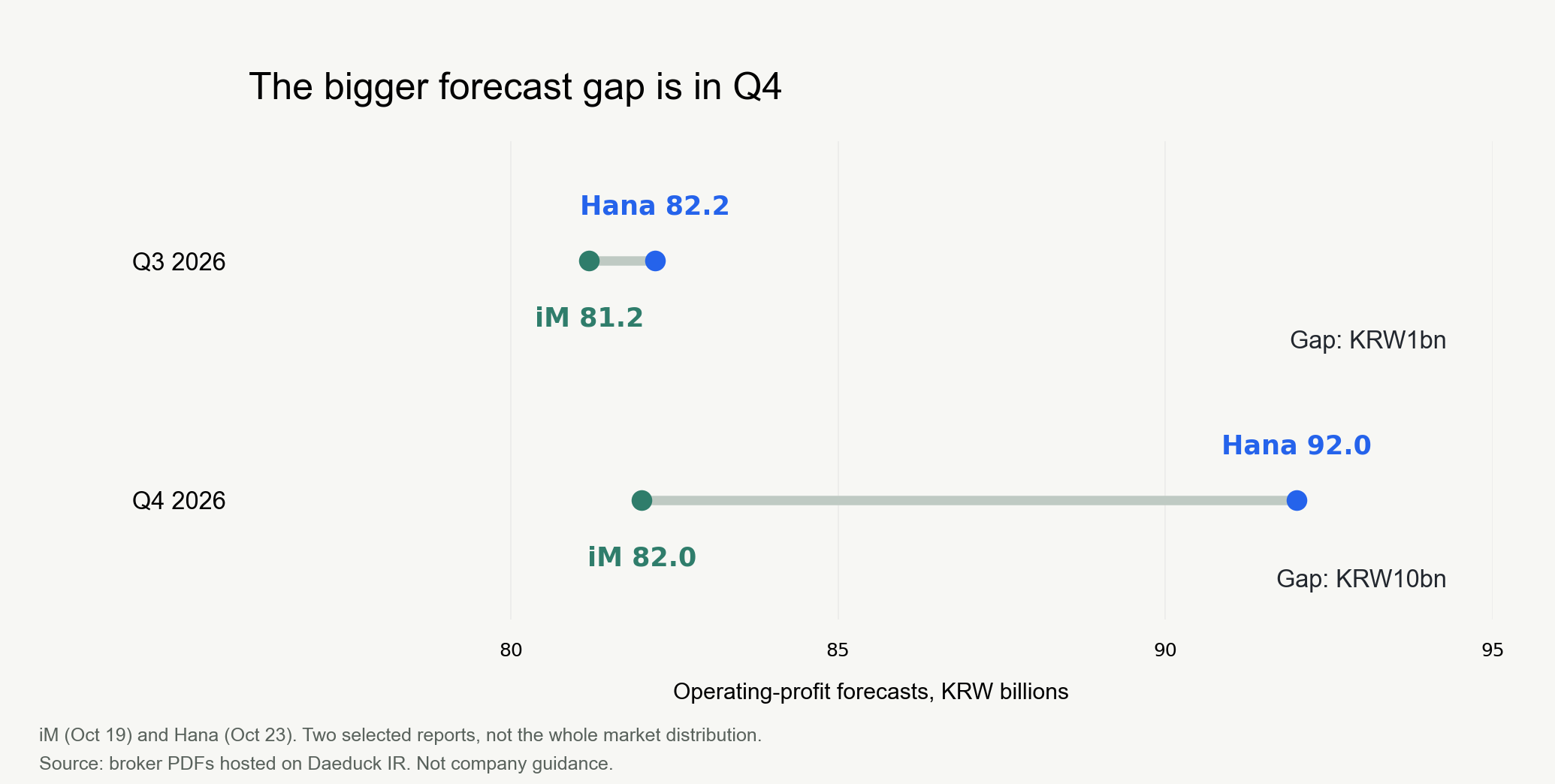
| iM, October 19 | 433.0 | 81.2 | About 82.0 |
| Hana, October 23 | 432.1 | 82.2 | 92.0 |
| Mirae Asset, October 19, separate reference | 419.0 | 80.4 | 90.5 |
| Our scenario, not company guidance | 430.2 | 81.7 | No numerical forecast |
Sources: Naver quarterly consensus, iM report, Hana report, Mirae Asset report. These are selected reports, not the distribution of every investor’s expectations. Mirae’s report carries a separate-financial-statement footnote, so we keep it separate and do not pool the figures into a new consensus.
We use iM’s PDF value of KRW81.2 billion rather than a rounded web summary. Hana’s KRW82.2 billion profit divided by KRW432.1 billion revenue implies about 19.0% margin, consistent with its table; the report’s prose says 19.3%. The arithmetic takes precedence.
The sharper disagreement is in Q4, where iM and Hana differ by about KRW10 billion. Their Q3 profit forecasts differ by only KRW1 billion. That gap makes the timing and quality of the next price increase more interesting than a headline Q3 result near KRW82 billion.
One margin point can erase the modeled beat
Our starting point is Daeduck’s official Q2 revenue: KRW343.5 billion of package substrates and KRW57.5 billion of MLB. We apply separate growth assumptions rather than copy SEMCO’s 22% package growth.
| Scenario | Package growth QoQ | MLB growth QoQ | Group margin | Revenue, KRW bn | Operating profit, KRW bn |
|---|---|---|---|---|---|
| Downside | +2% | +5% | 17.5% | 410.7 | 71.9 |
| Base | +6% | +15% | 19.0% | 430.2 | 81.7 |
| Upside | +8% | +20% | 20.0% | 440.0 | 88.0 |
The base calculation is 343.5 × 1.06 + 57.5 × 1.15 = KRW430.235bn, followed by 430.235 × 19% = KRW81.74465bn. Rounded to the nearest KRW1 billion, that is revenue of about KRW430 billion and profit of about KRW82 billion.
We use KRW80–85 billion as a practical central profit range. It is about 3.1–9.5% above the KRW77.6 billion consensus. It is not a statistical confidence interval; the downside and upside scenarios lie outside it.
At base revenue, one percentage point of operating margin changes profit by KRW4.302 billion. The base profit exceeds consensus by KRW4.145 billion. A margin near 18.04%, rather than 19%, would bring the same revenue model back to consensus.
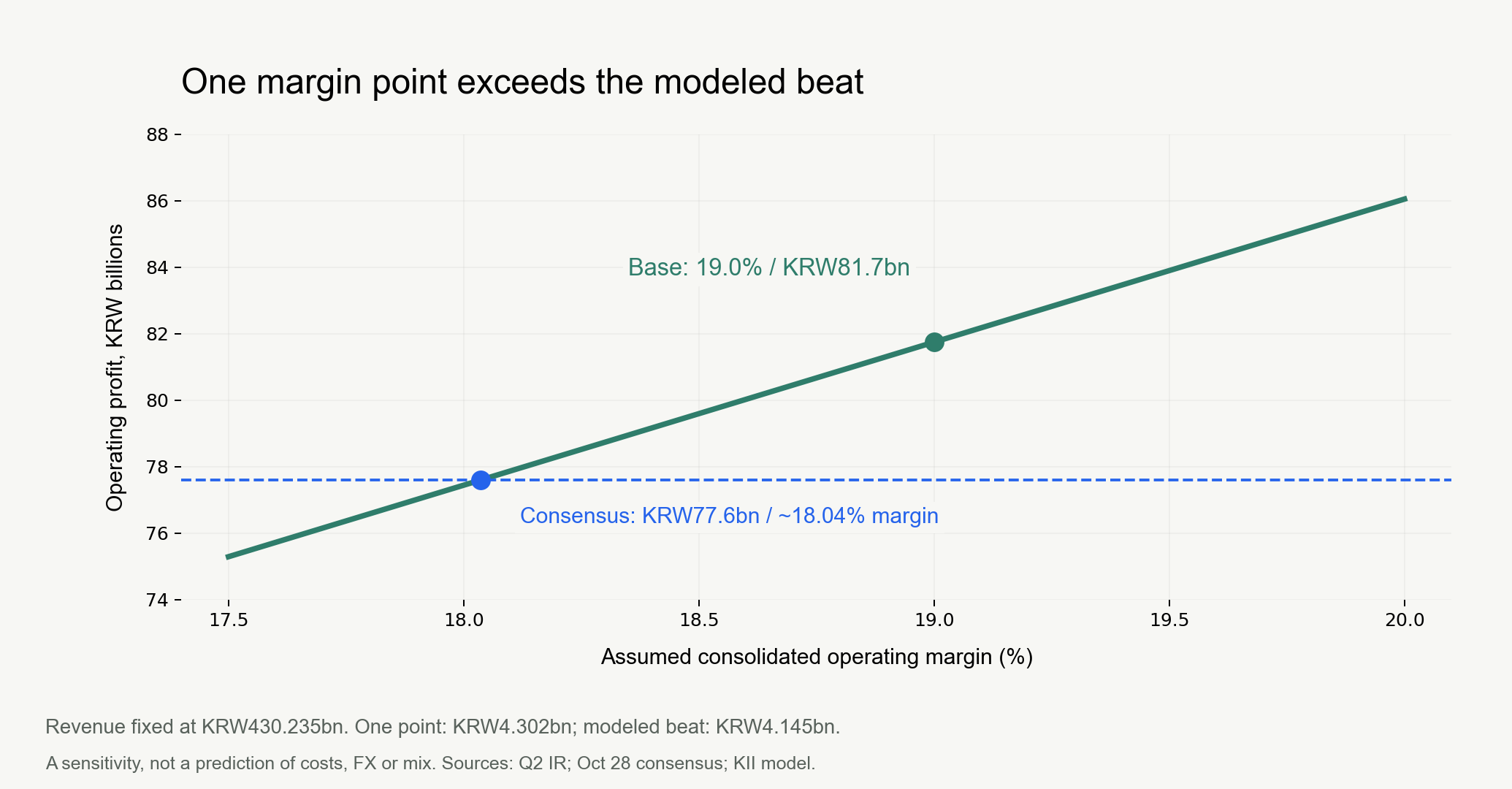
This does not predict a margin miss. It shows why reported demand strength alone is insufficient. Product yield, higher-value shipments, price realization and exchange rates can determine whether the small modeled beat exists at all.
The price increase must exceed the cost increase
An increase that merely passes through raw-material inflation protects economics. An increase driven by scarce capacity can expand the amount retained by the supplier. Investors need to establish which mechanism is operating.
iM’s October 19 report distinguishes the earlier raw-material pass-through from the proposed later price adjustment tied to tighter supply. Its illustrative calculation assumes 2027 memory-substrate sales of KRW706 billion, a 10% price increase and a 35% contribution margin, producing about KRW24.7 billion of additional annual operating profit. Those are broker assumptions, not a signed price agreement or our forecast. iM report, p.1.
The application date matters as much as the quoted percentage. A negotiated increase affects profit only when qualifying products ship at the new terms. Mix changes, customer concessions and material costs can offset part of the headline increase.
The other lever is manufacturing execution. Broker reports describe improving yields on large FC-BGA products and MLB capacity ramping. Those assessments need confirmation in company disclosures and subsequent financial results. A broker’s reported yield should not become a company-issued fact without attribution.
Higher cash is not all free cash
SEMCO’s Q3 presentation reports KRW1.1452 trillion of quarterly operating cash flow and KRW862.7 billion of property, plant, equipment and intangible additions. Subtracting the latter leaves a simple residual of KRW282.5 billion. This is our calculation, not an official company-defined FCF metric.
The company’s cash balance rose by KRW799.3 billion, but financing activities also supplied KRW551.1 billion; the borrowing-flow line was positive KRW589.1 billion. The cash increase cannot all be described as operating generation. These are Q3 standalone cash flows, not nine-month cumulative figures. Official IR cash-flow slide.
For Daeduck, the October 22 facility-investment decision is KRW615 billion, scheduled through December 31, 2030. The filing cites internal funds and external borrowing among funding sources. It is a multi-year investment plan, not a single-quarter cash payment, and a decision made in October cannot be the direct cause of July–September earnings. Investment filing.
The investment case needs the sequence: customer commitments, capacity commissioning, acceptable yields, shipments, collections, then returns on the capital spent. New capacity can improve growth and simultaneously make cash-flow verification more important.
Today’s prices already assume substantial improvement
At the October 28 regular-session close, Daeduck was KRW138,000, up 8.07%, and SEMCO was KRW1,306,000, up 8.74%. Daeduck was 15.29% above its October 26 close of KRW119,700. KOSPI also rose sharply, closing at 6,012.44, up 6.63%. None of these gains is a clean estimate of the effect of SEMCO’s announcement alone. Daeduck closing data, SEMCO closing data, market-close report.
The following gives a common-date valuation reference, not an apples-to-apples fair-value ranking.
| Company | October 28 KRX close | Recorded FY2027 consensus EPS | Price / forecast EPS |
|---|---|---|---|
| Samsung Electro-Mechanics | KRW1,306,000 | KRW41,821 | 31.2× |
| Daeduck Electronics | KRW138,000 | KRW6,613 | 20.9× |
EPS source: Naver/WiseReport snapshot captured at 16:38 KST on October 28, SEMCO and Daeduck. Analyst counts and detailed EPS accounting-scope flags were not preserved in this snapshot. The estimates are neither reported earnings nor guaranteed outcomes.
SEMCO offers exposure to both MLCC and package substrates, with actual Q3 earnings evidence. Daeduck is more concentrated in substrates and boards, but its next earnings release and new-capacity economics still have to be tested. The lower forecast multiple alone does not establish that Daeduck is the better investment.
If 2027 EPS were 20% below those estimates with prices unchanged, the respective multiples would rise to about 39.0× and 26.1×. That is a sensitivity, not a forecast. The price paid for future improvement matters alongside the industry story.
How to read Daeduck’s October 30 release
The following are conditional interpretations, not probabilities or price targets. The chart references originated in the October 28 intraday analysis; the KRW138,000 close remained inside its KRW132,000–141,000 observation zone. We do not reuse the intraday moving-average value as a confirmed closing average.
| Result and outlook | Investment interpretation | Dated price reference |
|---|---|---|
| Profit clearly above KRW85bn, with concrete Q4 pricing or customer-contract improvement | Supports another estimate upgrade; quality and recurring contribution still matter | Sustained trading above KRW141,000 would strengthen the case for retesting KRW145,000–150,000 |
| Profit around KRW80–85bn, positive direction but little new information | Good earnings can coexist with profit-taking after expectations rose | Observe KRW132,000–141,000 rather than assume an automatic breakout |
| Profit below KRW80bn or a weak Q4 explanation | Could disappoint the recently upgraded broker expectations even near portal consensus | Failure around KRW132,000–134,600 would put the earlier KRW127,500 area back in view |
These levels must be reconsidered if the market or pre-release price changes materially. A one-off profit gain without better pricing, utilization or cash collection would not carry the same meaning as recurring improvement.
The company scheduled preliminary consolidated results for October 30, followed by an investor roadshow on November 4–6. Missing contract detail on the first date should remain an open question, not automatically become a failure. Results notice, IR notice.
For sector context, Samsung Electronics’ detailed earnings call is scheduled for October 29 at 10 a.m. KST. Its October 8 preliminary release is a separate event. Tomorrow’s memory and downstream-business details may inform the substrate backdrop, but they cannot establish Daeduck’s own shipments or margins. Samsung Electronics calendar.
Our investment judgment
We are constructive on the substrate cycle and selective on individual suppliers. SEMCO has delivered a strong group result and a clear package-demand signal. Daeduck’s central Q3 earnings case is also constructive, but it is close to estimates already published before SEMCO’s release.
The evidence that would justify greater confidence is now specific: price increases that improve margin after material costs, stable yields as higher-value capacity ramps, and customer contracts that clarify who funds the expansion and when cash is collected. Until those details improve, a result near KRW82 billion is primarily confirmation of the current case.
Which would change your view most on October 30: a larger Q3 profit beat, evidence of Q4 pricing beyond cost pass-through, or a signed customer agreement that supports expansion funding? Pick one and explain what would count as convincing evidence.
Research and information only; not investment advice. Forecasts and price scenarios are analytical assumptions, not company guidance, trade instructions or personalized portfolio decisions. Figures are date-bound. AI tools assisted research and editing.