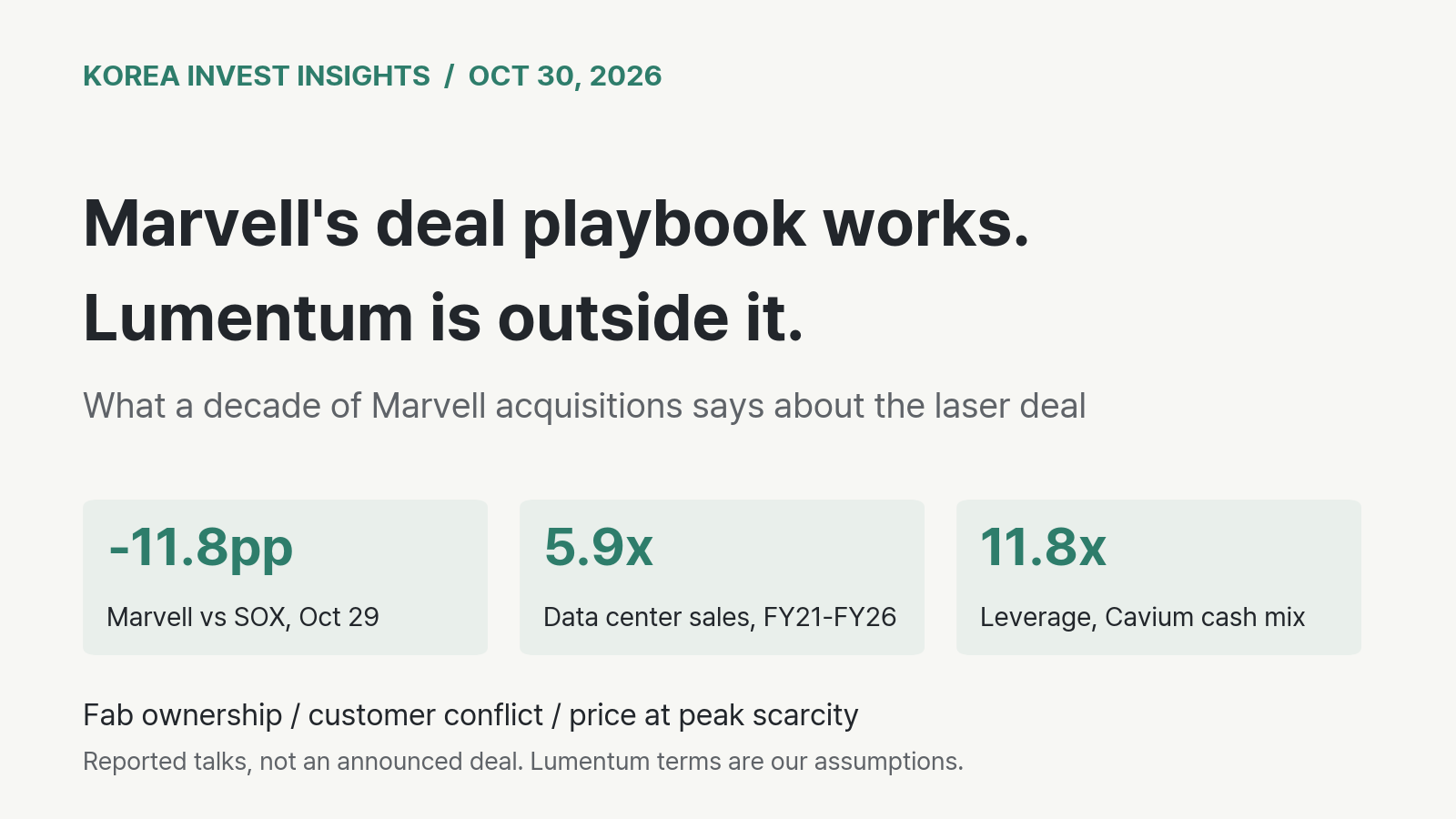
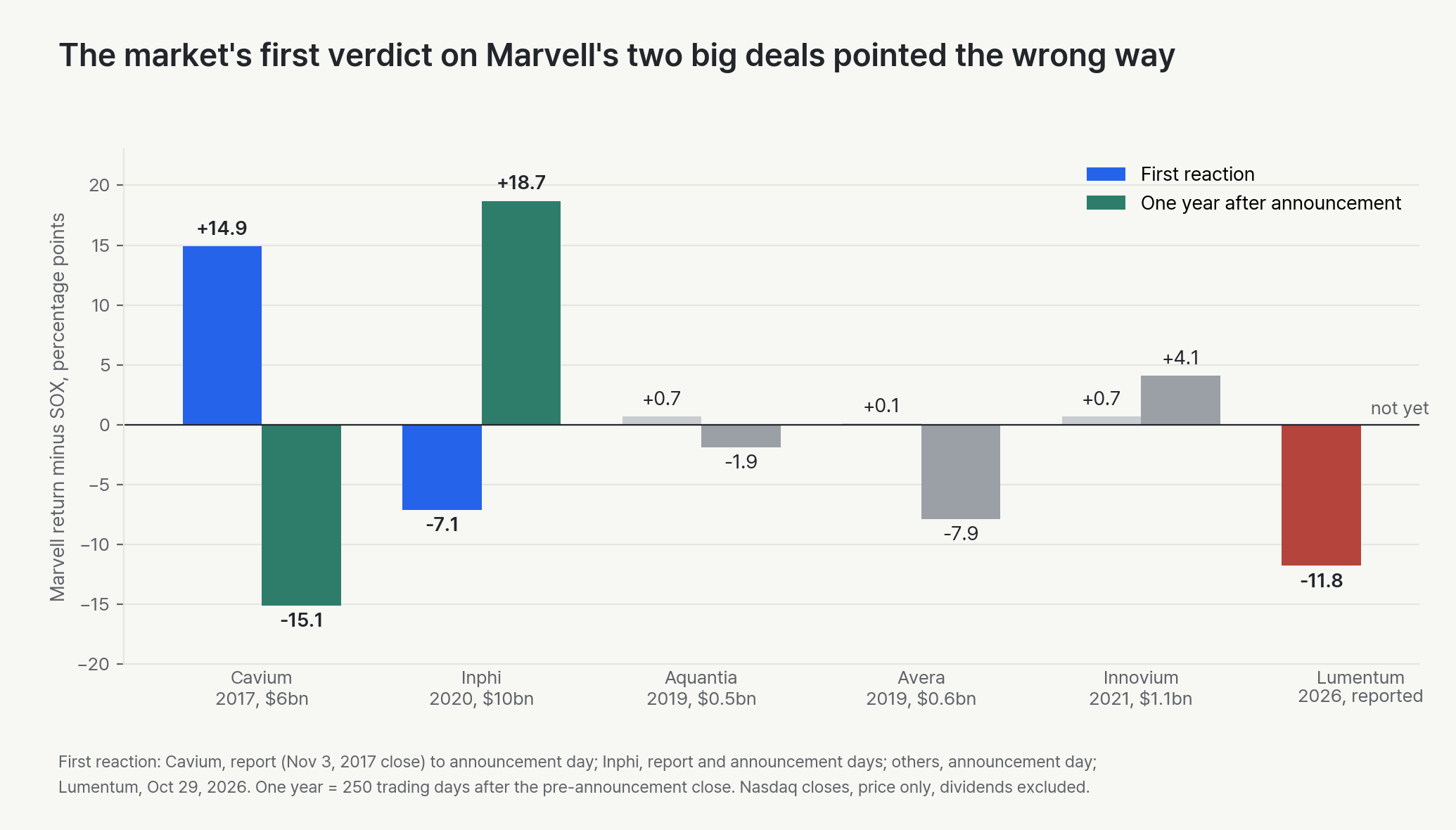
On Thursday, October 29, Marvell Technology closed at $218.34, down 13.2%. The Philadelphia semiconductor index (SOX) fell 1.4%. The 11.8-point gap is the clearest measure of the market’s verdict on Bloomberg’s report that Marvell is in advanced talks to buy Lumentum, the laser and optics maker. No price or payment mix has been reported. Not all of the gap is about the deal: Alphabet fell 12.6% the same day after its results, and Marvell designs custom chips for Google. But Broadcom, Google’s larger chip partner, fell only 1.9%. By our measure, it is the worst first reaction to any Marvell acquisition in Matt Murphy’s ten years as chief executive.
History says not to trust that verdict too quickly. In 2017 the market cheered the Cavium deal. From the first press report to the announcement day, Marvell beat the SOX by 14.9 points. One year later it trailed the index by 15.1 points. In 2020 the market disliked the Inphi deal. Over the report and announcement days, Marvell lagged by 7.1 points. One year later it led by 18.7 points. Both times, the first reaction and the one-year result pointed in opposite directions.
Our judgment: Marvell’s acquisition skill is real, but it was proven in a narrow zone, and Lumentum sits outside that zone. Marvell knows how to buy fabless technology, take out cost, sell non-core units at high multiples and keep its investment-grade rating. That skill turned Avera and Inphi into the seeds of a data center business that grew from $1.04 billion to $6.10 billion in five fiscal years. Lumentum is a different kind of target. It runs its own laser wafer fabs. It is a customer of Marvell’s optical signal processors. And Marvell would buy it at what may be the peak of a laser shortage. The track record lowers the integration risk. It does not lower the price risk. In our view, the variable that dominates is whether lasers stay scarce after 2028.
This article is dated October 30, 2026, Korea time. The deal is reported, not announced. As of this morning, neither company has filed an 8-K about it on SEC EDGAR, and neither has confirmed the talks. Prices are Nasdaq closes for October 29. Every Lumentum deal number below is our scenario. Our first take on the reported talks covers the laser logic and the dilution math.
What to take away
- Thursday was the largest negative first reaction in Marvell’s deal history. Against the SOX, Marvell lost about $25 billion of value that the index does not explain, though part of it may be Alphabet’s results. Lumentum gained only about $2 billion. In an all-stock deal with a fixed exchange ratio, every dollar Marvell loses also comes out of the price Lumentum holders would receive.
- Two deals built Marvell’s AI business. Marvell’s latest annual report names custom products and electro-optics as its growth drivers. Custom silicon started with Avera, the ASIC unit Marvell bought from GlobalFoundries. Electro-optics started with Inphi.
- Marvell’s own precedents rule out a large cash share. If Marvell paid for Lumentum with the cash share it used for Cavium (47.5%), gross debt would reach about 11.8 times combined trailing EBITDA. Its new credit facility allows 4.5 times after a large deal, on our reading of the limit.
- The share overhang would dwarf Inphi’s. The stock part of the Inphi price was worth about $5.9 billion. If an all-stock exchange ratio were set on Marvell’s October 28 price, the new shares would be worth about $100 billion at Thursday’s close. After the Inphi announcement, Marvell trailed the SOX by 8.2 points within five trading days and took about three months to get back to even.
- The price is the unproven part. At a 20% premium, Marvell would pay about 23 times Lumentum’s guided quarterly revenue run rate. It paid about 14 times for Inphi, and Inphi worked. The question is whether 1.7 times Inphi’s multiple can work too.
The playbook, deal by deal
Since Murphy took over in July 2016, Marvell has bought companies at a steady pace. It used cash and stock in different mixes, and it sold businesses it did not need to pay for what it did.
| Deal | Announced to closed | Announced price | Cash share | Funding | China review |
|---|---|---|---|---|---|
| Cavium (processors, security) | Nov 2017 to Jul 2018 | about $6bn | 47.5% | $0.9bn term loan and $1bn of notes; share count up about 31% | SAMR cleared after 221 days |
| Aquantia (Ethernet PHYs) | May to Sep 2019 | about $0.45bn | 100% | Cash on hand and revolver | Not a closing condition |
| Avera (custom ASICs) | May to Nov 2019 | $0.65bn plus up to $0.09bn | 100% | Bridge loan, repaid with the NXP sale proceeds | Not found |
| Inphi (electro-optical DSPs) | Oct 2020 to Apr 2021 | about $10bn | 40.7% | $1.75bn term loans and $2bn of notes; share count up about 20% | SAMR cleared after 145 days |
| Innovium (switches) | Aug to Oct 2021 | about $1.1bn | 0% | All stock | Not mentioned |
| Celestial AI (photonic interconnect) | Dec 2025 to Feb 2026 | about $3.25bn upfront plus up to $2.25bn earnout | about 31% | About $1bn cash and about 27 million shares | Not found |
| XConn (CXL and PCIe switches) | Closed Feb 2026 | about $0.47bn | about 60% | About $0.28bn cash and about 2.1 million shares | Not found |
| Lumentum (our assumption) | Reported | about $115bn at a 20% premium | 0–15% | See below | Pending |
Price is the value announced with each deal; for XConn it is the consideration at closing. Accounting purchase prices in the 10-K reports differ slightly. Cash share is the cash part of the per-share price at Marvell’s closing price before the news. Sources: Marvell’s 8-K filings, proxy statements and 10-K reports on SEC EDGAR. The Cavium and Inphi clearances are from Marvell’s own announcements of China’s State Administration for Market Regulation (SAMR) approval.
The order of the deals tells the strategy. Marvell filled the empty boxes of a data center connectivity stack one at a time: processors and security, custom ASICs, electro-optical signal processors, switches, memory-expansion switches and finally photonic interconnect. The laser is the last empty box in the optical stack. On strategy, Lumentum fits the pattern exactly.
What the playbook produced
A growth engine. Marvell’s data center revenue was $1.04 billion in fiscal 2021, 35% of sales. In fiscal 2026 it was $6.10 billion, 74% of sales. Marvell does not report revenue by acquired business, so the credit cannot be split exactly. But the two lines its 10-K names as growth drivers, custom silicon and electro-optics, both began as acquisitions.
Cost discipline. The Cavium deal came with a target of $150–175 million of annual cost savings. By the March 2019 earnings call, management was talking about $200 million. For Inphi, Marvell set a $125 million run-rate target within 18 months of closing. We could not find a primary-source report of either target’s final delivery.
Expensive exits. Marvell sold its Wi-Fi and Bluetooth business to NXP in 2019 for $1.76 billion in cash and used the money to repay the Avera bridge loan. In 2025 it sold its automotive Ethernet business, which included Aquantia, to Infineon for $2.5 billion in cash, about 10 to 11 times that unit’s revenue by our estimate.
A protected balance sheet. Marvell kept its investment-grade rating through both large deals. Its debt was about $4.6 billion at the end of fiscal 2022 and is $5.0 billion today, while revenue roughly doubled. Its 10-K reports have recorded no goodwill impairment from fiscal 2019 through fiscal 2026. The clear write-down was smaller: in fiscal 2021 Marvell cut back its server processor line, a Cavium legacy by our reading, and booked $119 million of charges.
Where the playbook ends
We split “M&A know-how” into the variables a deal actually tests. Here is how the record maps onto Lumentum.
| Variable | Marvell’s record | Verdict | What Lumentum tests |
|---|---|---|---|
| Picking the growth axis | Avera and Inphi seeded a 5.9-times larger data center business | Proven | Same logic: the laser is the optical bottleneck |
| Cost take-out | Cavium target raised to $200m; Inphi run-rate plan published | Partly proven; final delivery not confirmed | Small relative to the price |
| Funding and rating | Investment grade kept through two large deals; asset sales repaid debt | Proven | Untested if the deal is all stock |
| China clearance | SAMR approved in 145–221 days in 2018–2021 | Proven, in an older climate | 42% of Marvell’s latest-quarter shipments went to China |
| Running fabs | Marvell has stayed fabless | No record | Lumentum runs indium phosphide (InP) laser fabs and module plants |
| Customer conflict | No precedent | No record | Lumentum buys Marvell DSPs; module makers that buy Lumentum lasers also buy Marvell DSPs |
| Price | Inphi: about 14 times run-rate revenue and a 43% premium, and it worked | One expensive success | About 23 times, 1.7 times the Inphi multiple, at our 20% premium |
| Relative size | Cavium was about 61% of Marvell’s market value | Proven | About 51%, inside the precedent |
The size is not the problem. Marvell has already absorbed a target that was larger relative to itself. The problem is that the variables most likely to decide this deal are ones Marvell has never had to manage: what it pays against the length of the laser shortage, how it runs a fab, and how it keeps customers who now compete with its own subsidiary. A Stifel note cited in trade coverage puts Marvell’s share of PAM4 optical DSPs at 60–65%. If even part of that customer base sees Marvell as a rival supplier, the dis-synergy could rival the synergy. TradingView / Seeking Alpha, Oct 29
The funding math: Marvell’s own precedents rule out a large cash share
Our reading of the record is that Marvell has used the cheapest currency available. In 2018 and 2021, debt was cheap: its Cavium-era notes paid about 4–5%, and its Inphi-era notes paid about 1.7–3%. So it mixed in 41–48% cash. Today the arithmetic is reversed. Marvell’s stock trades at a high multiple of expected earnings, so its earnings yield is below the after-tax cost of new debt. On that test, stock is now the cheaper currency. A mostly-stock deal would follow the same rule Marvell has always used, with a different currency.
The credit agreement settles the rest. On October 22, Marvell signed a new $3 billion revolving credit facility. Its leverage limit is 4.0 times EBITDA and rises to 4.5 times for the quarter in which Marvell closes an acquisition of at least $500 million and the following three quarters. Marvell 8-K, Oct 23
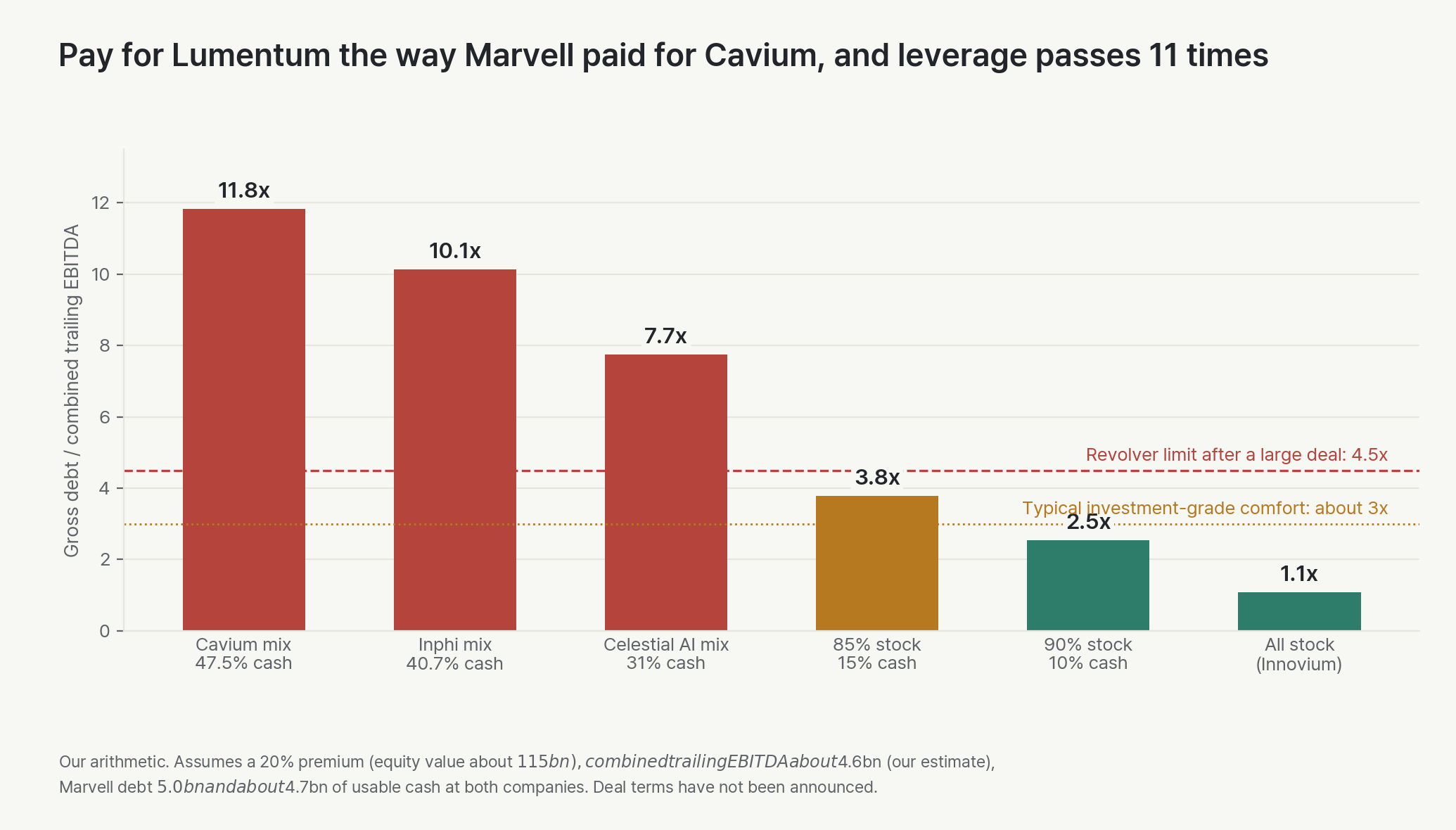
On our assumptions, any precedent mix with real cash would exceed the 4.5-times limit. We have not matched the credit agreement’s exact EBITDA definition, so treat the bars as estimates. The usable cash in the chart combines Marvell’s $3.9 billion and Lumentum’s balance, less operating minimums. A deal with 15% cash stays under the limit but sits above the roughly 3 times that investment-grade issuers usually keep. That leaves two realistic structures: all stock, or about 90% stock with a small fixed cash amount per share. The cash version gives Lumentum holders a more certain value, which helps in a premium negotiation. The all-stock version leaves Marvell’s balance sheet untouched and puts the full weight of the deal on its share price.
The all-stock trap
An all-stock deal has a cost that does not show up in leverage ratios.
The signal. On October 6, Marvell’s management told investors it expects non-GAAP earnings per share above $30 in fiscal 2031. At Marvell’s price before the report, that target valued the stock at about 8.4 times fiscal 2031 earnings.
A management team that believes its own target sees its shares as cheap, and a cheap currency is a strange thing to spend. When a buyer pays in stock anyway, investors start to doubt either the long-term target or the price of the target company. Thursday’s drop is consistent with that reading. It is also consistent with other explanations, such as customer conflict and lower margins from owning fabs, and we cannot separate them.
The overhang. In a fixed-ratio stock deal, merger-arbitrage funds buy the target and short the buyer until the deal closes. With Inphi, the stock part of the price was about $5.9 billion, and Marvell still lagged the SOX for about three months. Here the stock part could be close to $100 billion.
Marvell’s past large deals took 173 to 228 days to close, with SAMR as the last gate. Lumentum’s own deals for Oclaro and NeoPhotonics each took about nine months. In today’s US–China climate, we assume nine to twelve months. A November announcement would close in the second half of 2027.
Nvidia in the middle. Nvidia bought $2 billion of convertible preferred stock in Marvell on March 31 and $2 billion in Lumentum on March 2. In an all-stock deal, its Lumentum preferred would likely be exchanged for Marvell shares, depending on the preferred terms and the merger agreement. Whether Nvidia supports the deal is unknown, and its view matters as both an investor and a customer.
Lumentum holders share the fall. Lumentum rose only 0.6% on Thursday. Once a fixed exchange ratio is signed, a lower Marvell price means a lower price for Lumentum. Before signing, Lumentum’s board can still push for more cash or price protection. Thursday showed how much value a fixed ratio can lose in one day.
What would change our view
The following announcement terms would tell us that this deal looks more like Inphi than like Cavium. If they arrive together, we would treat the first-day drop as an overreaction. They are signals of intent, not proof of execution.
- A public commitment to run Lumentum as a neutral laser supplier, with information walls and continued supply to outside module makers.
- A plan for Cloud Light, Lumentum’s module business, such as a separation or sale.
- A premium of 20% or less.
- A synergy target of at least $1 billion a year, with a date. A 20% premium is worth about $19 billion. Valued at 25 times after-tax earnings, it takes about $0.9 billion of annual pre-tax synergy to earn that back, by our estimate.
The opposite signal would be a plan to integrate modules and sell complete optical engines in direct competition with module makers. In that case, customer conflict would cancel the strategic gain from owning the laser.
| Date | What to check |
|---|---|
| November 5 | Lumentum’s first-quarter results against guidance of $1.225–1.275 billion in revenue, plus any comment on laser lead times or the talks |
| Early November | The earliest announcement window in press reports: cash share, exchange ratio, committed financing, synergy target, neutral-supply terms, module plan, expected close and Nvidia’s position |
| 5, 20 and 60 trading days after any announcement | Marvell against the SOX, compared with the Inphi path of -8.2, -4.1 and +0.2 points |
| Early December (date not confirmed) | Marvell’s fiscal third-quarter results, buyback pace and funding plan |
Is Lumentum Marvell’s next Inphi or its next Cavium? Tell us which matters more to you: how long the laser shortage lasts, or whether Lumentum’s customers keep buying from a Marvell-owned supplier.
Research and information only; not investment advice. Estimates and scenarios are analytical assumptions, not company guidance, trade instructions or personalized portfolio decisions. Event returns use Nasdaq closing prices, price only. Figures are date-bound. AI tools assisted research and editing.