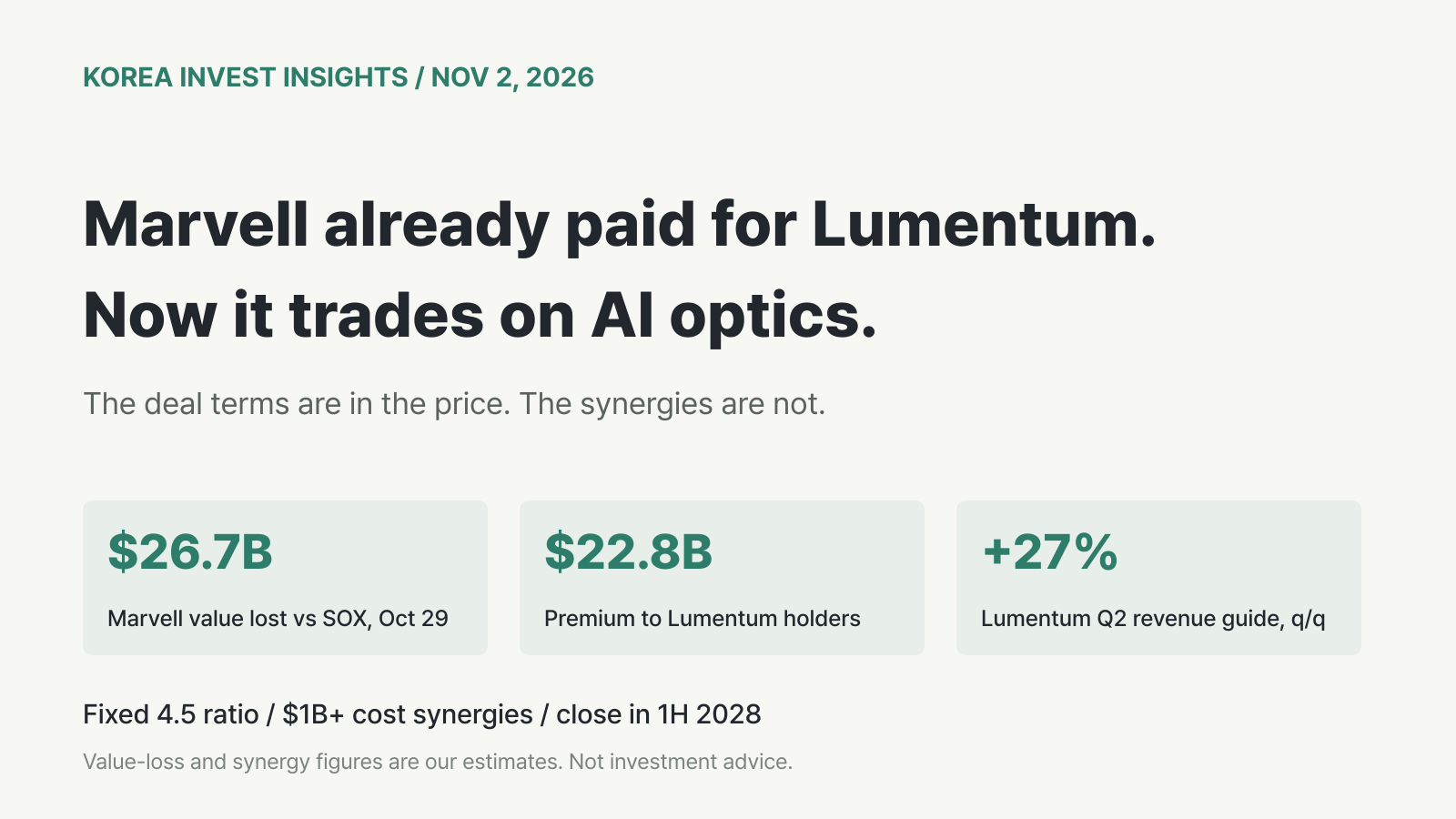
On Monday, November 2, Marvell Technology agreed to buy Lumentum in an all-stock deal. Lumentum holders get 4.5 Marvell shares for each share, a 23.9% premium on unaffected prices. The deal needs no new debt. Marvell promises more than $1 billion a year of cost synergies and expects to close in the first half of 2028. The terms are better than the market feared. The stock did not bounce. It fell again. In pre-market trading at 8:27 a.m. New York time, Marvell was down 3.1% and Lumentum was down 5.8%.
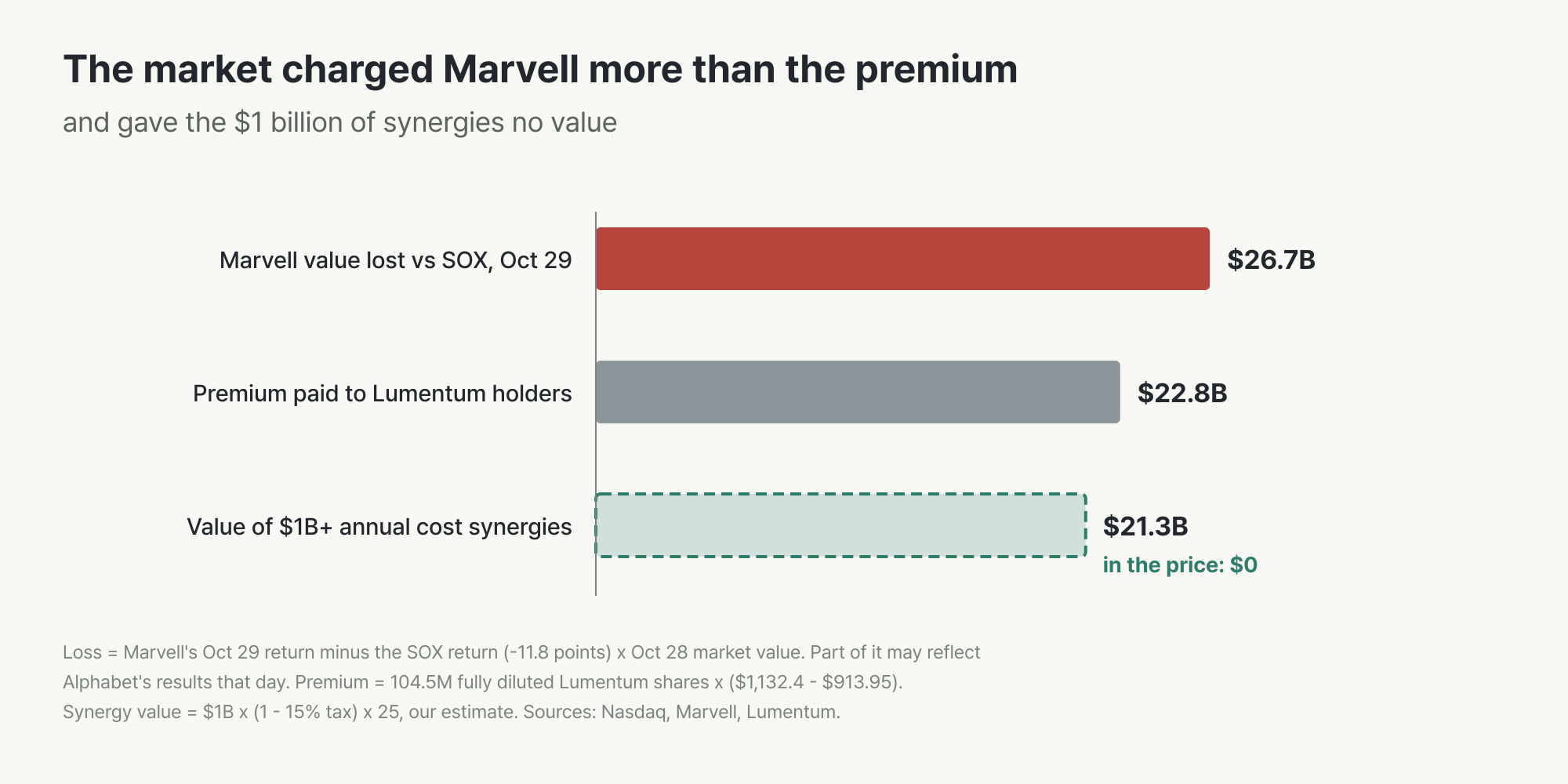
The common read is that investors hate the price. Our read is that they have already charged for it, and then some. On October 29, the day the talks leaked, Marvell fell 11.8 percentage points more than the Philadelphia semiconductor index (SOX). That gap is about $26.7 billion of market value. The premium Marvell agreed to pay is about $22.8 billion. The promised synergies, after tax and valued at 25 times, are worth about $21.3 billion, close to the full premium. The stock price gives them nothing.
Our judgment: for the next 6 to 12 months, the AI optics spending cycle will drive Marvell’s stock more than the deal terms will. The exchange ratio is fixed, so Marvell and Lumentum now move together, and Marvell’s sensitivity to optics rises. We lean neutral to mildly positive. The price and the dilution are settled, and the stock already carries them. The synergies are as large as the premium, and the stock gives them zero value. That puts the asymmetry on the upside. Lumentum’s business is also speeding up. Its revenue guidance for the December quarter is 27% above the September quarter, and its second co-packaged optics (NPO/CPO) win comes with more than $5 billion of purchase commitments. The variable that could flip this view is customer neutrality.
This article is dated November 2, 2026, Korea time. Closing prices are Nasdaq closes through October 30. Pre-market quotes are from 8:27 a.m. ET on November 2, before the regular session. We read Marvell’s press release and investor presentation, the merger agreement Marvell filed on Form 8-K this morning, and Lumentum’s first-quarter results on Form 8-K. Our first take on the reported talks and our look at Marvell’s deal record set up the tests we use below.
What to take away
- The terms beat the fear on funding, meet it on price and miss it on timing. All stock and zero debt remove the credit-rating risk. A 23.9% premium sits between our 20% “good” line and our 30% “bad” line. A close in the first half of 2028 is longer than the 9 to 12 months that precedents suggested.
- The stock already paid more than the premium. The October 29 loss beyond the SOX ($26.7 billion) is larger than the premium ($22.8 billion). The synergy target is worth about the same as the premium and is priced at zero. The confirmed terms brought no rebound before the open.
- For a year, Marvell is an optics stock. With a fixed ratio, Lumentum trades as 4.5 Marvell shares less a spread. On current guidance, Lumentum would supply about 38% of the combined company’s earnings. On October 30, Marvell fell about as much as the optics group did.
- Lumentum is accelerating into the deal. First-quarter revenue grew 25.5% from the prior quarter. Guidance points to about $1.6 billion next quarter at an operating margin of 45% or more. Every dollar Lumentum earns before closing is bought with a fixed number of Marvell shares.
- Customer neutrality decides the long-term value. If Nvidia walks away from its purchase commitments or a large module maker qualifies Broadcom’s signal processors, we turn negative.
The terms beat the fear on funding and miss it on timing
The question for this table is simple. Compared with what the market expected before Monday, were the announced terms better or worse?
| Item | Expected before Monday | Announced | Verdict |
|---|---|---|---|
| Payment | All stock was the likely case (CNBC, October 30) | All stock, no new debt | As expected. The credit-rating risk is gone |
| Premium | “Not a big premium” (CNBC). Our lines: 20% or less is good, above 30% is bad | 23.9% | Middle |
| New Marvell shares | About +42% to +44% in our earlier cash-and-stock case | About +50.6% (470 million new shares on 930 million) | More, because there is no cash |
| Earnings per share | Analysts warned of dilution | Company: higher non-GAAP EPS in the first year after closing | Better than feared, but the gain depends on synergies |
| Synergies | Our bull line: $1 billion a year, with a date | More than $1 billion a year of run-rate cost synergies, no date | The size is met. The date is missing |
| Closing | 9 to 12 months on precedents | First half of 2028. The outside date is November 1, 2027, and it can extend to August 1, 2028 for regulatory approvals | Longer |
| Nvidia and neutral supply | A plan for Nvidia’s stake and for neutral supply | Nvidia’s Lumentum preferred stock can convert into matching Marvell preferred. Nothing on purchase commitments. Both module businesses stay | Not met |
| Lumentum results | Consensus (as of October 28): $1.253 billion for the September quarter, $1.480 billion for the December quarter | $1.263 billion actual. Guidance midpoint $1.600 billion | Guidance is strong |
By our own test from Thursday, this deal looks less like Inphi, Marvell’s best deal. We listed four signals that would mark an Inphi-type deal: a pledge to run Lumentum as a neutral laser supplier, a plan for the module business, a premium of 20% or less, and $1 billion of synergies with a date. Only the synergy size arrived. The deal still carries the customer risk we flagged. What changed is the price of the stock.
The merger agreement adds detail. Marvell owes Lumentum $5.8 billion if Marvell’s board changes its recommendation or takes a better offer. Lumentum owes $2.9 billion in the reverse case. If regulators block the deal, or the outside date passes while only regulatory approvals are missing, Marvell pays a $3.2 billion regulatory fee. That is about 2.8% of the $115 billion enterprise value. The public text does not name China. The list of required approvals beyond U.S. antitrust review sits in a disclosure letter that is not public. Marvell does not have to accept remedies that would be material to the combined company.
The stock already paid more than the premium
The chart at the top answers one question: has the market charged Marvell for the premium yet?
The loss is Marvell’s October 29 return minus the SOX return, applied to Marvell’s market value on October 28. Marvell fell 13.2%, and the SOX fell 1.4%. Part of the gap may reflect Alphabet’s results that day. Marvell designs custom chips for Google. Broadcom, Google’s larger chip partner, fell only 1.9%, so most of the gap belongs to the deal. The premium is Lumentum’s 104.5 million fully diluted shares times the difference between the $1,132.40 deal value and the $913.95 unaffected price.
The market took about $3.9 billion more than the premium. That extra discount is the market’s charge for customer loss and for a fabless company that will now run laser fabs. The synergies got nothing. On our numbers, it takes about $1.07 billion a year of pre-tax synergy to earn back a $22.8 billion premium at 25 times after-tax earnings. Marvell’s target, more than $1 billion, is close to that line. If Marvell delivers it, its holders break even against the unaffected price. Today’s stock price assumes zero. Any credible proof of synergy is upside from here.
Marvell’s fall also cut the price of Lumentum. At Marvell’s October 30 close of $196.40, a Lumentum share is worth $883.80 in the deal. That is 3.3% below Lumentum’s unaffected price. In earnings terms, Marvell’s guided non-GAAP EPS for its fiscal third quarter is $1.10. At four times that, Marvell trades at 44.6 times earnings. Lumentum’s guided EPS for the December quarter is $6.05. At four times that, the deal values Lumentum at 36.5 times. Marvell pays with a currency at 45 times earnings for earnings at about 37 times.
That gap explains a split in the earnings math. Both columns below are our estimates.
| Basis | No synergy | $0.5 billion synergy | $1 billion synergy |
|---|---|---|---|
| Calendar 2027, consensus as of October 28 | -4.3% | +0.1% | +4.5% |
| Calendar 2027, if Lumentum earns $32 a share (our assumption) | -1.0% | +3.4% | +7.7% |
| Current guidance, annualized (Marvell $1.10, Lumentum $6.05 a quarter) | about +6% to +7% | n/a | n/a |
On current run rates, the deal adds to Marvell’s EPS before any synergy. Consensus expects Marvell’s earnings to grow much faster than Lumentum’s into 2027, so the 2027 math shows dilution before synergies. That consensus may be stale on the Lumentum side. Lumentum’s first-quarter EPS ($4.57) and second-quarter guidance ($6.05) already total $10.62. Consensus for fiscal 2027, which ends in June, is $21.80. That asks for only $11.18 in the second half, less than two quarters at the December-quarter guidance ($12.10). If that number rises, the 2027 dilution shrinks toward -1%.
For the next year, Marvell is an optics stock
This is the part of the deal the market has not fully absorbed. A fixed exchange ratio with no collar ties the two stocks. Lumentum now trades as 4.5 Marvell shares less a merger spread. Marvell holders, in turn, will own 67% of a company in which Lumentum supplies about 38% of current run-rate earnings. Marvell’s own optical signal processors also sell into the same transceiver build. The combined earnings base leans on optical demand much more than Marvell’s did alone.
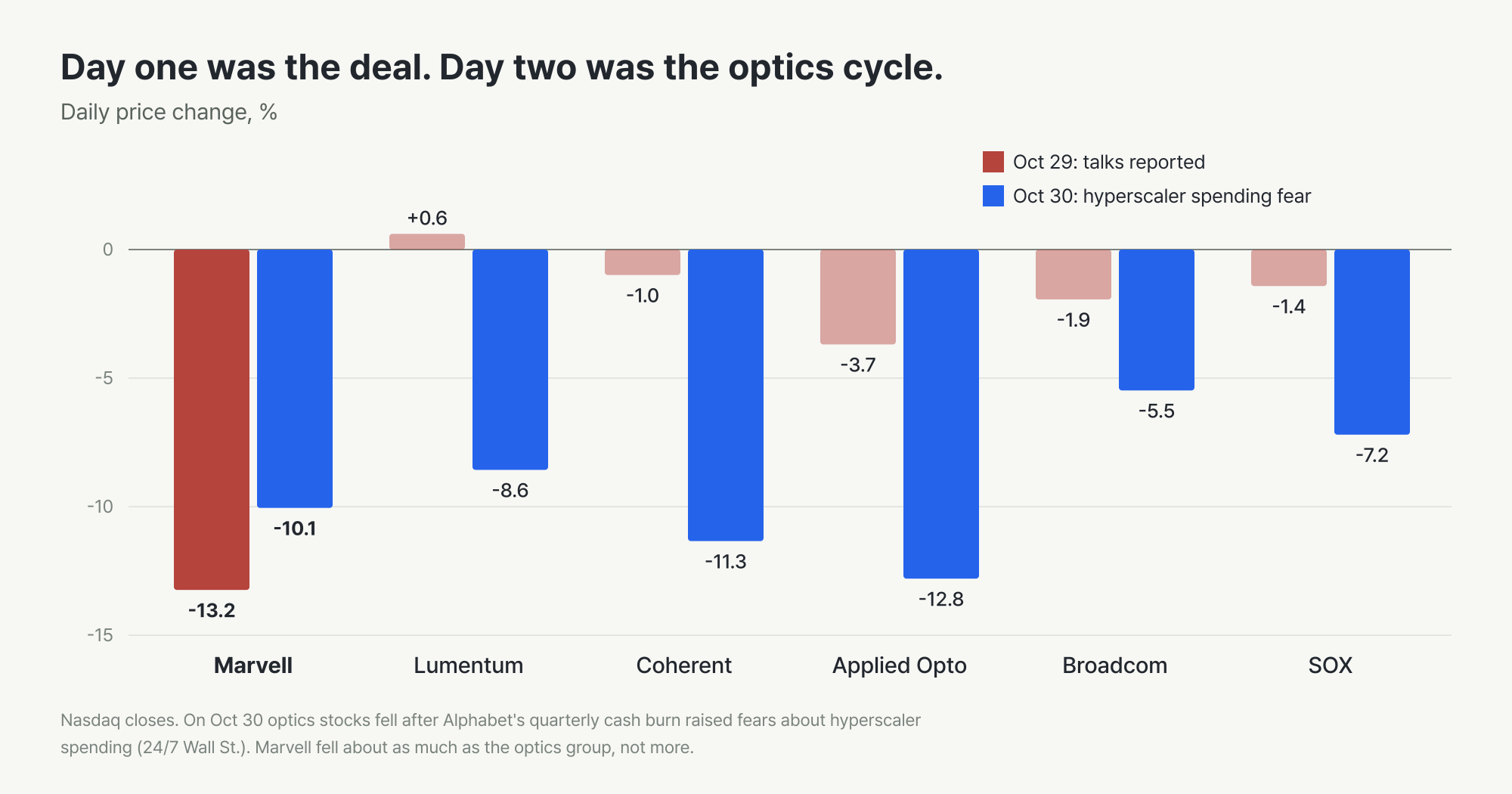
The two days after the leak show the shift. October 29 was the deal: Marvell fell 13.2% and the optics names barely moved. October 30 was the cycle. Alphabet’s quarterly cash burn of $9.1 billion, against about $3.5 billion expected, spread fear about hyperscaler spending down the supply chain (24/7 Wall St.). Marvell fell 10.1%. The optics group (Lumentum, Coherent, Applied Optoelectronics) fell 10.9% on average. Marvell traded like an optics stock that day. We expect that link to hold until the deal closes.
Nothing about the deal itself resolves within a year. The S-4 registration, the shareholder votes and the regulatory reviews are process steps. The synergies can only be proven after closing in 2028. In the meantime, the numbers that move the stock will be hyperscaler spending guidance, optical orders and optical prices. That is a tug of war. On one side sits Alphabet’s cash burn. On the other sits Lumentum’s order book.
Lumentum’s own price says the market is not betting on the deal. At 8:27 a.m., Lumentum traded at $791.87 before the open, 8.2% below the $856.62 that 4.5 Marvell shares were worth. Spread over the time to a 2028 close, that is about 6% a year. The spread is modest, and it says little about closing odds, because Lumentum’s standalone value and the deal value are close to each other.
Lumentum is accelerating into the deal
This chart asks whether Marvell is buying a business at its peak or one that is still gaining speed.
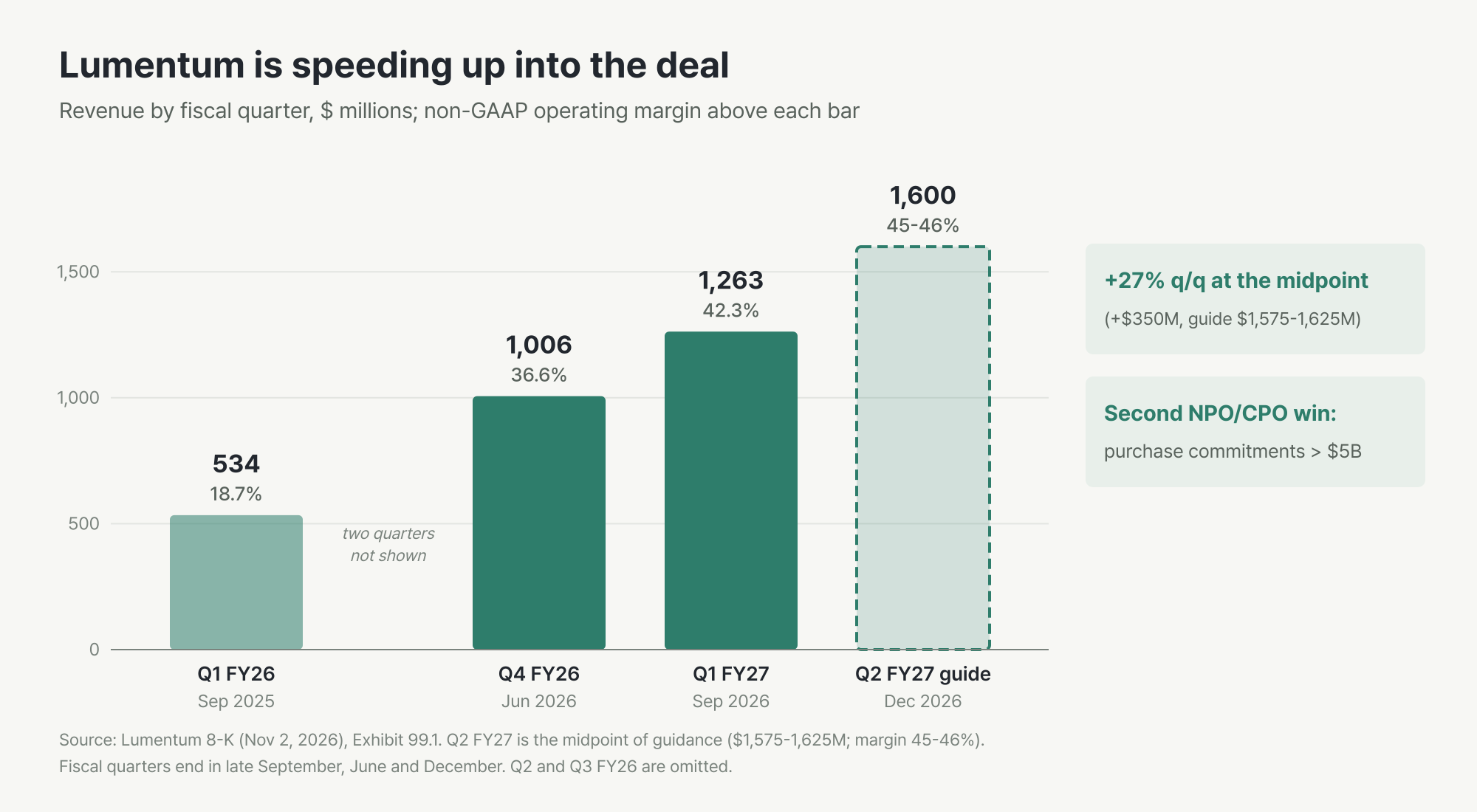
Lumentum reported its fiscal first quarter on Monday, three days earlier than expected. Revenue was $1.263 billion, up 25.5% from the prior quarter and 136.5% from a year ago. The non-GAAP operating margin rose to 42.3%. For the December quarter, Lumentum guides to $1.575 to $1.625 billion of revenue and a 45% to 46% margin. Chief executive Michael Hurlston said the company expects to add about $350 million of revenue in one quarter. He noted that this is more than the whole company’s quarterly revenue two years ago.
Two lines in the release matter more for Marvell. Lumentum secured its second major NPO/CPO win, backed by purchase commitments of more than $5 billion. Demand visibility for optical circuit switches has also grown, and Lumentum expects them to become a multi-billion-dollar yearly business. Both point to the scale-up optics market that Marvell says is the reason for the deal.
The fixed ratio makes this growth valuable to Marvell holders. Marvell issues a set number of shares no matter what Lumentum earns before closing. Each upgrade to Lumentum’s earnings before 2028 lowers the effective price.
Customer neutrality is the variable that flips us
The risk sits in the source of the synergies. Marvell’s presentation describes them as run-rate synergies, “primarily COGS”, meaning cost of goods sold. We think much of that will come from internal sourcing: Marvell signal processors, drivers and amplifiers inside Lumentum modules, and Lumentum lasers inside Marvell optical engines. This is our inference, because the company has not published a breakdown.
The same mechanism gives outside customers reasons to leave. Module makers that compete with Lumentum can move to Broadcom’s signal processors. Stifel estimates Marvell’s share of PAM4 signal processors at 60% to 65%, and that share is exposed. Laser customers that compete with Marvell can move to Coherent. Coherent traded 1.6% higher before Monday’s open, which fits that bet. The announcement kept both module businesses and said nothing about Nvidia’s purchase commitments. Eighteen months to closing is enough time for a customer to qualify a second source.
We would turn negative on any of these signals:
- Nvidia declines to carry over its Lumentum purchase commitments, or moves volume to Coherent.
- A large module maker qualifies Broadcom’s signal processor for its next platform.
- A regulator, most likely China’s, asks for conditions that Marvell refuses. The agreement lets Marvell refuse material remedies, which would raise the chance of a break and the $3.2 billion fee.
We would turn more positive if the S-4 shows a synergy breakdown with dates, or if Nvidia confirms its commitments.
What to watch
| When | What to check | Our line |
|---|---|---|
| November 2 to 4 | Marvell against the SOX over three trading days from the October 30 close | Within -5%: the market accepts the terms. Worse than -10%: rejection |
| November 14 | Nvidia’s 13F filing: its Lumentum and Marvell holdings | A cut would be a customer-conflict signal |
| Early December (date not confirmed) | Marvell’s fiscal third-quarter results and fourth-quarter guidance | Custom silicon pace and scale-up optics revenue |
| About 4 to 8 weeks after signing (precedent) | The S-4 registration statement | Synergy breakdown and timing, management projections for Lumentum |
| November 1, 2027, extendable to August 1, 2028 | Outside date | The $3.2 billion regulatory fee if approvals fail |
Over the next year, what will move Marvell more: proof that the $1 billion of synergies is real, or the next hyperscaler spending number? Tell us which one you are watching.
Research and information only; not investment advice. Estimates and scenarios are analytical assumptions, not company guidance, trade instructions or personalized portfolio decisions. Event returns use Nasdaq closing prices, price only. Pre-market quotes are not final prices. Figures are date-bound. AI tools assisted research and editing.