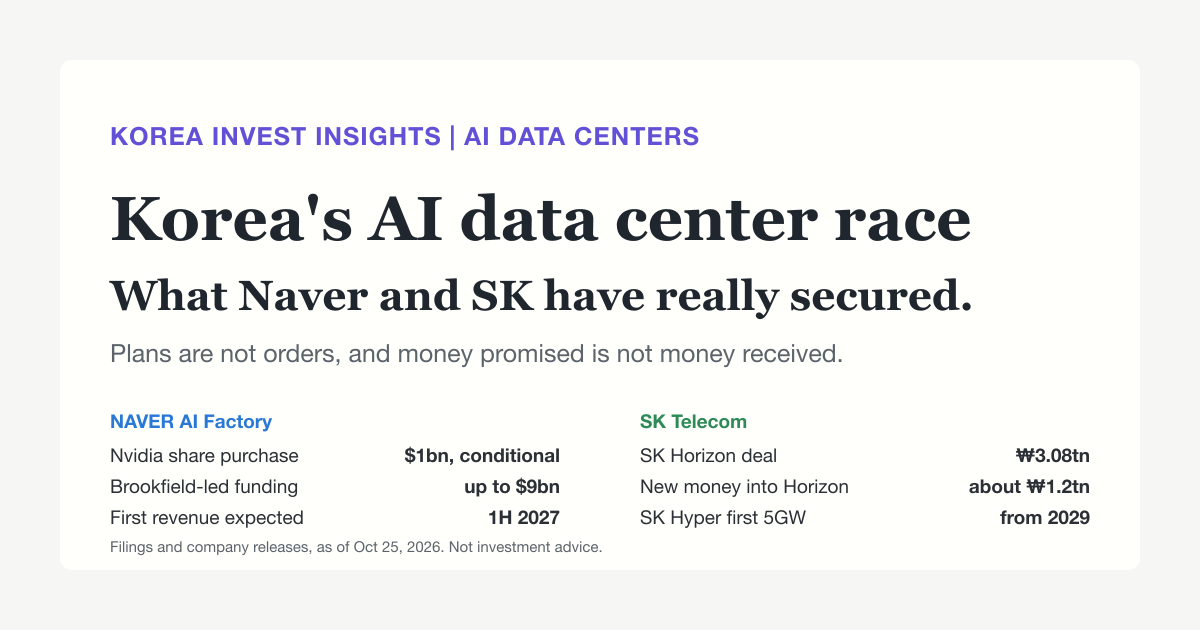
Korea wants to be Asia’s hub for AI computing, and the announcements have been huge. Nvidia said Naver plans to deploy more than 60,000 of its chips. Brookfield says it will put up to $9 billion into Naver’s first AI factory. SK Telecom set up a new company to build 5 gigawatts of data centers, and that company’s chief executive put the cost of the first phase at about $350 billion.
Big numbers are easy to announce and hard to finish. A plan is not an order. An order is not a delivery. And money promised is not money in the bank. This post sorts out what each company has actually secured, using filings and company releases up to October 25, 2026.
The short answer: Naver is furthest along in turning AI computing into a business it can sell. SK Horizon, the data center unit SK Telecom is splitting off, has the most visible cash today because it already runs paying data centers. SK Hyper is a long-dated development project. Its value depends on customers, power and outside money that are not yet signed.
Five things to take away
- These are three different businesses, not two companies. Naver’s AI Factory sells computing. SK Horizon rents out buildings, power and connections. SK Hyper develops new gigawatt-scale sites. Their numbers should not be compared one to one or added up.
- Naver’s money is the most concrete, but it is conditional. Nvidia agreed to buy $1 billion of new Naver shares, on condition that Naver secures at least $9 billion of computing infrastructure. Brookfield says it is committed to investing up to $9 billion in the first 200MW phase. Neither the payment nor the final financing close was confirmed as of Oct 25.12
- SK Horizon’s ₩3.08 trillion deal is mostly a sale. About ₩1.88 trillion goes to SK Telecom for existing shares. About ₩1.2 trillion is new money for Horizon itself.3
- “Securing GPUs” usually means a plan. Most Korean GPU counts are deployment plans or rough conversions, not chips that are delivered, running and billed.45
- Revenue is not payback. Naver expects AI Factory revenue from the first half of 2027. SK Hyper’s first 5GW opens in phases from 2029. None of the new projects has published a breakeven date, and overseas peers show that fast-growing AI clouds can still burn cash.
Data are as of Oct 25, 2026. Calculations marked as ours are illustrations, not company forecasts.
1. Three businesses, three stages
Start by separating the companies from the projects.
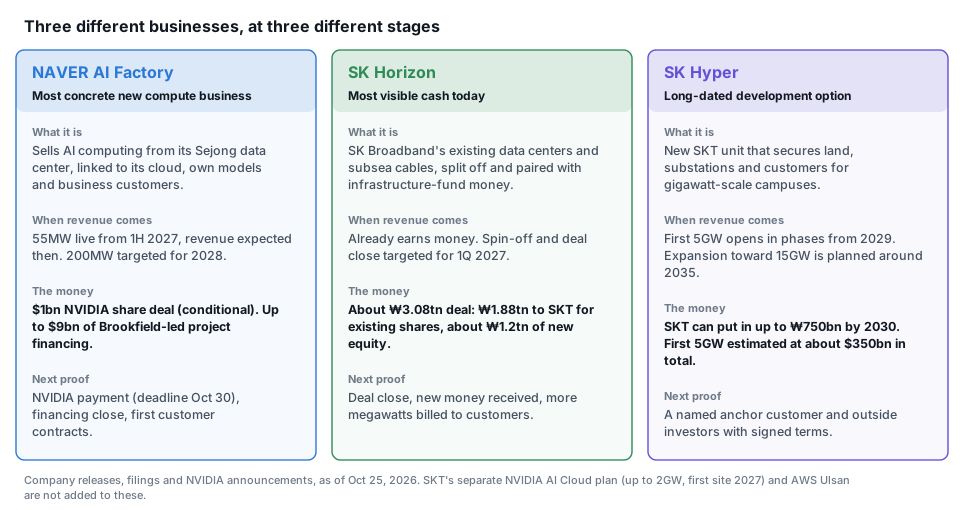
Naver’s AI Factory sells computing. “AI factory” is Nvidia’s name for a data center built to train and run AI models. Naver plans to run one at its Gak Sejong data center, linked to its own cloud, its HyperCLOVA X models and its search and shopping services. It is the first phase of a 1GW project with Nvidia. The first 55MW (megawatts of power capacity) is due to start in the first half of 2027, and 200MW is targeted for 2028.62 Naver expects related revenue from the first half of 2027.7
SK Horizon rents out buildings, power and connections. SK Telecom is splitting SK Broadband’s data center and subsea cable business into a new company. Infrastructure investor KKR and a group led by IMM Investment are buying in. The new company covers 8 existing data centers plus sites under construction, 318MW in total.8 Its data centers already earn money today.
SK Hyper develops new sites. SK Telecom set up SK Hyper in July as a wholly owned subsidiary. Its job is to secure land, substations and customers for gigawatt-scale campuses. The first 5GW is due to open in phases from 2029, with expansion toward 15GW planned around 2035.9
A fourth item is easy to mix up: SK Telecom’s own AI cloud with Nvidia, a plan of up to 2GW with the first site targeted for 2027.10 SK Telecom has said that how much of its partner projects falls inside SK Hyper depends on each contract, so we do not add these numbers together.11
Why does this matter? A company that sells computing earns more per megawatt, but it carries the chip risk. A company that rents out buildings earns less but steadier money, and its customers carry the chip risk. Valuing the two the same way is the most common mistake in this debate.
2. When does the money start?
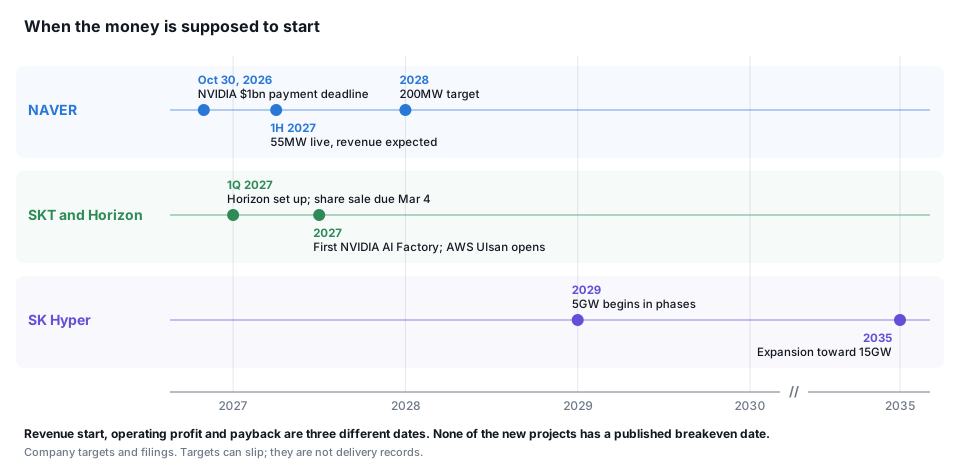
Three dates often get mixed up: the day revenue starts, the day the business makes an operating profit, and the day the investment is paid back. For the new projects, only the first has been announced.
| Business | When revenue starts or is due | Profit and payback |
|---|---|---|
| Naver’s existing cloud and AI | Running today | Mixed into existing results; must be separated from the AI Factory |
| Naver AI Factory | 55MW from 1H 2027; 200MW target for 2028 | No breakeven date published |
| SK Telecom’s AI data centers today | ₩136.2bn of revenue in Q2 2026, up 92.5% | Profit per GPU cluster not disclosed |
| SK Horizon | Earns money today; new company due in 1Q 2027 | A spin-off does not create new demand by itself |
| AWS Ulsan and SKT’s first Nvidia AI factory | Both targeted for 2027 | Need commercial operation and customer billing |
| SK Hyper | First 5GW from 2029; CEO says revenue is possible as early as 2027 | Type and size of any 2027 revenue not disclosed |
Sources: company releases, SK Telecom’s second-quarter results and press reports of the SK Hyper interview.7121314
One accounting detail matters here. In the second quarter, Naver lengthened the useful life of its GPU and CPU servers from five to six years. That defers about ₩100 billion of cost a year.15 It makes reported profit look better sooner. It does not change how much cash the chips cost, or how fast they lose value in the rental market.
3. Naver’s edge: one company from the building to the app
Naver runs the data center, the GPU clusters, the cloud platform, its own AI models and the services that use them. That lets it sell more than raw chip time. It can help a customer build, train and deploy a model. Its own search and shopping demand can also fill early capacity.
| Strength | Naver’s advantage | What still needs proof |
|---|---|---|
| Customers | Its own services, Korean companies and government, overseas sovereign AI deals | Whether Korean demand alone can fill 200MW and more; few overseas contracts are public |
| Product | Links the building to models and apps | Performance and support against global GPU clouds on equal terms |
| Supply and capital | Nvidia as a future shareholder, Brookfield as capital partner | Final financing terms, lease payments and guarantees |
| Profit path | Computing revenue plus better own services | Separating GPU profit from the rest of Naver |
There is a catch in the second column. When Naver’s own services use the chips, that is not outside revenue. Its value shows up as lower computing bills, better ad conversion or better products, and it has to be measured that way.
On customers, Naver’s chief executive said the company would try to secure customers for the first capacity in advance.7 No customer names, contracted megawatts, prices, terms or minimum-use commitments have been published. That is a good sign of intent, but not yet enough to calculate the profit on any contract.
4. SK’s edge: land, power and connections
SK Telecom is building two layers. SK Horizon takes the existing data centers and subsea cables and pairs them with infrastructure money. SK Hyper takes on new land, power and customers. This split lets steady, running assets raise infrastructure capital, while each new project raises its own money.
SK’s network, subsea cables, enterprise sales and data center experience help bring overseas customers to Korean sites. The group’s construction, energy and memory businesses can also help with design and purchasing. But being in the same group does not automatically give a project a power connection, cheap electricity, first call on high-bandwidth memory or a cheap guarantee. Each of those needs its own contract.
| Partner | Role | What it is not |
|---|---|---|
| KKR | Equity investor in SK Horizon | Not committed money for SK Hyper’s 5GW |
| IMM-led group | Co-investor in SK Horizon, 20% final stake | Not a guarantor of customer revenue |
| Nvidia | AI cloud design, chips and memory partnership | No disclosed equity investment in SKT or SK Hyper; no promise to buy unused capacity |
| AWS | Partner for the Ulsan AI Zone, due to run by 2027 under a 15-year agreement | Leased megawatts and minimum use not disclosed |
| Lambda | GPU cloud partner; SKT invested in it | Money flowing out of SKT, not into SK Hyper |
| Penguin Solutions | AI cluster design and operations; SKT invested $200m | Separate from any outside funding for SK Hyper |
Sources: SK Telecom, Nvidia and Penguin Solutions releases.131617
SK Hyper’s weakness is not that its goals are big. It is that the customer, money and power contracts behind them are not yet public. SK says it will build in steps as demand appears. That lowers the risk of spending everything at once. It also means revenue waits until customers sign.
5. “Securing GPUs” has five steps
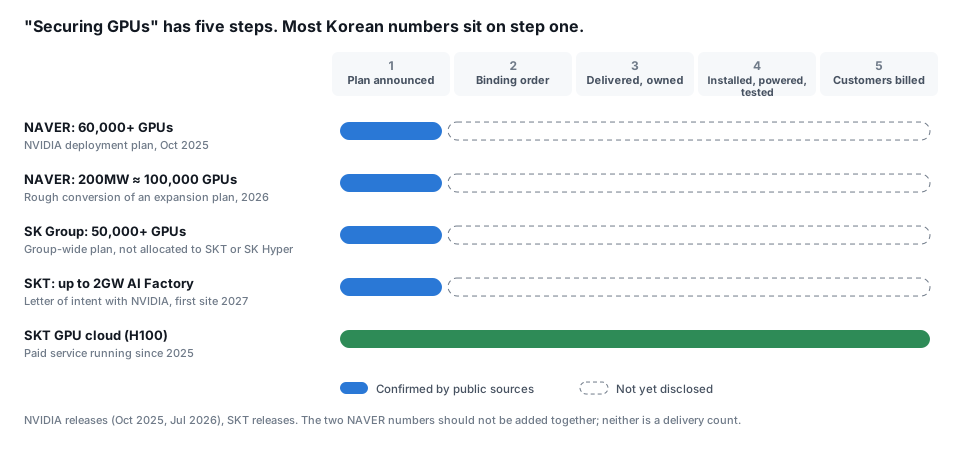
To know what “securing GPUs” really means, check five steps in order. A plan is announced. A binding order is placed. The chips are delivered and owned. They are installed with power and networking and pass testing. Customers start paying. A headline number usually tells you only the first step.
- Naver, 60,000+ GPUs. In October 2025, Nvidia said Naver Cloud plans to deploy more than 60,000 of its GPUs, part of more than 260,000 planned across Korea.4
- Naver, 200MW, about 100,000 GPUs. In July 2026, Nvidia described Naver’s 200MW expansion as roughly 100,000 GPUs on its next-generation Vera Rubin platform.5 This is a rough conversion of a plan. It should not be added to the 60,000.
- SK Group, 50,000+ GPUs. This is a group-wide plan from October 2025. There is no basis for treating it as chips owned by SK Telecom or SK Hyper.4
- SK Telecom, up to 2GW. A letter of intent with Nvidia for AI factories, part of a wider SK–Nvidia partnership described as worth more than $500 billion, which also covers memory.10 Chip counts, prices and delivery dates are not public.
- SK Telecom’s existing GPU cloud. A paid service built with Lambda has been running since 2025.16 It is the only item here that clearly reaches the billing step, and it is small.
Locking in chips early helps when a chip generation is in short supply. Customers buy a start date as much as a machine. But if power, cooling or networking is late, the chips sit idle and the owner pays for them anyway. And each new Nvidia generation pushes down the hourly rental price of the old one. So the useful comparison is not chip counts. It is the chip generation, the date the cluster can serve customers, how many hours customers actually pay for, and the price once the next generation arrives.
6. Nvidia’s role: supplier, shareholder or customer?
Nvidia can play three roles. Each needs its own contract.
| Role | Naver | SK Telecom and SK Group | Benchmark abroad |
|---|---|---|---|
| Technology and supply | Nvidia data center designs, Blackwell and Vera Rubin chips | Same, plus memory co-development with SK hynix | Shared technology helps but gives no exclusivity |
| Shareholder | $1bn share purchase agreement | No equity investment found | Nvidia has invested in CoreWeave and Nebius |
| Backstop customer | Not found | Not found | CoreWeave: Nvidia must buy unused capacity |
The backstop matters most. In September 2025, CoreWeave disclosed an order from Nvidia with an initial value of $6.3 billion. Under it, Nvidia is obliged to buy cloud capacity that CoreWeave’s other customers leave unused, through April 2032, subject to delivery and termination terms.18 That kind of contract moves part of the demand risk onto the supplier. We found nothing like it for Naver or SK Telecom.
Naver’s case is still stronger than an ordinary partnership. A shareholder has a stake in the outcome. But Nvidia also sells the chips. When investment money and chip purchases are linked, Nvidia’s revenue and Naver’s eventual return are different things. Having Nvidia as a shareholder does not guarantee customers or returns.
7. Follow the money
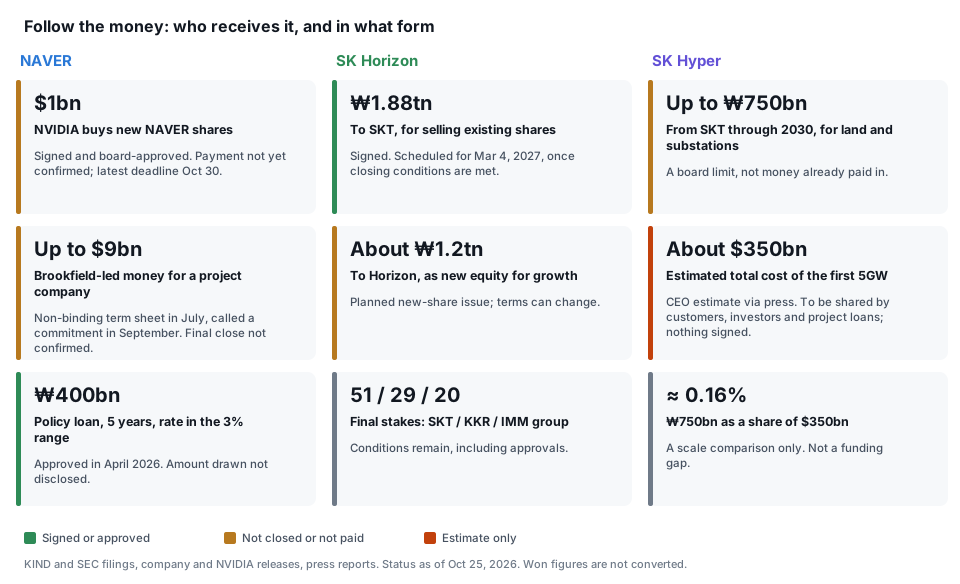
The size of a funding headline matters less than who receives the money, in what form and on what conditions.
Naver. Nvidia’s $1 billion share purchase comes with a condition: Naver must secure at least $9 billion of computing infrastructure, separate from Nvidia’s own money. So the $1 billion and the $9 billion should not be added up as cash in hand. October 30 is the latest payment date in the contract. Payment can come earlier, and the date can be extended, so it needs its own filing.1
Brookfield’s money moved from a non-binding term sheet in July to a commitment to invest up to $9 billion in September.192 That is progress. But a press release does not confirm that the bank loans and project equity have closed. Korean press reported that KB Kookmin, Shinhan, Hana, Woori and NH Investment & Securities are reviewing loans, with Naver to lease the facility long-term.20 Those institutions are reviewing; they are not signed lenders.
If a separate project company owns the assets, Naver spends less cash upfront. In exchange, long-term lease payments, minimum-use obligations, guarantees and profit sharing decide the real burden. Until those contracts are public, we cannot say the debt burden has gone away. And closing the 200MW financing would not mean the full 1GW is funded.
Naver itself is not short of cash, but not all of it is free to spend. At end-June it had ₩8.40 trillion of cash and short-term financial assets on a consolidated basis. Its own net cash figure, which takes out Naver Financial’s cash and debt, was ₩1.83 trillion.15 A ₩400 billion policy loan (five years, with interest in the 3% range) covers 43% of a ₩922 billion Sejong expansion and GPU project. The remaining ₩522 billion equals about 29% of that net cash.21 This is a size comparison, not a verdict on how Naver will pay.
SK Horizon. The deal totals about ₩3.08 trillion. About ₩1.88 trillion (61%) is SK Telecom selling existing shares, and about ₩1.2 trillion (39%) is new equity for Horizon.3 Final stakes are SK Telecom 51%, KKR 29% and the IMM-led group 20%. For SK Telecom as a group, the whole deal brings in outside money. But only the ₩1.2 trillion lands in Horizon for growth. Horizon’s new capex plans, debt and investor rights are not fully public, so we cannot yet say whether that is enough.
SK Hyper. Two numbers are often compared. SK Telecom’s board approved up to ₩750 billion of investment through 2030 for land and substations.9 SK Hyper’s chief executive estimated, in an interview reported by Korean press, that the first 5GW alone would need about $350 billion.14 At ₩1,325 per dollar, ₩750 billion is about 0.16% of $350 billion. But one is seed money for site development and the other is the full cost of a multi-year build, including equipment. The ratio shows scale, not a funding gap. The real gap can only be measured project by project, once customers and investors sign.
8. Lessons from abroad
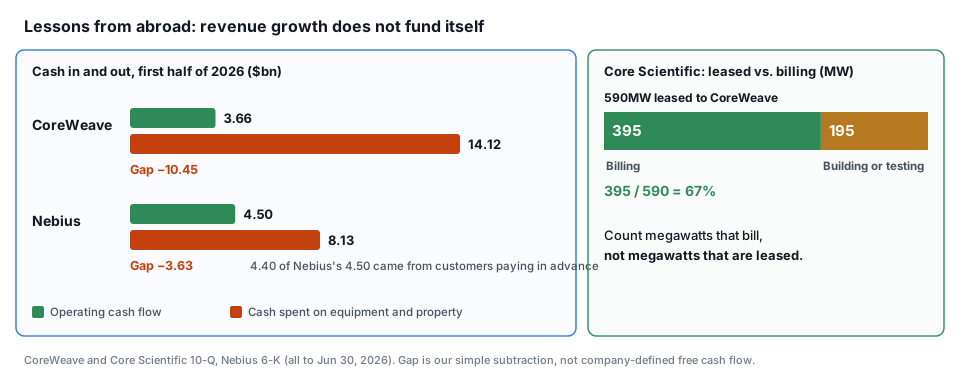
Overseas companies that already run this business show what to watch.
| Company | Comparable to | What the numbers show | Lesson |
|---|---|---|---|
| CoreWeave | Naver and SKT GPU clouds | First-half 2026 operating cash flow of $3.66bn against $14.12bn spent on equipment and property | Fast revenue growth does not remove the need for outside money |
| Nebius | GPU cloud growth and funding | Operating cash flow of $4.50bn, of which $4.40bn came from customers paying in advance; capex of $8.13bn | Prepayments help fund growth but come with service obligations |
| Core Scientific | SK Horizon and SK Hyper as site providers | 590MW leased to CoreWeave, of which 395MW is billing; 195MW still being built or tested | Count megawatts that bill, not megawatts that are signed |
| Singtel’s Nxera | SK Horizon | Telecom data center platform with outside capital; an investor paid S$337m for preference shares in Nxera | Closest model to Horizon: keep site money and GPU money separate |
Sources: company filings and annual report.22232425
Nebius also shows how funding works in practice. On Oct 22 it announced a $3.5 billion financing facility arranged by Citi, with a 364-day term and interest of SOFR plus 2.75%, rising to at most 3.50%.26 A facility is not cash until it is drawn. And funding chips and buildings that last years with one-year money only works if longer-term financing follows.
Korean operators may have an edge over US “neoclouds” (GPU-rental specialists like CoreWeave and Nebius) in local sovereign demand, existing telecom networks and their own services. They have not yet shown an edge in signed contracts with very large global customers, in dollar funding, or in running huge GPU fleets. We have no like-for-like data on power costs, chip prices, utilization or contract prices, so we do not rank their cost advantage.
9. The payback test
Raising construction money is only half the job. The project also has to earn it back.
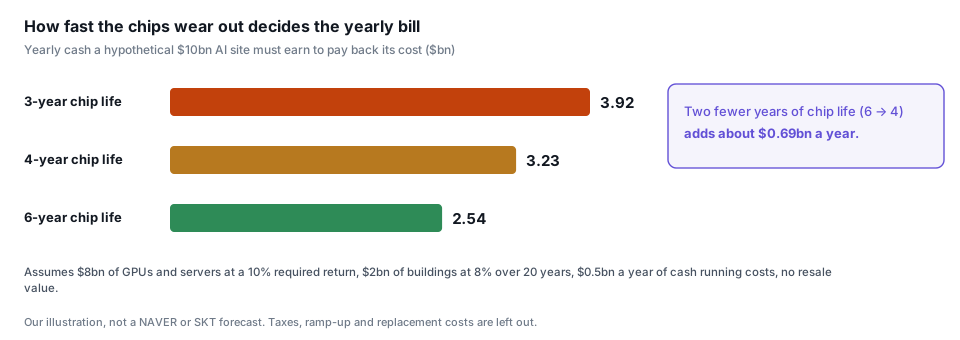
To show why chip life matters so much, take a hypothetical $10 billion AI site. It has $8 billion of GPUs and servers that must earn 10% a year, $2 billion of buildings that must earn 8% over 20 years, and $0.5 billion a year of cash running costs. If the chips stay useful for six years, the site must earn about $2.54 billion a year to pay back its cost plus the required return. At four years, it needs $3.23 billion. At three years, $3.92 billion.27 Cutting chip life from six years to four alone adds about $0.69 billion a year.
This is not a forecast for Naver or SK. Naver may lease rather than own, and the real split of costs depends on its contracts. The point is who carries this risk: the building owner, the lenders or the computing seller. For shareholders, that question matters more than the headline investment.
For funding, a simple 12-month coverage test helps:
- Money available: cash on hand, signed but undrawn facilities whose conditions are met, customer prepayments that can be used, and a cautious estimate of operating cash inflow.
- Money needed: committed construction and chip payments, interest, principal and lease payments, working capital, and a reserve for delays.
Divide the first by the second. Do not count conditional money, or the same money twice. Include parent guarantees and minimum lease payments if they exist. Neither company has published enough to calculate this for the new projects, and we do not treat missing items as zero.
10. What would change our view
| Business | Our read today | Good signs | Warning signs |
|---|---|---|---|
| Naver | The most concrete path from customers and capital to new computing revenue | Nvidia payment, Brookfield financing close, minimum-use contracts with first customers, 55MW passing tests and billing | Funding conditions missed, start-up delays, lease terms longer than customer contracts |
| SK Horizon | The clearest structure for growing running assets | Deal close, new money received, more megawatts billing at new sites | Deal delays, larger capital obligations, customer concentration, weaker power-cost pass-through |
| SK Hyper | A long-dated development option; full funding not yet judged | A named anchor customer, signed outside investors, a grid connection and money being spent | Rising development costs with no customers, larger parent guarantees, land or grid delays |
The strongest argument against our caution: computing is still scarce worldwide, and outside capital is eager. That can speed things up. Naver says it is lining up customers early, and SK says it will invest step by step with demand. Unpublished contracts are not proof of failure.
But a supplier’s partnership or investment is different evidence from an independent customer’s ability to pay. Even long contracts carry acceptance tests, termination rights for delays, credit risk and power-cost terms. The key question is not how big the revenue is. It is who carries the cost of idle GPUs and construction overruns.
11. What this means for memory chips
Korea’s AI build-out adds a new source of demand for memory, including high-bandwidth memory (HBM) from SK hynix and Samsung. But plans should not be turned into this year’s GPU orders or HBM sales. SK Hyper’s 5GW is a 2029-and-later story. SK Telecom’s own AI cloud is a 2027 story. And Nvidia’s memory partnership with SK does not prove that SK’s data centers will buy all of their HBM from SK hynix.
12. Calendar: what to watch
| When | What | What counts as a pass |
|---|---|---|
| After Oct 30, 2026 | Naver filing on the Nvidia share sale | Payment completed, or the terms of an extension |
| Naver’s next results and funding filings | Brookfield project company, customer and lease structure | Financing closed and drawn, parent guarantees, customer contract terms and capacity |
| Late 2026 to early 2027 | SK Hyper outside investors | Named investors, equity or debt, amounts, drawdown terms, anchor-customer commitments |
| 1Q 2027 | SK Horizon set-up and deal close | Approvals, payment for old and new shares, stakes and net debt after the deal |
| 1H 2027 | Naver’s 55MW and SKT’s first AI factory | Power on, GPUs delivered, customer acceptance, billing starts |
Bottom line
Korea has real assets in this race: a national internet champion with its own AI stack, a telecom group with land, power and networks, and supportive policy money. What it does not have yet is public proof that the new capacity will be paid for. Watch three things in order: money that actually arrives, megawatts that actually bill, and contracts that say who pays for idle chips. Naver should show the first two soonest. SK Horizon already shows the second for its existing sites. SK Hyper has to show all three.
Interest note: We use AI models, including Anthropic’s Claude and OpenAI’s models, in our research. SK Telecom invested about $100 million in Anthropic in 2023, and OpenAI has announced plans to explore AI data centers in Korea with SK Telecom. We cite public figures only and make no judgment about the effect on either company.28
Disclaimer: For research and information purposes only. Not investment advice. Names cited are for analytical illustration; readers should perform their own due diligence and consult licensed advisors before any investment decision.
NAVER disclosure of the share issue to Nvidia (KIND), 2026-07-27: about $1 billion; condition that NAVER secures at least $9 billion of computing infrastructure, excluding this investment; Oct 30, 2026 is the latest payment date and can be extended. In Korean. ↩︎ ↩︎
NAVER press release, 2026-09-04: Brookfield “has committed to investing up to US$9 billion” in the 200MW first phase of a 1GW AI factory project. ↩︎ ↩︎ ↩︎
SK Telecom Form 6-K, 2026-08-27: 24,481,427 existing shares sold for ₩1,881,128,369,253; 15,617,069 new shares for about ₩1.20 trillion; scheduled disposal date 2027-03-04. ↩︎ ↩︎
Nvidia newsroom, 2025-10-30: more than 260,000 GPUs planned in Korea, including NAVER Cloud more than 60,000 and SK Group more than 50,000. All described as plans. ↩︎ ↩︎ ↩︎
Nvidia blog, July 2026: NAVER’s 200MW expansion at roughly 100,000 GPUs on Vera Rubin. ↩︎ ↩︎
NAVER story, 2026-07-24: 55MW from the first half of 2027, 200MW in 2028. ↩︎
NAVER second-quarter 2026 results release, 2026-08-07: AI Factory revenue expected from the first half of 2027; plan to secure customers for the first capacity in advance. In Korean. ↩︎ ↩︎ ↩︎
SK Telecom newsroom, 2026-08-27: SK Horizon to be set up in the first quarter of 2027; 318MW including 8 existing data centers and new sites; stakes of 51%, 29% and 20%. ↩︎
SK Telecom newsroom, 2026-07-23: SK Hyper set up; ₩750bn by 2030 for sites and substations; phased opening of 5GW in 2029; sequential expansion toward 15GW in 2035. ↩︎ ↩︎
Nvidia Korea blog, 2026-07-25: partnership of more than $500 billion, letter of intent for SK Telecom AI factories of up to 2GW, first factory targeted for 2027. In Korean. ↩︎ ↩︎
SK Telecom newsroom Q&A, 2026. In Korean. ↩︎
SK Telecom second-quarter 2026 results, 2026-08-05: AI data center revenue ₩136.2bn, up 92.5% from a year earlier. ↩︎
SK Telecom newsroom, 2025-06-22: AWS and SK Group Ulsan AI Zone, operation targeted by 2027, 15-year strategic agreement. ↩︎ ↩︎
The Korea Economic Daily, 2026-10-23, and The Elec, 2026-10-23, both citing the SK Hyper chief executive’s Bloomberg interview: about $350 billion for the first 5GW; revenue possible as early as next year. Secondary; both rely on the same interview. In Korean. ↩︎ ↩︎
NAVER second-quarter 2026 IR presentation, pp. 7 and 9: consolidated cash and short-term financial instruments ₩8,401.4bn, company-defined net cash ₩1,825.7bn; server useful life changed from five to six years, about ₩100bn of annual cost deferral. ↩︎ ↩︎
SK Telecom newsroom, 2025-01-13: GPU-as-a-service launch with Lambda, in which SKT has invested. ↩︎ ↩︎
Penguin Solutions, 2025-01-09: SK Telecom investment of $200 million. ↩︎
CoreWeave Form 8-K, September 2025: initial order value of $6.3 billion; Nvidia obligated to buy residual unused capacity through 2032-04-13. ↩︎
Nvidia newsroom, July 2026: Brookfield “entered into a nonbinding term sheet to fund up to $9 billion.” ↩︎
Seoul Economic Daily, 2026-09-23, citing unnamed investment-banking sources. Secondary. ↩︎
Financial Services Commission, 2026-04-16: ₩400bn of loans (₩340bn from the advanced strategic industries fund and ₩60bn from Korea Development Bank) for a ₩922.1bn project, five-year term, low rate in the 3% range. In Korean. ↩︎
CoreWeave Form 10-Q, six months to 2026-06-30: operating cash flow $3,663m; purchases of property and equipment $14,117m. The gap is our subtraction, not company-defined free cash flow. ↩︎
Nebius Form 6-K, Exhibit 99.1, 2026-08-12: six-month operating cash flow $4,504.1m; capex $8,130.3m; increase in deferred revenue $4,395.0m. ↩︎
Core Scientific Form 10-Q, as of 2026-06-30: about 590MW of leased customer power capacity at five CoreWeave sites, 395MW billable, 195MW under construction or commissioning. ↩︎
Singtel Annual Report 2026, year to 2026-03-31: Nxera preference shares issued to Stellar Asia Holdings II for net S$337m (5.8%); FY27 growth capex of about S$1.2bn, mainly Nxera and RE:AI. ↩︎
Nebius newsroom, 2026-10-22: $3.5 billion senior secured facility, 364 days, Term SOFR plus 2.75% rising to up to 3.50%. Drawn amount not disclosed. ↩︎
Our illustration. Capital recovery factor CRF(r, n) = r / [1 − (1 + r)^−n]. Yearly amount = $8bn × CRF(10%, chip life) + $2bn × CRF(8%, 20) + $0.5bn. Taxes, ramp-up, resale value, inflation and replacement costs are left out. Not a forecast for NAVER or SK. ↩︎
The Korea Economic Daily (KED Global), 2023-08-13, on SK Telecom’s investment in Anthropic; OpenAI, 2025-10-01, on exploring AI data centers in Korea with SK Telecom. ↩︎