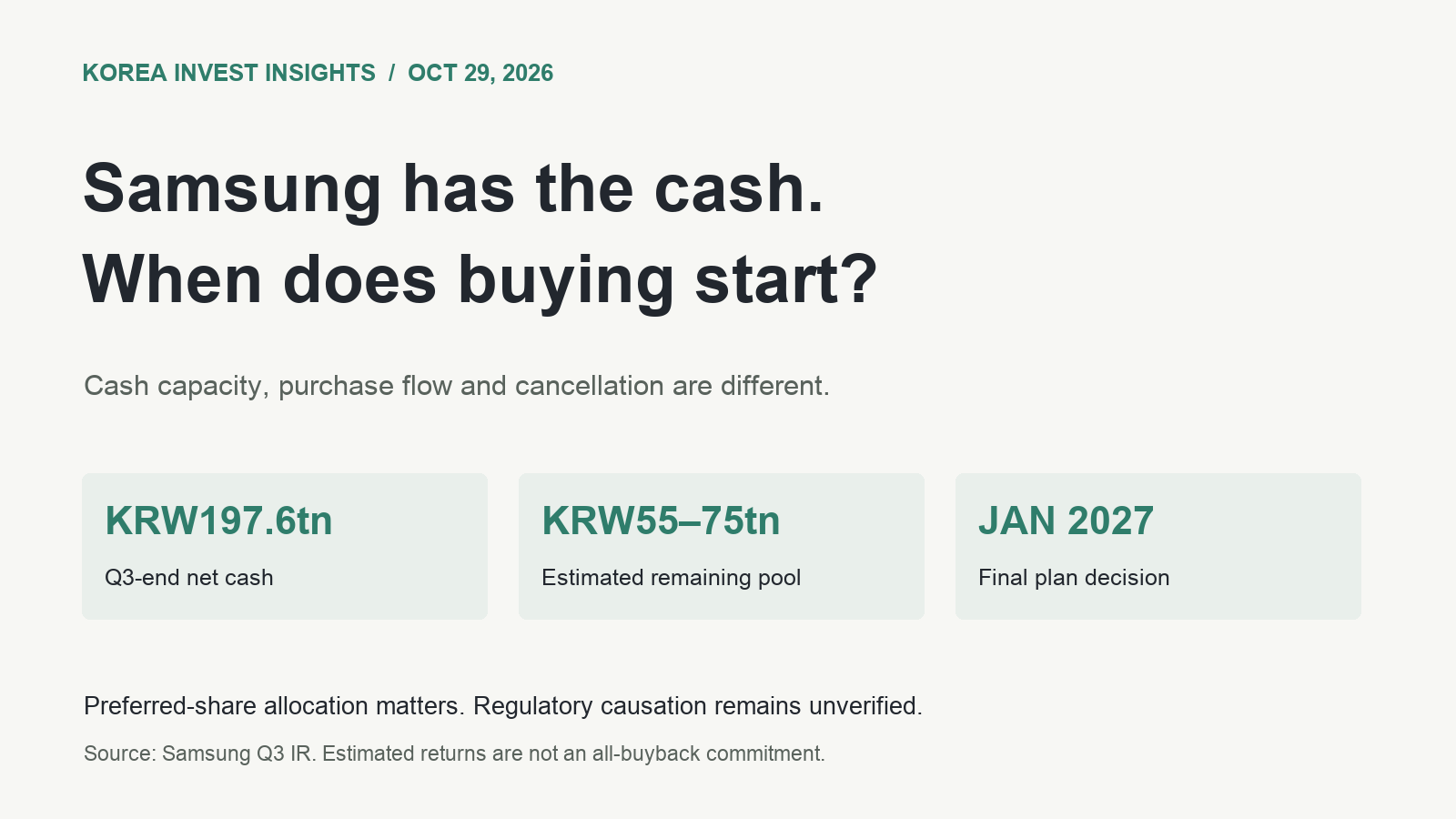
Samsung Electronics ended Q3 with KRW197.6 trillion in net cash. Its common shares were still down more than 5% on the morning of October 29. Cash on a balance sheet and a buy order in the market are different things.
My leading interpretation is that the gap between expectations and the timing of execution mattered more than Samsung’s ability to fund returns. That is a hypothesis, not a measured decomposition of the share-price decline. Preferred shares falling less is consistent with interest in a larger preferred-share buyback allocation. It does not prove the cause.
One correction comes first: Samsung did not newly postpone its remaining return decision to January today. The company had already specified late January 2027 in its August 21 disclosure. Investors hoping for an earlier commitment did not receive one in the announced plan. August disclosure
Dated October 29, 2026. Prices below are Naver’s KRX intraday observations around 11:07 KST, not closing prices. Disclosed facts, observed prices and analytical interpretations are kept separate.
KRW55–75 trillion is not a buy order
Samsung described an estimated KRW90–110 trillion in 2026 returns, less roughly KRW35 trillion already planned or completed, leaving KRW55–75 trillion. The remainder includes dividends and substantial repurchases and cancellations. It is not an all-buyback budget. Final amounts, execution plans and the next return policy are scheduled for the late-January board meeting. Official Q3 IR, final slide
| Item | Amount or date | What it means |
|---|---|---|
| Estimated 2026 returns | KRW90–110tn | Subject to results, investment and final calculation |
| Planned or completed | About KRW35tn | Includes first-half regular dividends and the Q3 dividend |
| Remaining pool | KRW55–75tn | Dividend/buyback allocation is not final |
| Final decision | Late January 2027 | A decision date is not a purchase start date |
Some pre-announcement coverage used KRW110 trillion minus KRW30 trillion to arrive at KRW80 trillion. On the company’s basis, the comparable upper-end calculation is 110 minus 35, or 75. That is a KRW5 trillion difference. Comparing the headline’s 80 with the company’s midpoint of 65 produces a 15 trillion gap, but also switches from an upper bound to a midpoint. It is not evidence of a 15 trillion cut in a previously committed payout. Nor is one headline a measured market consensus. Pre-announcement coverage
The lower end of 55 is also not a guaranteed minimum payment. Samsung’s policy returns 50% of cumulative 2024–2026 free cash flow, with the final pool dependent on results and investment. Official calculation conditions
The company’s calculation also deducts deposit-like memory LTA advances and employee performance-related stock-compensation spending. Half of an increase in cash is therefore not automatically available for distribution under this policy.
The KRW15 trillion program ended. All future buying is not prohibited.
The completed employee-compensation program is now verifiable beyond a news headline. Samsung bought 56,856,305 common shares between August 24 and October 6 for KRW14,999,999,899,750, effectively KRW15 trillion. Official acquisition result
Those purchases created market demand. Shares bought for employee compensation can subsequently return to circulation, however. They are not equivalent to permanent cancellation and should not automatically be counted as the same shareholder-return effect.
The verified conclusion is narrower than “Samsung will not buy any shares until January”: that program is complete, and the next purchase schedule for the remaining return pool has not been specified. A separate compensation program or a new board resolution could change the picture.
SK hynix is at a different execution stage. It approved roughly KRW20 trillion of repurchases on October 28, with an acquisition window from October 29 to January 28, 2027. About half is for shareholder-return cancellation and half for employee compensation. An open acquisition window does not establish actual first-day purchases. SK hynix acquisition filing
The comparison is therefore about the next identifiable buyer: one company has a specified acquisition period and amount; the other has a large remaining pool with its detailed plan still ahead.
Preferred-share allocation has a governance dimension
Samsung explicitly linked its willingness to consider and adjust the preferred-share allocation to the common/preferred price gap and market conditions. It did not commit to a numerical allocation. Official IR
There is another reason to watch that allocation. Samsung Life and Samsung Fire & Marine’s Samsung Electronics stakes sit within Korea’s rules governing financial institutions’ ownership of other companies. In March 2026, the two insurers announced roughly KRW1.5 trillion of disposals and described them as a preemptive response to regulatory risk. Contemporaneous report
The legal framework should not be compressed into a universal “10% is forbidden” rule. Article 24 establishes approval requirements tied to voting-share ownership and control. The 10% threshold discussed in Samsung reporting needs to be distinguished from the statute’s general tests. The legal denominator at repurchase and cancellation should not be assumed identical. Official Article 24
There is relevant counterevidence. In 2017, Reuters reported a Financial Services Commission official explaining that treasury shares were already excluded from the voting-share denominator, so cancellation did not change the ratio. I have not verified whether the detailed calculation rules subsequently changed. A formula in which cancellation mechanically forces insurer selling would therefore overstate what has been established here. Historical regulatory explanation
Preferred shares are non-voting, and Samsung has left room to adjust their allocation. Treating that as a confirmed design to solve a governance constraint goes further than the evidence. I have not verified a company statement saying this law caused the choice of January. Completing the annual FCF calculation and announcing the next return policy together are alternative explanations.
Relative resilience is a clue, not proof
The following observations use one provider and market, with source timestamps only three seconds apart.
| Security | Price, KRW | Day change | Source time, KST |
|---|---|---|---|
| Samsung common | 229,500 | −5.17% | 11:07:21 |
| Samsung preferred | 184,500 | −2.95% | 11:07:18 |
| SK hynix | 1,514,000 | +1.82% | 11:07:20 |
Sources: Naver public APIs for Samsung common, Samsung preferred and SK hynix. KRX intraday observations.
Preferred shares fell 2.22 percentage points less than common shares. That aligns with the preferred-allocation message, but the snapshot cannot identify investor motives.
Common shares had also risen about 9.0% the previous day, from KRW222,000 to KRW242,000. Return expectations, reversal of that rally, broad selling and interpretations of divisional earnings can all matter. Without an identified attribution model, ranking the missing buyback catalyst first remains my working judgment.
The 19.6% discount is not a dividend waiting to be collected
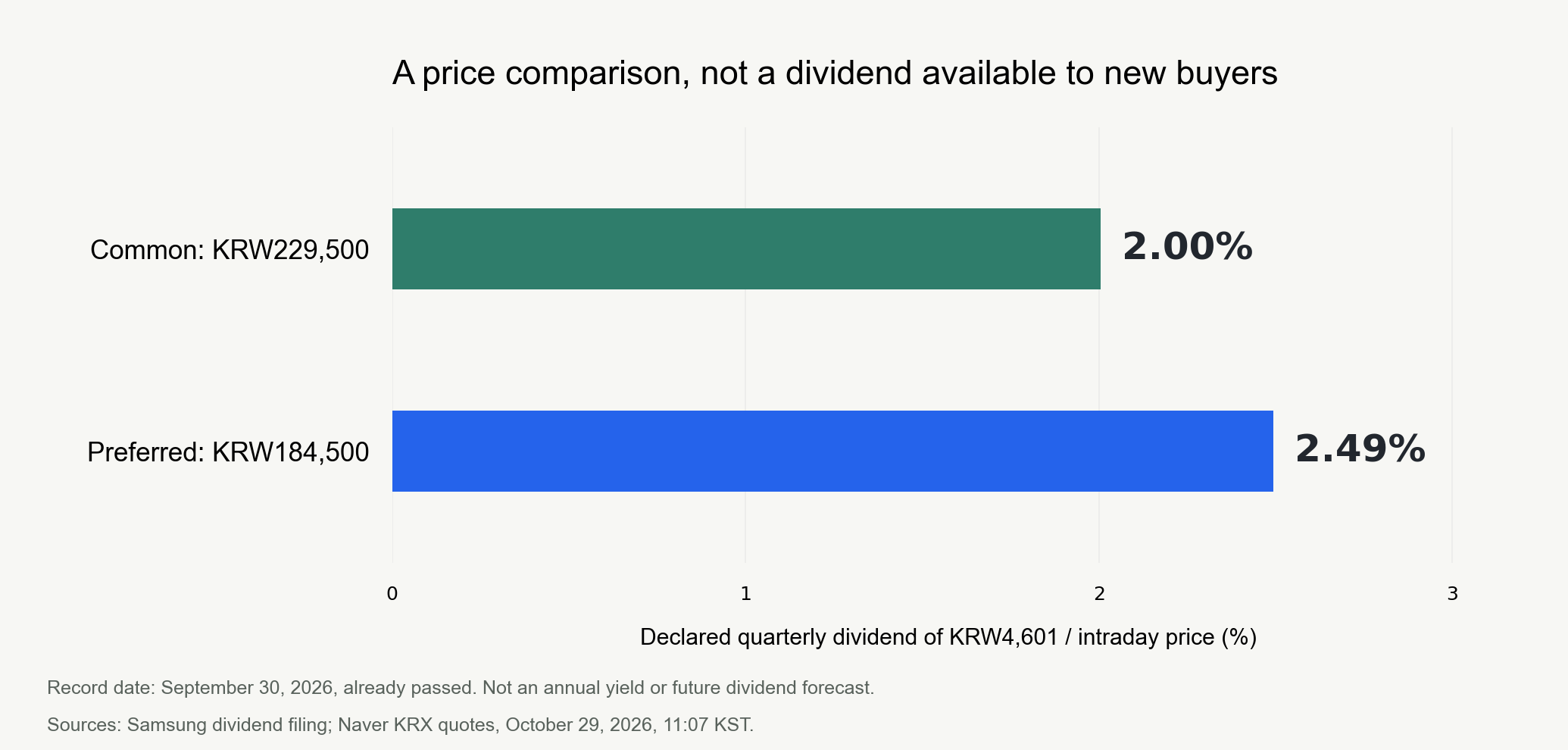
At the quoted prices, preferred shares traded at a 19.6% discount. The declared Q3 dividend is identical for both classes at KRW4,601 per share.
| Calculation | Result | Interpretation |
|---|---|---|
| 1 − 184,500 / 229,500 | 19.61% | Preferred price discount |
| 4,601 / 229,500 | 2.00% | Declared quarterly dividend / common price |
| 4,601 / 184,500 | 2.49% | Declared quarterly dividend / preferred price |
The record date was September 30. Buying today does not entitle the buyer to this dividend. These ratios compare prices; they are not annual yields or forecasts of future payouts. Dividend resolution
A narrower discount also means less remaining relative-value upside under a fixed common-price assumption. If common stays at KRW229,500 and the discount narrows to 15%, preferred would be KRW195,075, or 5.73% above the snapshot. At a 25% discount, it would be KRW172,125, down 6.71%. These are sensitivities, not targets or expected returns. Preferred can lose money even as the discount narrows if common shares fall enough.
Watch the purpose and the first purchase date
An unresolved return plan alone would not make me downgrade the memory-demand outlook. Samsung disclosed about KRW84.4 trillion of 2026 capital spending and expects AI demand to exceed supply in 2027. Those remain spending plans and company forecasts. Capital investment consumes cash, and a large net-cash balance is not the same as unrestricted distributable cash. Capex filing, official business outlook
Four disclosures could change the judgment:
- A new repurchase or trust agreement before January would require reassessing the distant-execution hypothesis.
- Its purpose, acquisition dates and share count would distinguish cancellation from compensation.
- New insurer disposals could inform the common-share return design, without by themselves proving imminent cancellation.
- The final January split across common, preferred and dividends would determine the demand directed at each security.
I have not verified an official source for May media claims of approximately KRW80 trillion in employee-share purchases over three years, so that figure is excluded from projected demand. I have also not obtained a complete Q&A transcript. Regulatory causation and the ranking of selling drivers remain analytical hypotheses, not company explanations.
If you could see just one disclosure before January, which would change your view most: the first purchase date, the preferred-share allocation, or an insurer stake sale? Leave your choice and the reasoning in the comments.
Public-source investment analysis, not an individualized trading recommendation. Prices and policy changes can alter the conclusion.