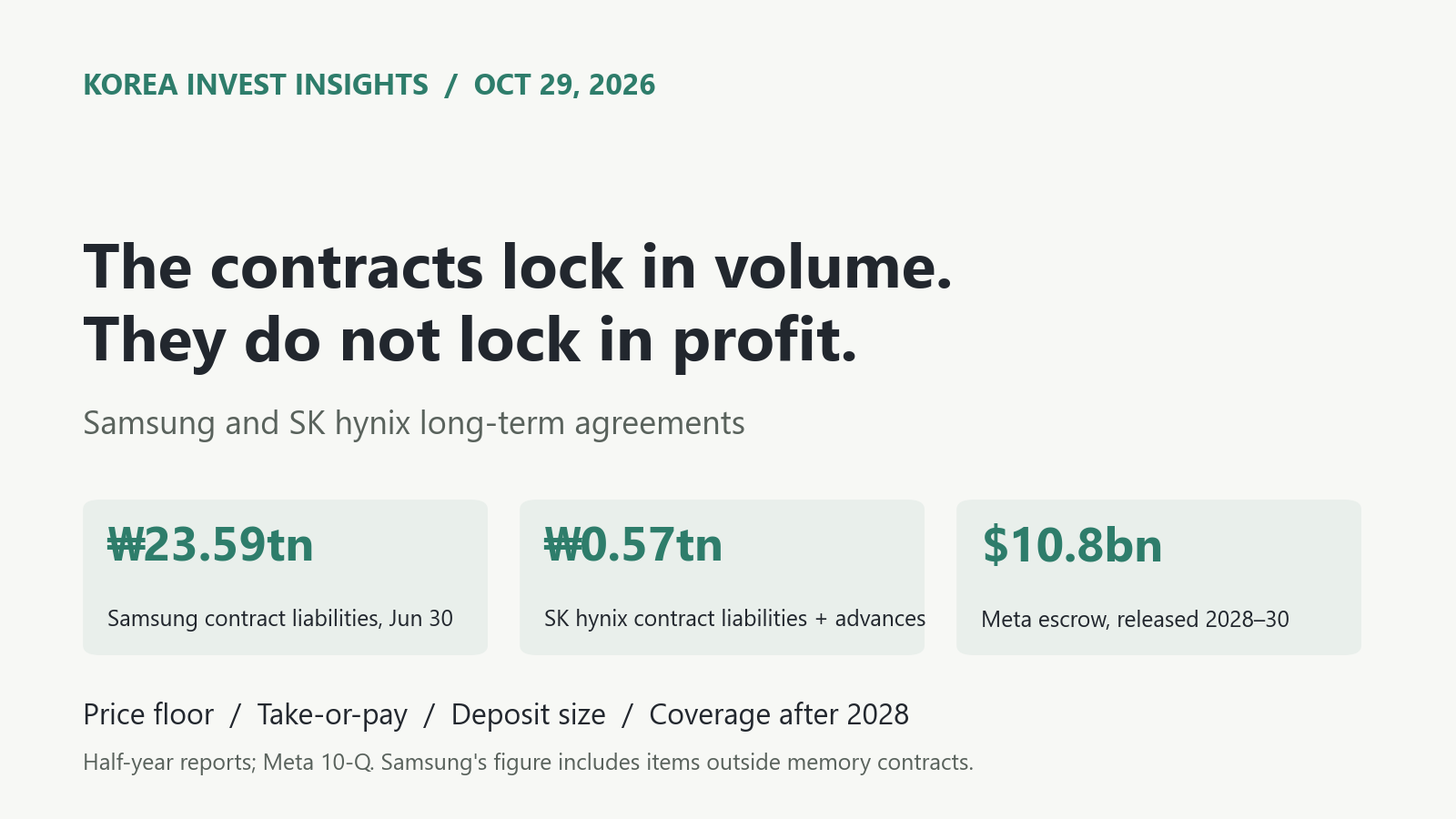
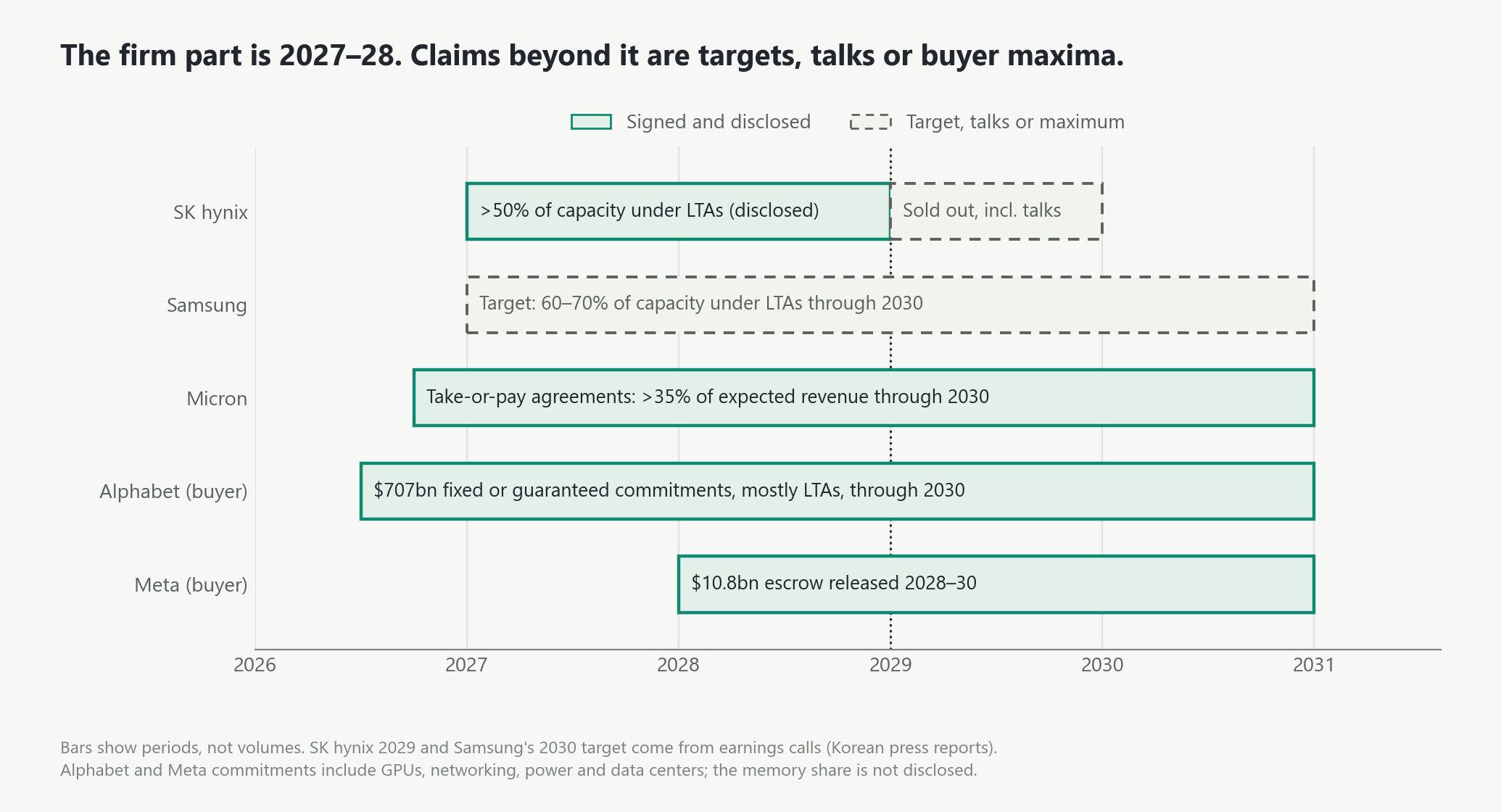
On its earnings call on October 29, Samsung Electronics said it had signed long-term agreements (LTAs) with 10 customers, was negotiating with 10 more, and aimed to cover 60–70% of its capacity through 2030. A day earlier, SK hynix said LTAs with 14 major customers cover more than half of its 2027 and 2028 capacity. On its call, the company described DRAM and HBM as effectively sold out through 2029.
Those are the strongest statements either company has made about demand. Their legal filings say something narrower. Samsung’s half-year report notes that the total order value and delivery period of its multi-year contracts may change with customer demand. SK hynix’s half-year report says it sets volumes and prices monthly and quarterly by mutual agreement and has no order backlog based on long-term contracts. On the buyer side, Alphabet’s CFO called a $924 billion purchase-commitment figure a maximum and said many contracts carry price and volume flexibility.
Our judgment: both companies’ LTAs are B-grade contracts. They lock in 2027–28 volume at market-linked prices. They are not a floor under profit. Delivery in 2027 looks safe, because the shortage itself enforces the contracts. How much the contracts protect profit in a downturn cannot be calculated until the price floor, the penalty terms and the size of deposits are disclosed. This does not change our scenario weights.
This article is dated October 29, 2026, after Samsung’s earnings call. Samsung and SK hynix balance-sheet figures are as of June 30, from their half-year reports. Microsoft and Meta figures are as of September 30. Alphabet had not filed its third-quarter 10-Q at the time of writing, so its $924 billion figure and the flexibility remark come from a call transcript. Statements from both Korean calls are taken from Korean press reports.
Five things to take away
- The firm part of the coverage is 2027–28. SK hynix has disclosed more than 50% of 2027 and 2028 capacity under contract. Samsung’s 60–70% through 2030 is a target. “Sold out through 2029” adds demand still under discussion to contracts already signed.
- Call language is about volume; filing language is about flexibility. Both are true. The gap is one reason Korean memory still trades at a low multiple of 2027 earnings.
- Buyers wrote the mirror image. Suppliers say terms may change. Alphabet says it may spend less than the maximum. Meta does not count variable obligations beyond minimum quantities or prices. A downturn after 2028 would travel through deferred volume and the bottom of price bands, not through broken contracts.
- Some of the collateral stays with the buyer. Meta holds $10.8 billion in escrow, to be released in 2028–30. Microsoft holds $12.6 billion of investments restricted under a supplier agreement. That pattern fits SK hynix showing only ₩0.57 trillion of contract liabilities and advances.
- Neither Korean company wins on contract quality. Samsung’s collateral is visible on its balance sheet. SK hynix is more specific about 2027–28 coverage, and it keeps about half its capacity outside LTAs, which raises both its upside and its downside.
A memory contract is only as strong as what the buyer must do in a downturn
“LTA” covers very different documents. We sort them into three grades by one test: what the buyer must still do when demand falls.
| Grade | What the contract contains | What happens in a downturn |
|---|---|---|
| A | Prepayment or deposit, take-or-pay, minimum volume, cancellation penalty | The buyer pays even if it takes less; the supplier keeps the cash |
| B | Committed volume; price linked to the market and reset periodically, sometimes inside a band | Volume is deferred and price falls to the bottom of the band |
| C | Forecasts, letters of intent, double ordering | Orders disappear |
Take-or-pay means the buyer pays for the contracted volume even if it takes less. Micron is the useful benchmark: it is the only one of the three large memory makers that discloses A-grade terms in its filings, although only for part of its revenue.
Both Korean contracts grade B; Micron is closest to A
The table answers one question: if demand weakens in 2028, what in the contract keeps the buyer paying?
| Samsung Electronics | SK hynix | Micron (benchmark) | |
|---|---|---|---|
| Signed | 10 customers signed, 10 in talks | 14 major customers | 26 strategic customer agreements |
| Coverage | Target: 60–70% of capacity through 2030 | Secured: more than 50% of 2027 and 2028 capacity | More than 35% of expected revenue through 2030 |
| Term | Five years by default, extended a year at a time | Typically five years; some customers ask for longer | Some run to 2031 |
| Price | Floor on commodity memory (level undisclosed), negotiated quarterly; HBM priced annually; 2027 HBM agreed at target prices | Market-linked within an agreed range; a ceiling is not mentioned | Fixed, or with upper and lower bounds, for about three-quarters of agreement revenue |
| Volume commitment | Half-year note: order value and delivery period may change | Half-year report: volume and price set monthly and quarterly; no LTA order backlog | Take-or-pay on all agreements |
| Cash collateral | Contract liabilities up ₩9.61tn in six months, to ₩23.59tn | Deposits said to exist, amount undisclosed; ₩0.57tn of contract liabilities and advances | $12.75bn of customer deposits received |
| Grade | B | B | Closest to A |
For Samsung and SK hynix, the honest answer to the question is that we do not know yet. Neither has disclosed a floor level, a minimum purchase obligation or a penalty. Sources: Samsung half-year review report, Samsung Q3 2026 IR presentation, Newsis on Samsung’s call, SK hynix half-year report, SK hynix Q3 release, Micron fiscal Q4 2026 prepared remarks.
The calls talk about volume. The filings talk about flexibility.
SK hynix’s “effectively sold out through 2029” was said on the call. The Asia Business Daily reported the basis: LTA volume already secured plus demand under concrete discussion. Digital Daily quoted the company’s head of DRAM marketing describing HBM over the next three years, a narrower scope. Asia Business Daily, Digital Daily. Either way, the statement describes visibility. It is not a disclosure of signed volume at fixed prices.
A correction to our earlier post. In our October 29 article on SK hynix’s results, we wrote that we could not find “sold out through 2029” in the published results materials and treated it as unconfirmed. That was accurate for the written materials. Several Korean reports of the call now confirm the statement, on the basis described above.
The filings are more precise. SK hynix’s half-year report, filed in English with the US SEC, says the company sets supply volumes and prices monthly and quarterly by mutual agreement with major customers, and that there is “no order backlog based on long term supply contracts.” Samsung’s half-year note on multi-year contracts says the total order value, the delivery period and other terms may change depending on customer demand and business progress.
The calls added detail on both sides. SK hynix’s CFO said deposits and other practical enforcement mechanisms exist, without giving an amount. He also said 2027 HBM volumes and prices have been agreed, and that the profit gap between HBM and commodity DRAM has narrowed meaningfully. Newspim. SK hynix said it will keep its LTA share at roughly 50% or more over the medium term and manage the rest of its capacity flexibly.
None of this is contradictory. The call statements are about how much demand the companies can see. The filings are about what the buyer is legally bound to take. A market that prices memory makers at a few times next year’s earnings is paying attention to the second.
Buyers disclosed the same flexibility from the other side
If the suppliers’ filings leave room to move, the buyers’ filings should show the same room. They do.
| Buyer | Commitments in filings | What the filing or call says about flexibility | Collateral disclosed |
|---|---|---|---|
| Alphabet | $707.0bn of fixed or guaranteed commitments beyond one year at June 30, the significant majority LTAs, generally fulfilled through 2030. Total purchase commitments $811.0bn, up from $149.1bn at end-2025 | CFO on the Q3 call: $924bn is the maximum contractual obligation; many contracts allow price and volume flexibility, so spending could be lower | None disclosed |
| Meta | $454.52bn of non-cancelable commitments at Sept 30, up from $349.31bn at June 30. $121.41bn due in 2027, up from $81.65bn | For agreements with variable terms, Meta does not estimate obligations beyond minimum quantities or pricing | $10.80bn of money market funds in escrow, released 2028–30; $1.53bn of unused letters of credit |
| Microsoft | $194.06bn of purchase commitments at June 30, 87% due within fiscal 2027, including take-or-pay | Higher memory and storage prices are built into its capex plan | $12.6bn of investments restricted under a supplier agreement; $35.7bn of receivables from facilitating server-component purchases |
The suppliers wrote that terms may change. The buyers wrote that they may spend less than the headline. When both sides of a contract disclose the same flexibility, a downturn does not have to break the contract to reach the supplier’s profit. It arrives as deferred volume and as prices drifting to the bottom of the agreed range.
Two caveats apply. Buyer commitments include GPUs, TPUs, networking, power and data-center construction; the memory share is not disclosed, and we did not estimate it. None of the three buyers names its memory suppliers. Sources: Alphabet Q2 10-Q, Alphabet Q3 call transcript, Meta Q3 10-Q, Microsoft FQ1 2027 10-Q, Microsoft FY2026 10-K.
Some of the collateral sits on the buyer’s balance sheet
A supplier deposit is usually pictured as cash the buyer hands over. The filings show a second structure: the buyer locks up its own assets as security and keeps them on its own balance sheet.
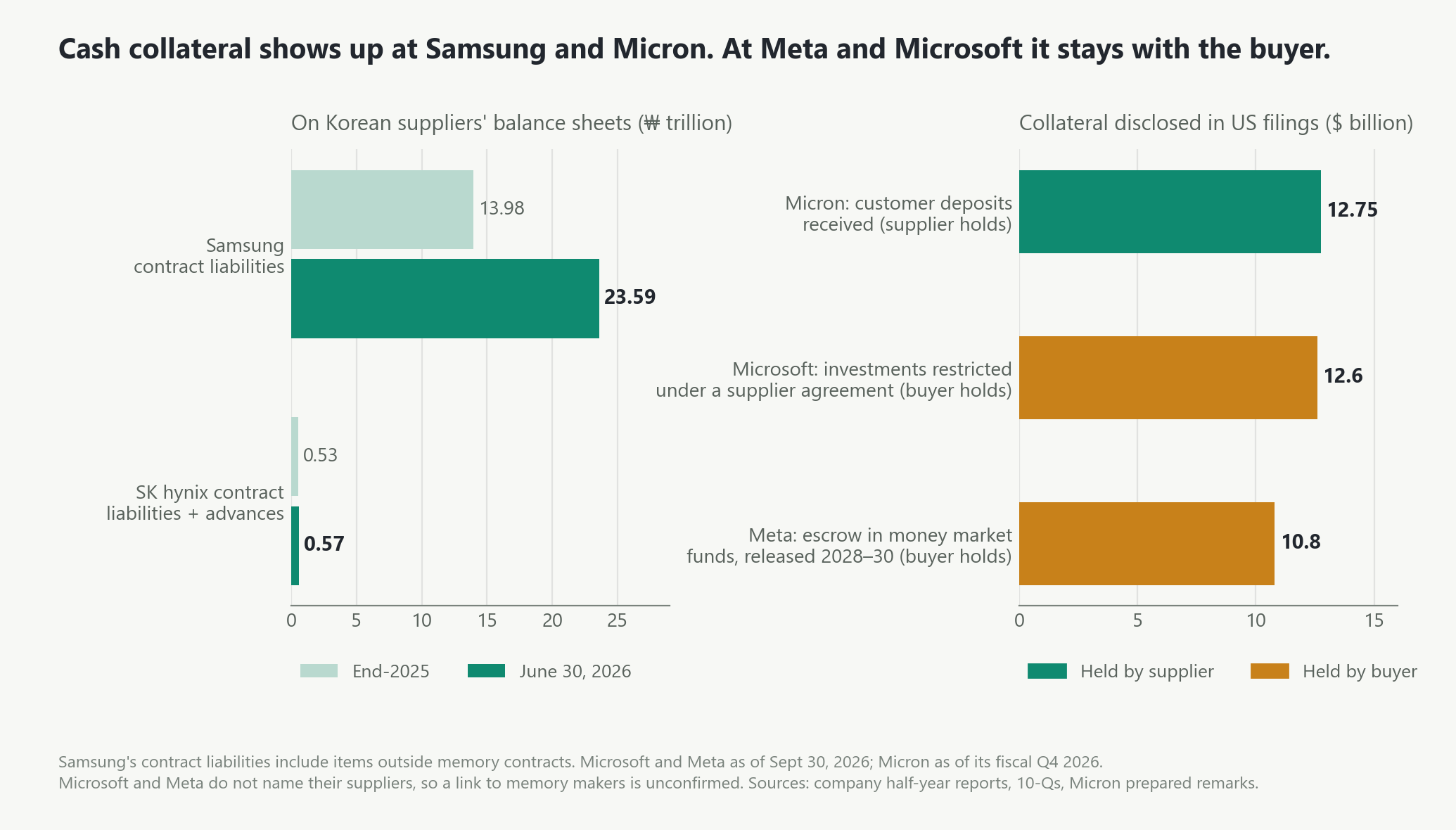
Samsung’s collateral is visible. Its contract liabilities rose from ₩13.98 trillion at the end of 2025 to ₩23.59 trillion at June 30, an increase of ₩9.61 trillion, or 68.8%. That is a change against the year-end balance, not a year-on-year change, as some reports described it. In the same period Samsung said it had written substantial deposit-like advances into its contracts. Not all of the balance is memory LTAs, since other businesses also carry contract liabilities. Other non-current liabilities rose from ₩7.95 trillion to ₩24.47 trillion over the same six months, but Samsung does not say where LTA deposits are booked, so we do not add the two accounts.
SK hynix’s collateral is barely visible. Contract liabilities were ₩0.52 trillion at June 30 and advances received ₩0.05 trillion, ₩0.57 trillion together. That is 2.4% of Samsung’s contract liabilities. Either the deposits had not been received by June 30, or they sit outside the balance sheet. A Korean report in August said the deposits are held in a third-party trust. The company has not confirmed that. MTN.
Meta and Microsoft keep the collateral themselves. Meta reclassified $10.80 billion of money market funds as restricted cash for escrow under multi-year infrastructure purchase agreements, to be released between 2028 and 2030 as it meets the purchase obligations. Microsoft’s investments restricted under a supplier agreement rose from $11.3 billion to $12.6 billion in the quarter, and its receivables from helping buy server components rose from $27.8 billion to $35.7 billion. With this structure, the supplier gets assurance that the buyer will perform, but not cash. It matches what SK hynix’s balance sheet shows. The link to memory makers is still unconfirmed, because neither buyer names the supplier.
Samsung’s summary third-quarter balance sheet shows other liabilities falling from ₩52.15 trillion to ₩48.63 trillion, and deferred revenue and other advances from ₩4.47 trillion to ₩3.81 trillion. The composition is not disclosed, so we do not read it as falling LTA deposits. The full quarterly report, due around November 13–16, will show contract liabilities at September 30.
2027 is protected by the shortage, not by the paperwork
In a shortage, even a B-grade contract behaves like an A-grade one. SK hynix says customers are asking for more than twice the HBM it can supply, and Samsung says its sellable 2027 HBM volume is already committed. A buyer that walks away from its contract now must buy at spot prices or from another supplier, and pay more.
The buyers are also signalling that they intend to take the volume. Meta’s commitments due in 2027 rose by $39.8 billion in one quarter, or 49%. Microsoft built higher memory and storage prices into its capex plan. Alphabet’s commitments under supply agreements run to 2030.
What would break this: a customer asking to defer 2027 volume, or spot prices falling below contract prices during 2027. Neither has been reported.
After 2028, the flexibility clauses decide
Once new fabs arrive, the shortage stops enforcing the contracts, and only two terms are left to protect profit: the price floor and the minimum volume. Neither company has disclosed either. That is why a view on 2029 earnings cannot yet be proved from the contracts, and why we do not use the LTAs to argue that the market’s discount to post-2028 earnings is too steep.
SK hynix’s 50% rule cuts both ways. Keeping about half of its capacity outside LTAs leaves room to earn more if the shortage lasts. If supply overtakes demand, that half is exposed to spot prices. If the contracted half also has a ceiling, SK hynix gives up some upside in a boom. The company has not said whether one exists.
One early signal is worth watching. SK hynix said some customers may move HBM from 12-high to 8-high stacks and offset the lost capacity with higher capacity per die. The company frames this as a response to the shortage and says it is already in its supply plan, so we do not treat it as a sign of weakening demand. Still, a change in what buyers specify is the kind of adjustment that would come first if they start economizing.
If credit tightens, which is our credit-squeeze case, the first thing to bend would be whether buyers use the flexibility they disclosed. Microsoft’s commitments are mostly due within a year. Alphabet’s run to 2030. Meta’s escrow is tied to 2028–30.
Samsung versus SK hynix: different strengths, no winner
We do not rank the two on contract quality. Samsung leads on visible collateral: ₩9.61 trillion of new contract liabilities in six months is the clearest sign of cash changing hands at either company. SK hynix leads on specificity: it has named the share of 2027–28 capacity under contract and described its price mechanism.
The bigger difference is cyclical exposure. SK hynix keeps about half its capacity outside LTAs by design. That makes its earnings more sensitive in both directions. Which company is better protected in a downturn can only be decided once the floor levels and penalty terms are public.
Our judgment, and what would change it
The LTAs make 2027 delivery highly likely and leave the size of post-2028 downside unknown. Our scenario weights are unchanged: S1 rebound 50%, S2 credit squeeze 15%, S3 demand slowdown 15%, S4 macro shock 20%. These are our subjective estimates; the rebound case sets out what would confirm the first. The price-floor level and HBM4 pricing per gigabyte remain undisclosed.
The next readings are close. The probabilities below are our subjective estimates.
| When (KST) | What to read | Base case | What would change the view |
|---|---|---|---|
| Oct 30–31 | Alphabet Q3 10-Q, commitments note | Fixed or guaranteed commitments of $707bn or more (80%) | Flexibility language written into the note itself would move it from a call remark into a filing |
| Around Nov 13–16 | Samsung Q3 quarterly report: contract liabilities at Sept 30 | ₩20–27tn (55%); above ₩27tn (25%); below ₩20tn (20%) | Below ₩20tn would mean falling advances, a weakening LTA signal; above ₩27tn would mean more collateral |
| Around Nov 13–16 | SK hynix Q3 quarterly report: order status | “No LTA order backlog” unchanged (85%) | A disclosed backlog or deposit amount would lift its contract quality within grade B |
| Mid-December | Micron fiscal Q1 2027: contract backlog and deposits | Backlog near $150bn holds (70%) | A lower backlog or changed deposit-return terms would signal weaker contract quality across the industry |
| Late January 2027 | Samsung and SK hynix Q4 calls | Floor level, HBM4 price per gigabyte and deposit amount stay undisclosed (85%) | Any of the three in numbers would let us size the downside protection |
Which number would make you treat these contracts as a floor under profit: the price-floor level, a take-or-pay clause, or the deposit amount? Tell us what you would need to see.
Research and information only; not investment advice. Estimates and scenarios are analytical assumptions, not company guidance, trade instructions or personalized portfolio decisions. Figures are date-bound. AI tools assisted research and editing.
Interest disclosure: We use AI models, including Anthropic’s Claude, in our research. Alphabet is an investor in Anthropic and one of its cloud providers, and some Microsoft Copilot features use Anthropic models. Only public disclosures are cited; no assessment is made of the effect on either company.