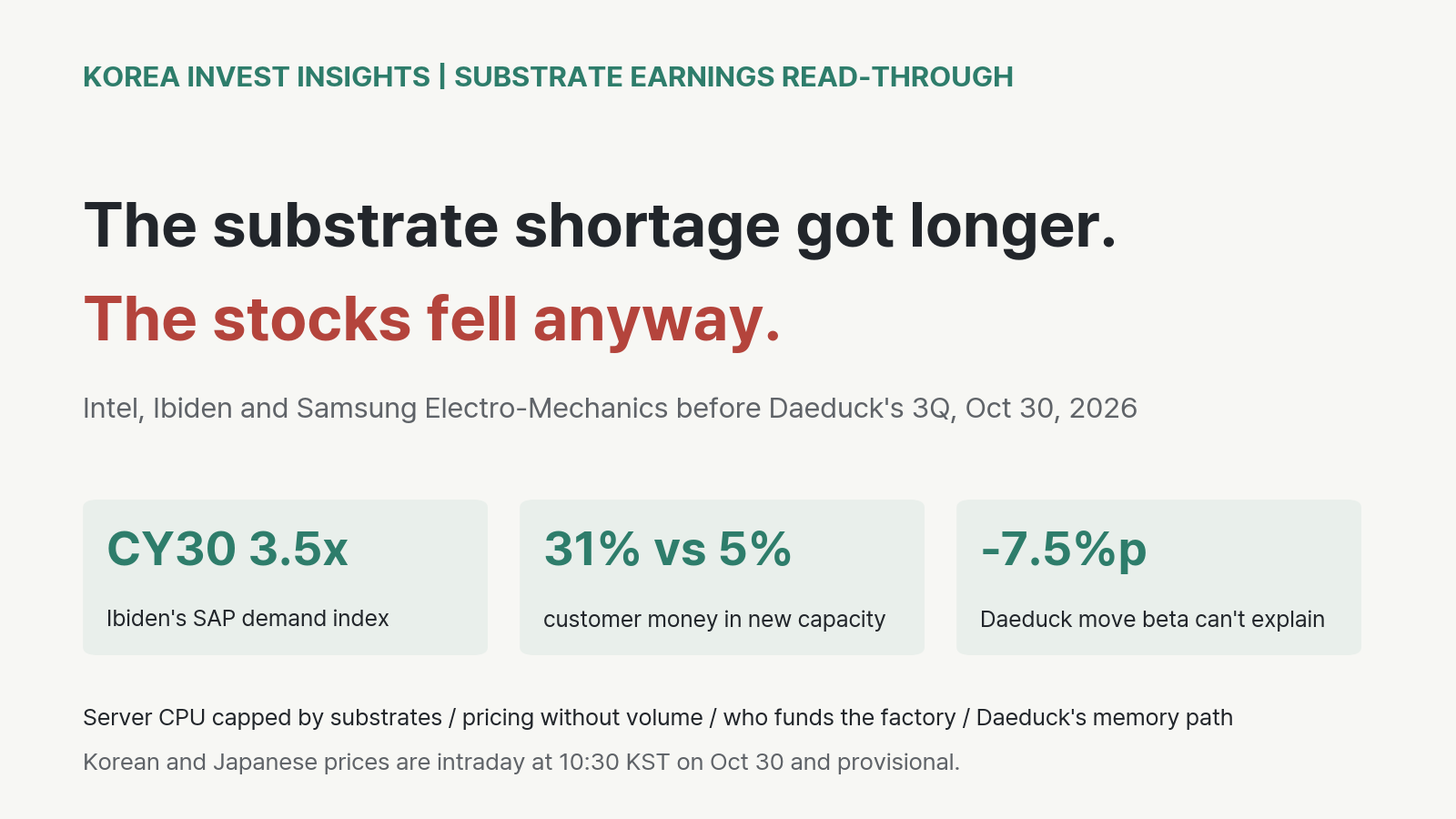
This week the substrate makers and their biggest customer reported one after another. Samsung Electro-Mechanics (SEMCO) reported on October 28, Ibiden on the afternoon of October 29, and Intel after the US close the same day. They pointed the same way. Advanced chip substrates are a bottleneck for AI and server chip supply, and the shortage runs past 2027.
- Intel: The CEO said “an industry wide shortage of advanced organic substrates for our EMIB packaging is also impacting our ability to scale output.” The CFO expects industry server CPU units to grow more than 30% in both 2026 and 2027, and higher “if additional industry supply were available.” Intel prepared remarks
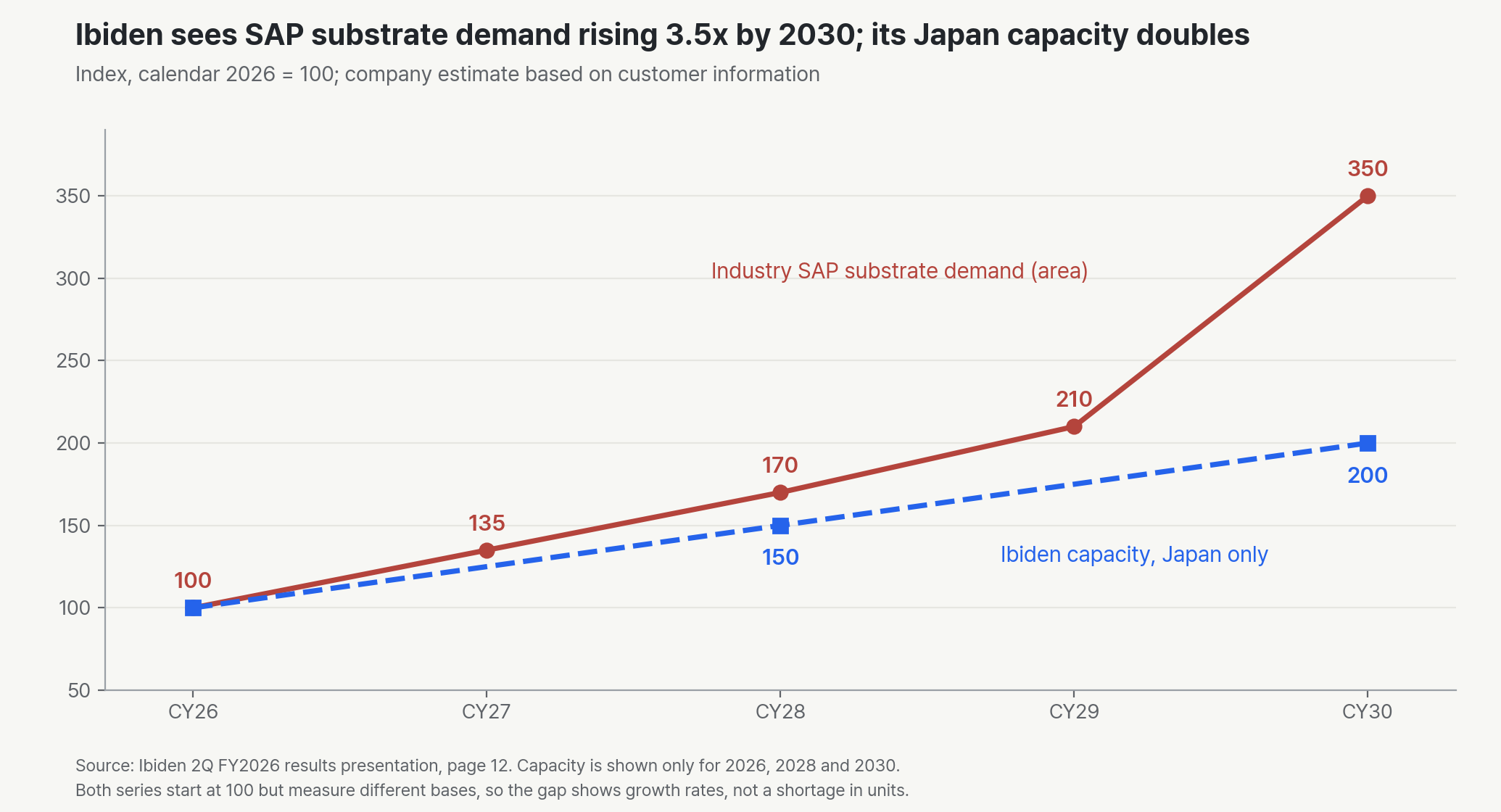
- Ibiden: It expects high-end substrate demand in 2030 at 3.5 times the 2026 level, well above industry capacity. It raised its fiscal 2027 operating profit guidance by JPY 15bn without changing revenue. Ibiden results presentation
- SEMCO: Package Solution revenue rose 22% from the prior quarter. Its fourth-quarter outlook says AI data-center customers keep asking for more supply. SEMCO 3Q IR
Then on the morning of October 30, Ibiden hit its daily limit-down (-15.2%), SEMCO fell 9.4% and Daeduck Electronics fell 13.0%. The KOSPI was down 4.7%.
Our view: today’s selling is not a verdict on the substrate cycle. The market left 2027 substrate profits alone and cut the multiple it pays for 2028 and beyond. Beta explains most of SEMCO’s drop. Daeduck has about 7.5 percentage points that beta does not explain. The signal that reaches Daeduck runs through memory substrate pricing, not the server bottleneck, and today’s 3Q release should be read on two things: fourth-quarter pricing and who pays for its new capacity.
On October 28 we said Daeduck’s results should be read on pricing, yield and cash collection. KII, Oct 28 Two days later Ibiden and Intel showed the industry benchmark for two of those: pricing and customer money.
We wrote this at 10:35 a.m. KST on October 30, before Daeduck’s 3Q numbers came out. Korean and Japanese prices are intraday at 10:30 a.m. KST on the same day and provisional.
Intel’s shock reads differently for PCs and servers
Intel’s third-quarter revenue was $16.5bn, up 21% from a year earlier, and non-GAAP EPS was $0.52. Data Center and AI revenue was $7.3bn, up 78%. The problem was the fourth-quarter guide: revenue of $15.0-16.0bn and non-GAAP EPS of $0.25, well below market expectations of about $17.1bn and $0.44. The stock fell 23% after hours. Intel 8-K
The causes split between PCs and servers.
| Business | What Intel said | What it means for substrates |
|---|---|---|
| PC | PC units fall about 12% in 2026 and about 10% in 2027, with no recovery “until memory availability improves and pricing begins to normalize” | Negative for PC substrate volume |
| Server | Server CPU units grow more than 30% in both 2026 and 2027, but the EMIB substrate shortage limits output. The industry stays supply-constrained “throughout 2027 and into 2028” | Positive for pricing and utilization of large server substrates |
Intel’s 8-K risk factors also cite “current industry-wide substrate and memory shortages.” On the call, management said substrate suppliers are adding about 40% capacity, mostly in the second half of 2027 (call transcript, secondary source). That makes the first half of 2027 the tightest stretch for server substrates.
The server side is the one that matters for substrate makers. The world’s largest server CPU supplier named substrates as a reason it cannot ship more. The rent from that scarcity goes to the makers with large, high-layer FC-BGA capacity: Ibiden, Shinko, Unimicron and SEMCO. Intel did not name its suppliers, and we have no primary evidence that SEMCO supplies Intel.
Ibiden raised profit without volume, and its customers pay for the plants
Ibiden’s fiscal second quarter (July to September) brought revenue of JPY 139.3bn (+42.1%) and operating profit of JPY 33.2bn (+122.5%). The electronics segment margin rose to 30.2% from 27.6% in the first quarter. Ibiden does not disclose standalone second-quarter figures, so these are first-half totals minus the first quarter. Ibiden 2Q earnings release
The shape of the guidance says more than the quarter.
- Fiscal 2027 operating profit guidance went from JPY 150bn to JPY 165bn, with revenue held at JPY 650bn. Profit rose JPY 15bn on the same sales. Ibiden did not give a breakdown. We read it as pricing and mix. In its first-quarter Q&A, Ibiden said average substrate prices rose more than expected because of the industry shortage.
- Customer advances went from JPY 80.95bn at the end of March to JPY 199.75bn at the end of September. That is 2.47 times in six months. Customers are paying before the plants are built.
- A new investment of about JPY 151bn. The earnings release describes it as high-performance IC package substrates for CPUs, coming online in stages from fiscal 2029. Nikkei reported that the president said the plan came out of talks with Intel. Ibiden says it will decide on further expansion (Cell 7 and 9) by March 2027, after it settles terms with customers.
Ibiden rose 2.0% on results day, then fell to its daily limit-down of JPY 8,359 on October 30. It had gained 19.5% in the three sessions before the release. Japanese market coverage tied the selling to its exposure to Intel as a major customer after Intel’s after-hours plunge. Traders Web If that is right, much of Ibiden’s excess drop is Intel customer risk. It should not be copied onto Korean makers with little Intel exposure.
Today’s selling looked like a basket trade
After the US Big Tech reports, AI hardware sold off as a group. Meta issued $25bn of common stock and $12.5bn of mandatory convertible preferred, and plans a $60bn at-the-market share program from the first quarter of 2027. Amazon’s third-quarter free cash flow was -$33.5bn on its own definition. The funding risk of AI capex rose in a single day.
- Taiwan’s substrate makers fell too: Unimicron about -6.3%, Kinsus about -4.2% and Nan Ya PCB about -6.6%, or 1.4 to 2.2 times the TAIEX (-3.0%), based on 10:30 a.m. KST quotes.
- In Korea, the selling ran through program trading. A broker’s provisional intraday tally at about 10:15 a.m. showed net program selling of KRW 331.4bn across the KOSPI. SK hynix (KRW -201.1bn) and SEMCO (KRW -144.5bn) together exceeded that total. Net program selling was 39% of turnover in SEMCO and 47% in Daeduck.
Take out the market and the stocks separate. We estimated KOSPI betas from daily returns over 60 trading days to October 28: 1.38 for SEMCO and 1.17 for Daeduck.
| Stock | Beta | Beta-implied move | Actual | Unexplained |
|---|---|---|---|---|
| SEMCO | 1.38 | -6.5% | -9.4% | -3.0pp |
| Daeduck | 1.17 | -5.5% | -13.0% | -7.5pp |
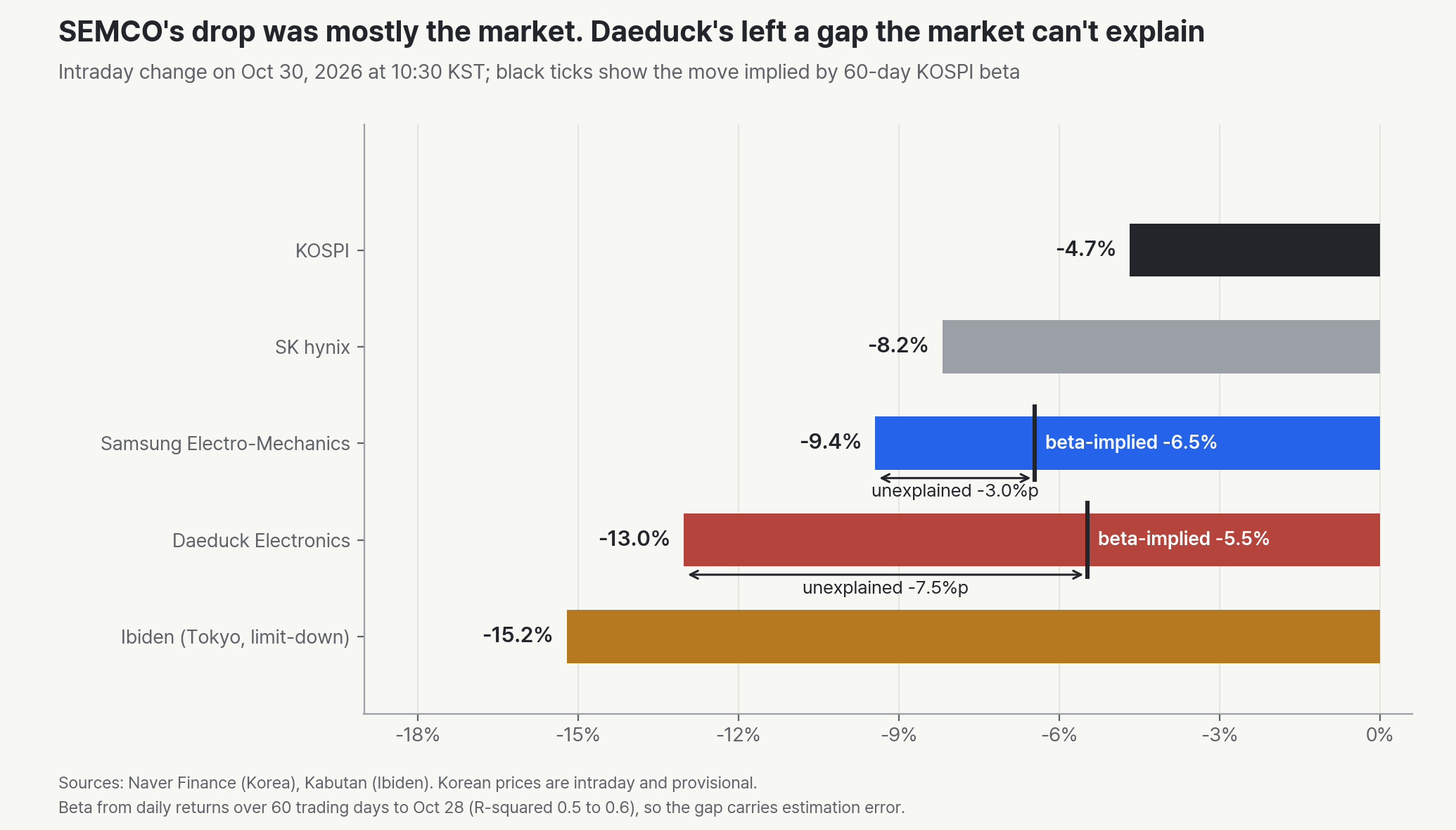
Both stocks have a typical daily residual (standard deviation) of about 4pp. SEMCO’s -3.0pp sits inside that. Daeduck’s -7.5pp is about 1.8 times it. The betas have an R-squared of 0.5 to 0.6, so these gaps carry estimation error.
SEMCO: the most direct read-through, and a market-sized drop
SEMCO’s third-quarter revenue was KRW 3.7633tn (+30%) and operating profit was KRW 691.0bn, an 18.4% margin. Package Solution revenue was KRW 939.0bn, up 58% from a year earlier and 22% from the prior quarter. That matches the sequential growth of Ibiden’s electronics segment (+22.6%). SEMCO named server CPU, AI accelerator and networking supply as the FC-BGA growth drivers.
| Variable | This week’s signal | Direction for SEMCO |
|---|---|---|
| Server and AI substrate supply | Intel’s “industry wide shortage,” Ibiden’s 2030 demand view, SEMCO’s own fourth-quarter “customers keep asking for more supply” | Positive, the largest variable |
| Pricing | Ibiden’s fiscal 2027 profit raised on unchanged revenue | Positive, SEMCO does not disclose package margin |
| PC | Intel’s PC unit declines in 2026 and 2027 | Mildly negative, PC share undisclosed |
| 2028 supply | Intel suppliers add capacity in 2H27, Ibiden’s new capacity in fiscal 2029, SEMCO’s Sejong plant in 2H28 | Multiple discount |
SEMCO does not need to supply Intel to benefit. Intel’s shortage adds one more buyer competing with AMD and hyperscaler ASIC customers for the same capacity. SEMCO’s drop today matched Taiwan’s substrate stocks, and beta explains most of it. On this week’s information, SEMCO’s substrate case got stronger and only its price got weaker.
Daeduck: the signal comes through memory substrate pricing
Daeduck’s second-quarter revenue was KRW 401.0bn and operating profit was KRW 70.3bn (17.5%). Revenue split into FCCSP 43%, FCBGA 23%, CSP 20% and MLB 14%. Its own materials list FCBGA uses as autonomous driving, optical modules, networking and CXL controllers. That is a different product tier from the EMIB substrates for server CPUs that Intel described. Daeduck 2Q IR
| This week’s signal | Path to Daeduck | Direction |
|---|---|---|
| Intel’s EMIB substrate shortage | No direct path | Small |
| Top makers running full | If top makers fill up with CPU and GPU substrates, networking and optics customers may move to second-tier makers | Mildly positive, still a hypothesis |
| Memory shortage persists | Intel says PCs will not recover before memory normalizes; if memory makers run flat out on constrained supply, memory substrate volume and pricing hold | Positive |
| Fewer PCs | While memory supply is tight, chips that PCs give up go to server DDR5 and SOCAMM | Slightly negative |
| Ibiden’s pricing | Higher industry average prices give second-tier makers bargaining power too | Positive, size unknown |
A broker estimate puts memory substrates at about 44% of Daeduck’s second-quarter revenue (Yuanta Securities, secondary source). So the Intel signal that reaches Daeduck is delayed memory normalization, not the server bottleneck. Memory substrates are a pricing business more than a volume business. SEMCO’s October 19 filing of a KRW 360.5bn package substrate supply contract sends the same signal. The contract covers calendar 2027. The counterparty is disclosed only as a “global large company,” and there is no advance payment. SEMCO contract filing Supply is tight, but customers are not paying for capacity in that market.
This is where Ibiden and Daeduck differ in numbers.
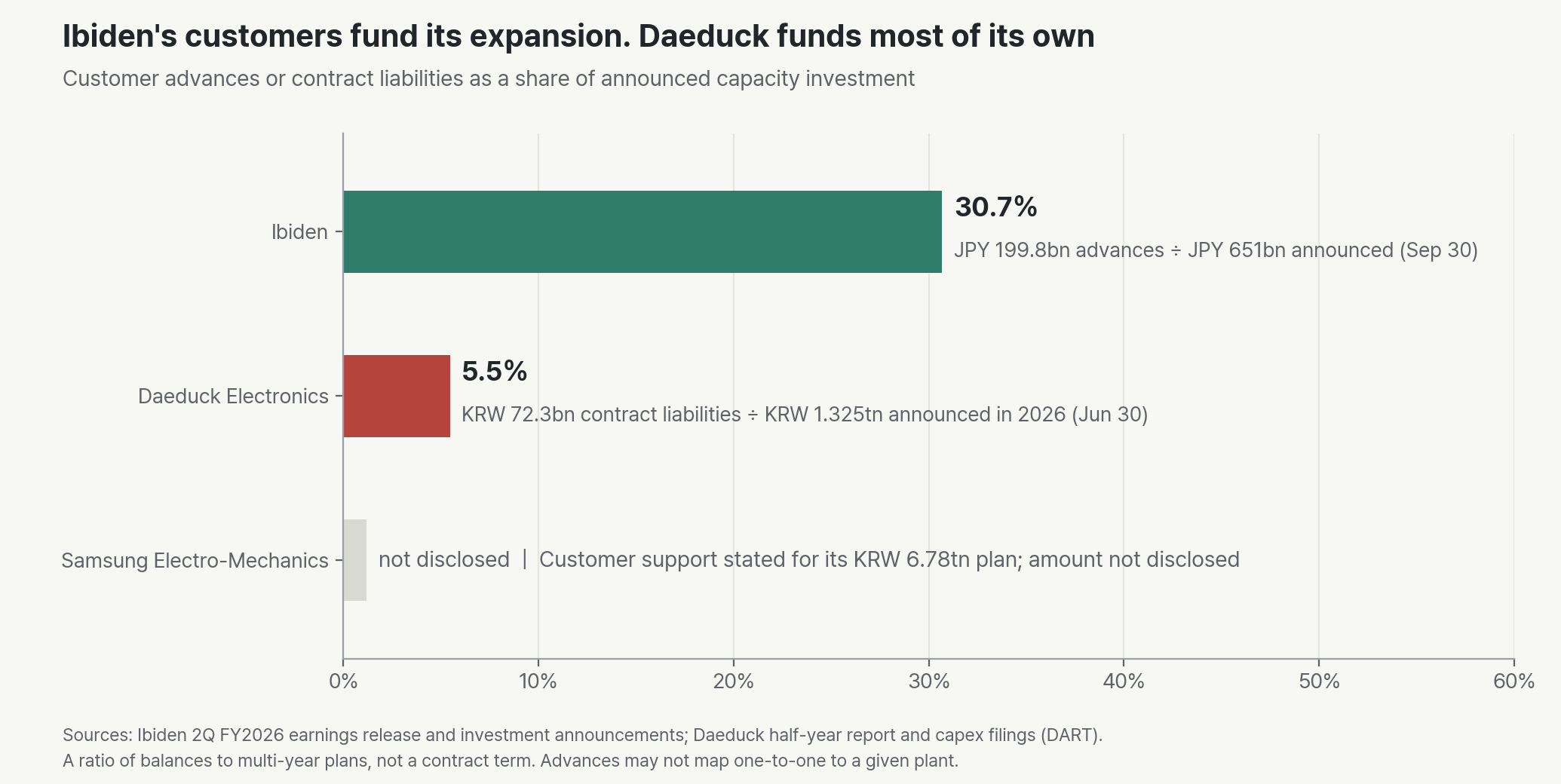
Daeduck’s 2026 capacity filings were KRW 213bn in May, KRW 497bn in July and KRW 615bn in October, KRW 1.325tn in total. Its contract liabilities at the end of June were KRW 72.3bn, about 5.5% of that. The October filing did not name the product or site, and listed internal funds and external borrowing as funding sources. Daeduck capex filing Customer money covers about 31% of Ibiden’s expansion. Daeduck builds mostly with its own money. On a day when the market reprices AI capex funding risk, that difference can show up as a discount.
How to read Daeduck’s -7.5pp
On information alone, Daeduck should have fallen less than SEMCO, because its Intel and PC exposure is smaller. It fell more. The one confirmed difference between the two is the earnings calendar. SEMCO reported on October 28, and Daeduck reports today. We read the gap as de-risking before the print. Holders who watched Ibiden hit limit-down the day after a strong report cut exposure before seeing Daeduck’s numbers. A discount for self-funded capex is a secondary hypothesis. We did not check trading by broker, so both remain hypotheses.
What would change our read: if third-quarter operating profit comes in clearly below consensus and the margin falls well below the second quarter’s 17.5%, we would treat today’s gap as selling that front-ran the numbers.
What to look for in today’s 3Q release
Daeduck said it would post its 3Q IR materials on its website on October 30. Its conference call is at 9:00 a.m. KST on November 4. IR schedule filing
| Item | Reference | How to read it |
|---|---|---|
| 3Q operating profit | Naver consensus KRW 77.6bn; selected broker reports KRW 80.4-82.2bn | A number inside that range may meet Ibiden-style “sell the good news” |
| Operating margin | 2Q 17.5% | Whether pricing ran ahead of cost increases |
| 4Q pricing | When memory substrate price increases apply | If they hit fourth-quarter shipments, 2027 estimates go up |
| Large FC-BGA | Whether large networking and optics substrates are in mass production | A server-CPU-class customer would turn the spillover hypothesis into fact |
| KRW 615bn expansion | Product, site and customer undisclosed | Customer prepayments or long-term supply agreements would shrink the self-funding discount; check on the November 4 call |
Ibiden hit limit-down the day after operating profit more than doubled and guidance went up. A KRW 80bn-range quarter alone is unlikely to move Daeduck’s stock. The reaction will turn on when fourth-quarter pricing reaches shipments, and whether customer money backs the expansion.
The market is cutting 2028
The candidates for what the market cut today are in the table below.
| Variable | Evidence | Weight in today’s selling |
|---|---|---|
| 2028 supply wave | Intel suppliers add about 40% (2H27), Ibiden’s new capacity (fiscal 2029), SEMCO Sejong (2H28) | Not new today |
| AI capex funding risk | Meta’s equity raise and ATM plan, Amazon’s negative free cash flow | Rose today; memory, Taiwan and Japan AI hardware fell together |
We see funding risk as the main driver of today’s selling. The supply wave is a known schedule. What changed today is the funding conditions of the customers. Substrate profits are solid through 2027. The multiple depends on whether customers can keep paying after 2028.
The evidence that would change this view is specific. If Ibiden’s customer advances keep rising next quarter and hyperscalers hold their 2027 capex plans after raising equity, today’s discount was too deep. If Ibiden pushes the Cell 7 and 9 decision past March 2027 because it cannot settle customer terms, or if advances fall, the market was right.
What to watch next
| When | What | How to read it |
|---|---|---|
| Oct 30 | Daeduck 3Q preliminary results and IR materials | Operating profit, margin, memory, non-memory and MLB split, 4Q pricing |
| Nov 4-6 | Daeduck call and NDR | Use of the KRW 615bn, customer prepayments and LTAs, server-CPU-class customers |
| Early Nov | Ibiden 2Q Q&A summary | Quarterly price talks, CPU customers, Cell 7 and 9 terms |
| Early Nov | AMD 3Q | Server CPU supply constraints and substrate comments |
| Mid-Nov | Daeduck 3Q quarterly report | Change in contract liabilities (advances) |
| By Mar 2027 | Ibiden Cell 7 and 9 decision | Customer terms and size of advances |
Was today’s substrate selling about 2028 supply or about AI capex funding? Tell us which number in Daeduck’s release would convince you today’s drop went too far.
Key sources
- Intel 8-K, third-quarter results, Oct 29
- Intel CEO and CFO prepared remarks, Oct 29
- Ibiden fiscal 2026 2Q earnings release (kessan tanshin), Oct 29
- Ibiden fiscal 2026 1Q earnings release
- Ibiden 2Q results presentation
- Ibiden 1Q Q&A summary
- Nikkei, Ibiden president’s briefing, Oct 29
- Traders Web via Yahoo! Finance Japan, Oct 30
- SEMCO 3Q results IR materials
- SEMCO package substrate supply contract filing, Oct 19
- Daeduck 2Q IR materials
- Daeduck capex filing, Oct 22
- Daeduck half-year report (contract liabilities)
- Daeduck IR schedule filing, Oct 15
- Kabutan, Ibiden daily prices
- Naver Finance prices and consensus, Taiwan Stock Exchange real-time quotes, intraday Oct 30
For research and information only, not investment advice. The beta split and cause attribution are analytical assumptions, not company guidance, trading instructions or personal portfolio decisions. Figures are dated, and Korean, Japanese and Taiwanese prices are intraday and provisional. AI tools were used in research and editing.