On July 16, 2026, House Select Committee on China Chairman John Moolenaar and Ranking Member George Whitesides sent a letter to the Secretary of Commerce. The two lawmakers called for tighter export controls on CXMT and YMTC, a prohibition on U.S. companies procuring their memory for AI systems and data centers, and allied participation — from South Korea, Japan, and the EU — in the same supply-chain rules.
The letter is real. Its language is strong. It is not, however, a regulation, an executive order, or a statute. This is a bipartisan policy demand addressed to the executive branch, not an enacted Chinese memory embargo. Conflating the two risks materially overstating the near-term significance for equity prices.
That does not mean the letter is inconsequential. If these demands translate into actual policy, the United States and its allies will find it harder to fill memory shortfalls with Chinese supply. This is not an event that immediately increases HBM shipments, but it does reduce the concern that CXMT and YMTC capacity additions in 2027–2028 will collapse global pricing. The China oversupply discount that investors have been applying to normalized earnings and target multiples for Samsung, SK Hynix, and Micron could narrow.
Context: This article follows Will Apple Really Use CXMT? and CXMT IPO and Memory Price Risk. Those earlier pieces addressed Chinese memory supply expansion and Apple’s use of alternative suppliers as a negotiating lever. This piece examines how the memory cycle changes if the United States moves to close that supply channel through policy. Related material is available at the AI HBM Hub and the Exclusive Analysis Hub.
TL;DR
- The July 16 House Select Committee letter has been officially confirmed. It is, however, a policy demand from two members of Congress addressed to the Commerce Department — not an enacted regulation.
- Three demands are on the table: strengthen controls on YMTC and accelerate CXMT’s Entity List review; prohibit U.S. persons and entities from procuring Chinese DRAM, HBM, and other memory for AI systems, data centers, federal IT, and critical infrastructure; coordinate with South Korea, Japan, and the EU on equivalent standards.
- The Entity List restricts the export, re-export, and in-country transfer of items subject to U.S. Export Administration Regulations when a listed entity is a party to the transaction. It does not automatically prohibit U.S. companies from purchasing finished Chinese memory products domestically. A purchase ban requires a separate executive order, agency directive, or legislation.
- If enacted, the policy is positive for market share and pricing power at Samsung, SK Hynix, and Micron. SanDisk and Kioxia also benefit as YMTC’s path into global NAND and enterprise SSD markets becomes more constrained.
- Product-level directness varies. Mobile and PC DRAM and NAND could feel the impact immediately; advanced HBM faces limited near-term supply alternatives regardless. This is more relevant to defending post-2028 competitive risk and multiples for SK Hynix than to 2026–2027 HBM EPS.
- The latest pricing outlook already signals a deceleration. TrendForce projected Q2 commodity DRAM contract prices up 58–63% quarter-over-quarter and NAND up 70–75%, but trimmed Q3 server DRAM growth to 13–18%. This letter is a policy signal that increases the plausibility of a sustained supply shortage into 2027 rather than a catalyst for another sharp near-term price spike.
- Our current stance is Watchlist — incorporate upon policy confirmation. Chasing memory equities on the letter alone is premature; the correct sequence is to watch for a CXMT Entity List notice, a U.S. corporate procurement restriction, allied coordination, Apple’s sourcing decisions, and Q3 contract pricing.
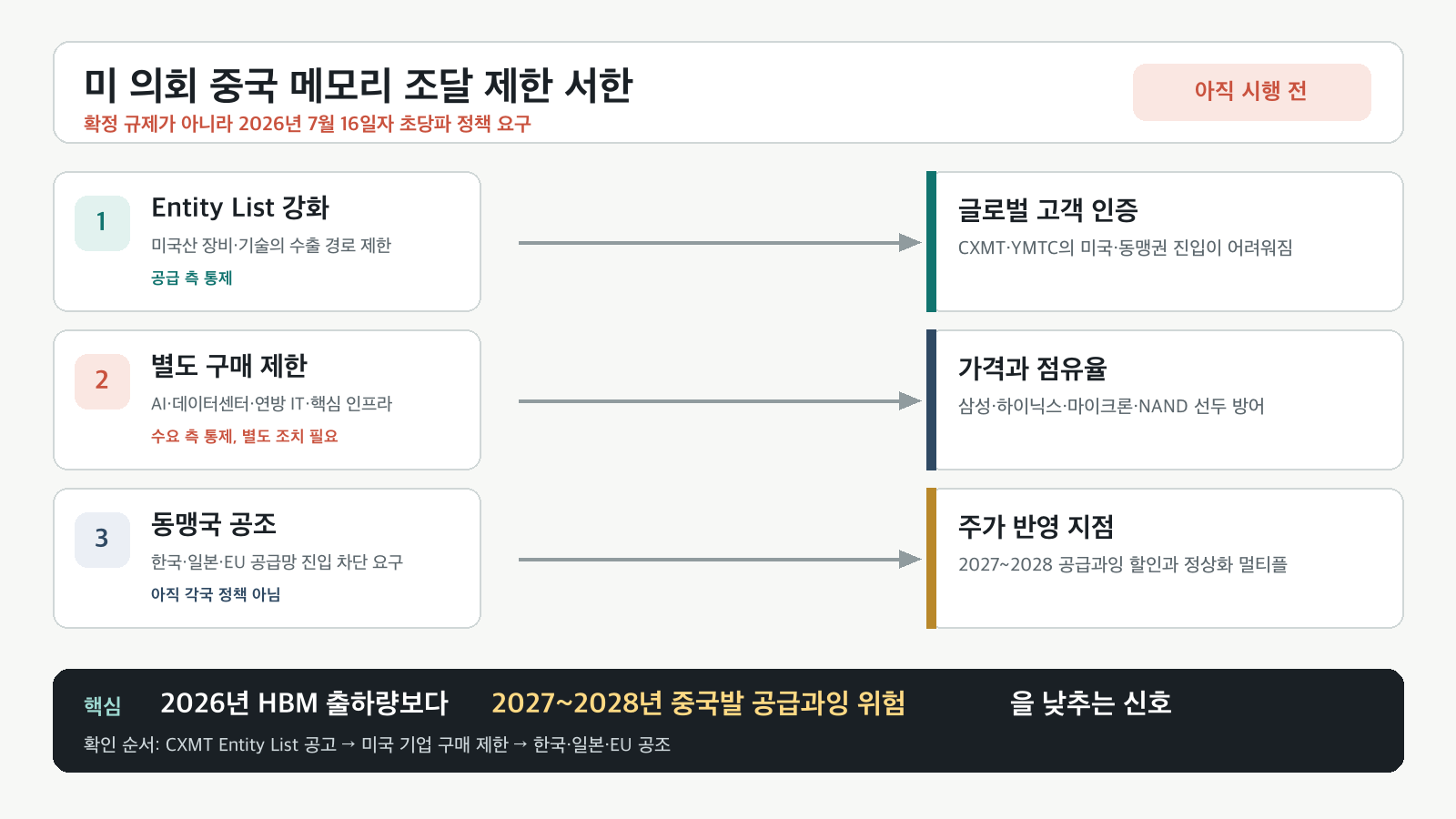
1. Three Demands Confirmed in the Letter
The signatories are Republican John Moolenaar, Chairman of the House Select Committee on China, and Democrat George Whitesides. The letter is addressed to Commerce Secretary Howard Lutnick. The bipartisan signal is clear given that members of opposing parties co-signed. It is not, however, a full congressional vote or a Commerce Department decision.
| Demand | Actual Content | Current Status |
|---|---|---|
| Tighten supply controls | Strengthen Entity List restrictions on YMTC; expedite formal Entity List review for CXMT | Policy request, not finalized |
| Create demand-side restrictions | Prohibit U.S. persons and entities from procuring DRAM, HBM, and other memory from YMTC, CXMT, and similar firms for AI systems, data centers, federal IT, and critical infrastructure | Requires separate executive order or agency directive |
| Allied coordination | Work with South Korea, Japan, and the EU to prevent CXMT and YMTC from entering allied supply chains | Diplomatic and policy coordination request |
The official letter also cited concerns that Apple and other U.S. technology companies are exploring purchases of Chinese memory. The demand is therefore not an abstract security slogan — it is an attempt to foreclose demand channels before CXMT and YMTC can achieve customer qualification and meaningful entry into global supply chains. Official House Select Committee Letter
Separating Fact from Overstatement
| Statement | Verdict | Reason |
|---|---|---|
| U.S. lawmakers demanded restrictions on Chinese memory procurement | Fact | Official letter dated July 16 confirmed |
| A full Chinese memory embargo has been finalized | Overstatement | No executive branch decision or implementing regulations |
| CXMT’s Entity List designation has been confirmed | Unconfirmed | Only an accelerated review was requested |
| Apple’s devices sold in China are automatically prohibited | Overstatement | The letter’s explicit scope covers AI, data centers, federal IT, and critical infrastructure |
| South Korea and Japan have banned Chinese memory | False | Coordination was requested; no national measures have been announced |
The policy direction is forceful, but multiple implementation thresholds remain. Equity analysis should therefore start from “which discount disappears if this is implemented” rather than “the ban is already in effect.”
2. The Entity List and a Purchase Prohibition Are Distinct Instruments
There is a reason the letter requests supply-side and demand-side controls separately: the two instruments operate differently under U.S. law.
The Bureau of Industry and Security’s Entity List imposes license requirements on the export, re-export, or in-country transfer of items subject to the Export Administration Regulations when a listed entity is a party to the transaction. The covered items include U.S.-origin semiconductor equipment, components, design tools, software, and process support. BIS Entity List Regulations
This mechanism pressures CXMT and YMTC on capacity and technology-node transitions. If equipment parts cannot be replaced on schedule and process support is unavailable, yields, wafer starts, and the pace of leading-edge conversion can slow.
It does not, however, automatically prohibit U.S. companies from purchasing finished DRAM or NAND chips that were manufactured in China. That is precisely why the lawmakers included a separate procurement prohibition as their second demand. The structure is as follows:
Entity List tightening
→ Restricts the path by which U.S.-origin equipment and technology reach Chinese memory makers
→ Pressures capacity, yield, and technology-node transition

Separate procurement ban
→ Restricts the path by which U.S. companies purchase finished Chinese memory products
→ Pressures customer qualification, revenue, and global market share
The maximum effect requires both instruments operating simultaneously — making production harder at the top of the supply chain while cutting off customers at the bottom. If only the Entity List is tightened without a purchase restriction, Chinese firms can route around it using non-U.S. equipment and domestic customers. If only a procurement ban is imposed without strong equipment controls, Chinese domestic capacity can continue to expand.
How Far Does This Reach for Apple?
The letter’s explicitly enumerated scope covers AI systems, data centers, federal IT, and critical infrastructure. Extending the prohibition to cover standard consumer iPhones and iPads sold within China would require either a broader definition in the implementing rules or a separate action.
It is therefore premature to conclude that Apple’s CXMT testing has been made immediately impossible. What has changed materially, however, is the regulatory stability Apple needs to use CXMT as a negotiating lever. If a supplier could be added to the Entity List at any time, and if certain products could become subject to procurement restrictions without advance notice, proceeding with volume qualification and long-term contracts becomes much more difficult.
3. The Transmission Path to the Memory Cycle
The core transmission channel is straightforward.
Procurement restrictions on Chinese memory
→ Narrowed customer qualification and sales channels for CXMT and YMTC globally
→ Market share defense at Samsung, SK Hynix, Micron, SanDisk, and Kioxia
→ Delayed inflection point for DRAM and NAND price declines
→ Higher expected normalized earnings and cash flows in 2027–2028
→ Compression of the China oversupply discount
The memory shortage itself is not new information. TrendForce projected Q2 2026 commodity DRAM contract prices up 58–63% quarter-over-quarter and NAND contract prices up 70–75%, driven by capacity prioritization toward HBM, server DRAM, and enterprise SSD at the expense of standard DRAM and NAND. TrendForce Q2 Outlook
The latest forecast also shows a deceleration in the rate of price increase. On July 9, TrendForce projected Q3 server DRAM contract prices rising 13–18%. It noted that long-term supply agreements are capping some price upside, but also that server DRAM tightness could extend into 2027 — with RDIMM bit supply growth of 15–20% potentially failing to keep pace with server CPU shipment growth. Prices could continue to rise quarter-over-quarter from H2 2026 through H2 2027, but at a more gradual pace. TrendForce Q3 Outlook
Two conclusions follow from this data.
- The near-term price spike is already in the market. The letter alone is insufficient to restart Q2-style rates of increase.
- The more important question is how quickly Chinese capacity additions end the 2027 supply shortage. If the United States and its allies exclude Chinese memory, the duration of the shortage extends.
4. Product-Level Impact Is Not Uniform
Treating CXMT and YMTC as a single “Chinese memory” block obscures the actual impact. CXMT’s core product is DRAM; YMTC’s is NAND. Customer qualification timelines and supply bottlenecks also differ by product.
| Product | Policy Directness | Impact Channel | Primary Beneficiaries |
|---|---|---|---|
| Mobile and PC DRAM | High | Limits CXMT’s qualification with Apple and PC customers and global volume expansion | Samsung, Micron, some SK Hynix |
| Server DRAM | Medium-High | Data center procurement restrictions block Chinese server memory entry | Samsung, SK Hynix, Micron |
| HBM | Low near-term, Medium-High long-term | Limited near-term supply alternatives; reduces China’s post-2028 catch-up risk | SK Hynix, Samsung, Micron |
| Consumer NAND | High | Limits YMTC’s entry into global smartphone and PC storage | SanDisk, Kioxia, Samsung |
| Enterprise SSD | High | Likely falls directly within the U.S. data center procurement scope | SanDisk, Kioxia, Samsung, SK Hynix/Solidigm |
HBM: Multiple Rather Than Near-Term EPS
CXMT is not currently a viable near-term substitute for leading-edge HBM from Samsung, SK Hynix, or Micron. Customer qualification, stacking yields, advanced packaging, interposers, and long-term supply agreements constitute high barriers to entry. Even if U.S. data centers were prohibited from purchasing CXMT HBM today, SK Hynix’s 2026 shipments would not increase immediately as a result.
The calculus changes when projecting past 2028. The market discounts the risk that Chinese firms deploy cash earned from commodity DRAM and state subsidies to pursue HBM development and close the gap with leading players. If equipment controls and customer exclusion operate simultaneously, the pace of that catch-up and the scale at which it can be commercialized are reduced. This effect appears first in normalized P/E and terminal value rather than current-year EPS.
More Direct Impact on Mobile DRAM and NAND
The Chinese alternatives Apple tested are closer to mobile and consumer memory. If CXMT establishes itself as a qualified supplier to Apple or global PC makers, the pricing leverage of the incumbent three erodes. If YMTC enters U.S. data center SSD and consumer device markets, the ceiling on NAND pricing falls as well.
The letter is designed to block precisely these qualification pathways. Accordingly, by product portfolio, Samsung and Micron are more direct beneficiaries on DRAM, while SanDisk and Kioxia benefit more directly on NAND.
5. Impact by Listed Company
| Company / Group | Impact | Investment Interpretation |
|---|---|---|
Micron MU | Strongly positive | The only large-scale U.S. memory maker. Full coverage across DRAM, HBM, and NAND makes Micron the most direct beneficiary of security-driven procurement and commercial customer diversification. Whether elevated policy expectations are already in the valuation requires a separate check. |
Samsung Electronics 005930 | Positive | Slower Chinese entry into mobile DRAM, commodity DRAM, and NAND is directly beneficial. Combined with an HBM recovery, earnings defensibility across the entire product portfolio improves. |
SK Hynix 000660 | Positive | Long-term competitive risk in server DRAM and HBM diminishes. Near-term HBM volume upside is limited; the more significant effect is multiple defense for post-2028 earnings durability. Enterprise SSD exposure through Solidigm is also relevant. |
SanDisk SNDK / Kioxia | Positive | YMTC’s entry into U.S. and allied consumer NAND and enterprise SSD supply chains becomes more constrained. Favorable for NAND pricing and customer share retention. |
| Apple, PC OEMs, server OEMs | Negative | Supplier optionality and pricing leverage are reduced. Higher component costs must be absorbed through product pricing, specifications, or margins. |
| Applied Materials, Lam Research, KLA | Conditionally negative | Tighter equipment controls on CXMT and YMTC create headwinds for China revenue. Incremental capacity buildout in the U.S., South Korea, and Japan could offset some demand. |
| CXMT / YMTC | Negative abroad, mixed domestically | International qualification and customer acquisition become harder. Domestic Chinese substitution, state subsidies, and localized equipment and materials transitions could accelerate. |
Differentiating Samsung and SK Hynix
This policy is marginally more direct for Samsung. Samsung’s exposure surface to Chinese competitors spans mobile DRAM, commodity DRAM, and NAND simultaneously. Blocking Chinese suppliers from global market entry defends both pricing and share across those product lines.
SK Hynix also benefits. Its current earnings, however, are concentrated in HBM and server DRAM, where CXMT is not yet a credible near-term threat. Near-term consensus estimates do not change materially. Instead, the reduction in post-2028 HBM catch-up risk and commodity DRAM oversupply concern strengthens the case that elevated profitability can persist longer — an argument that applies more to the duration of normalized earnings than to the next quarter’s EPS.
The letter alone is not sufficient grounds to reverse the relative priority between Samsung and SK Hynix. By product portfolio, it is a more direct earnings-defense catalyst for Samsung and more of a structural moat extension for SK Hynix’s HBM competitive position.
6. The Global Memory Market Could Bifurcate
Chinese production capacity does not disappear. What changes is the geography of permissible sales.
| Market | Expected Structure | Pricing and Earnings Impact |
|---|---|---|
| United States and allies | Centered on qualified non-Chinese suppliers; stricter security procurement and origin rules | Shortage conditions persist; higher ASPs and margins become sustainable |
| China domestic | CXMT and YMTC localization accelerates; subsidies and transition to local equipment and materials | Market share expansion possible; medium-term oversupply and price competition risk |
| Emerging markets | Potential acceptance of Chinese memory as cost and regulation trade-offs are weighed | Could become a bypass sales channel for Chinese producers |
This bifurcation is not uniformly positive for Samsung, SK Hynix, and Micron. In the U.S. and allied markets, pricing and margins may improve. In Chinese customer markets, however, the transition to domestic suppliers could accelerate. The net effect is a trade-off between higher global margins and a smaller China addressable market.
If Chinese volumes concentrate domestically and in emerging markets, regional price divergence for the same DRAM and NAND products could widen. U.S. and allied buyers pay a premium for qualified suppliers, while China’s domestic capacity additions drive price competition internally. The premise that global memory prices move as one unified market weakens.
7. Share Prices May Reflect This Through Discount Rates Before EPS
Memory equity valuations are not determined by the next quarter’s earnings alone. Investors simultaneously assess how long cyclical peak earnings persist, how quickly new supply arrives, and where normalized margins ultimately settle.
Chinese capacity additions compress valuations through three channels.
- They create concern that commodity DRAM and NAND prices could fall sharply in 2027–2028.
- They raise the probability that state-backed late entrants can challenge incumbents in HBM.
- They give customers leverage to use a fourth supplier as a pricing card in negotiations.
If procurement restrictions and equipment controls are actually implemented, all three risks diminish. The effect may therefore appear in the duration of normalized earnings and target multiples before it shows up in next-quarter EPS revisions.
Policy not enacted
→ Chinese capacity additions flow into global supply
→ 2027–2028 price decline risk persists
→ Normalized earnings and P/E discounted

Policy enacted
→ Barrier between Chinese capacity and global customers
→ Speed of oversupply transmission slows
→ Earnings duration revised upward
→ China oversupply discount compresses
Chinese production capacity does not vanish entirely. If China’s domestic price declines spill over into emerging markets, or if non-U.S. equipment ecosystems mature faster than expected, discount rates could widen again.
8. Three Policy Scenarios
| Scenario | Development | Impact on Memory Equities |
|---|---|---|
| 1. Letter only | CXMT review delayed; no separate purchase ban; no allied coordination | Near-term news effect fades. Existing China oversupply risk intact. |
| 2. U.S.-only partial implementation | CXMT added to Entity List; procurement restrictions applied to AI, data centers, and federal IT | Direct benefit for Micron. Korean companies also defend U.S. customer share and pricing. |
| 3. Allied joint implementation | U.S. actions joined by South Korea, Japan, and EU; customer qualification and equipment/materials channels blocked simultaneously | Deep global supply chain bifurcation. Most positive for long-term multiples at the incumbent three and leading NAND players. |
The third scenario is the most consequential variable. If only the United States restricts access while China successfully enters South Korean, Japanese, and European supply chains, the global pricing defense is limited. Conversely, if allied nations apply equivalent origin and security standards, CXMT and YMTC capacity additions — however large — struggle to translate into global customer revenue.
9. Catalysts to Monitor
| Item to Confirm | Significance |
|---|---|
| BIS CXMT Entity List review or Federal Register notice | Confirms whether supply-side controls are actually initiated |
| Commerce Department or White House U.S. corporate purchase restriction | Confirms whether demand channels for finished Chinese memory products are closed |
| Apple’s CXMT or YMTC qualification or procurement halt | Confirms whether policy pressure reaches consumer electronics at scale |
| South Korea, Japan, EU coordination announcements | Confirms whether Chinese capacity is actually blocked from flowing into global pricing |
| Q3 DRAM and NAND contract prices | Confirms whether fundamentals — not just policy expectations — support earnings estimates |
| CXMT and YMTC domestic capacity additions and local equipment transition | Indicates how long equipment controls suppress supply |
Our current stance is Watchlist — incorporate upon policy confirmation. The letter alone does not justify chasing memory equities. Until Commerce Department actions materialize, this is more appropriately used as a basis for reweighting risk scenarios than for revising EPS models upward.
10. Bear Case and Invalidation Conditions
Macro Failure Conditions
If memory prices rise too quickly, smartphone, PC, and server customers may reduce shipments or trade down on specifications. A policy that protects suppliers could produce demand destruction, with the impact of declining unit volumes exceeding the benefit of higher ASPs. An AI investment slowdown combined with higher interest rates would not spare server memory.
Company-Level Failure Conditions
If Chinese memory concentrates in China and emerging markets rather than the United States, it could accelerate the erosion of Samsung, SK Hynix, and Micron’s China customer base. If domestic Chinese demand is large enough and the local equipment and materials ecosystem matures, the supply-suppression effect of the Entity List could prove shorter-lived than expected.
Policy Invalidation Conditions
The thesis weakens materially if the following combination emerges:
- CXMT’s Entity List designation is delayed indefinitely.
- The United States grants broad exceptions for Apple’s China-market consumer products.
- The procurement ban remains limited to federal agencies and does not apply to private AI and data center operators.
- South Korea, Japan, and the EU do not coordinate.
- CXMT and YMTC transition rapidly to non-U.S. equipment, sustaining volume and yields.
Conversely, if CXMT’s designation, private-sector data center procurement restrictions, and allied coordination materialize together, this letter graduates from political signaling to a structural variable in the memory cycle.
11. Final Assessment
The July 16 letter is an official document with specific demands. It is not, however, an enacted Chinese memory embargo. Near-term equity catalysts therefore require policy confirmation.
The investment case is clear. If the United States and its allies choose not to fill memory shortfalls with Chinese supply, Samsung, SK Hynix, and Micron can defend market share and pricing leverage for longer. SanDisk and Kioxia also benefit directly from YMTC’s restricted path into NAND and enterprise SSD.
By product, the impact is more direct for Samsung’s mobile DRAM, commodity DRAM, and NAND; for SK Hynix the more significant effect is an extended duration for its HBM competitive advantage. Micron, as the only large-scale U.S. memory maker, is the clearest and most straightforward policy beneficiary.
In one sentence: This letter is not news that raises 2026 HBM shipments — it is a policy signal that reduces the risk of Chinese-origin oversupply eroding global memory profitability in 2027–2028. Until concrete regulations emerge, it is more accurately read as a basis for recalibrating discount rates than as a catalyst to chase.
Evidence Classification
Confirmed Facts
- On July 16, 2026, Representatives John Moolenaar and George Whitesides sent an official letter to the Secretary of Commerce.
- The letter calls for strengthened controls on YMTC, accelerated Entity List review for CXMT, specific U.S. procurement restrictions, and coordination with South Korea, Japan, and the EU.
- The Entity List restricts the export, re-export, and in-country transfer of items subject to U.S. Export Administration Regulations.
- TrendForce projected Q2 commodity DRAM contract prices up 58–63% and NAND up 70–75% quarter-over-quarter.
- TrendForce projected Q3 server DRAM up 13–18% and flagged potential supply tightness into 2027.
Analysis and Inference
- If enacted, the greatest effect is a reduction in the 2027–2028 China oversupply risk and a compression of the normalized earnings discount rate.
- Samsung faces more direct exposure on mobile DRAM, commodity DRAM, and NAND; for SK Hynix the more important consideration is reduced long-term competitive risk in HBM.
- A bifurcated market structure — high prices in the U.S. and allied markets alongside domestic price competition within China — may emerge.
Unconfirmed Items
- Whether and when CXMT will be added to the Entity List
- The legal form, scope, and exceptions of any separate purchase prohibition
- Apple’s actual order volume from CXMT and YMTC and allocation by supplier
- Whether South Korea, Japan, and the EU will coordinate
- The specific EPS uplift for Samsung, SK Hynix, and Micron if restrictions are implemented
Key Sources
- House Select Committee on China: Official Moolenaar–Whitesides Letter
- U.S. Commerce Department BIS: Entity List Regulations
- TrendForce: Q2 2026 DRAM and NAND Price Outlook
- TrendForce: Q3 2026 Server DRAM Outlook
This article is provided for informational purposes based on publicly available sources and does not constitute a recommendation to buy or sell any specific security.